
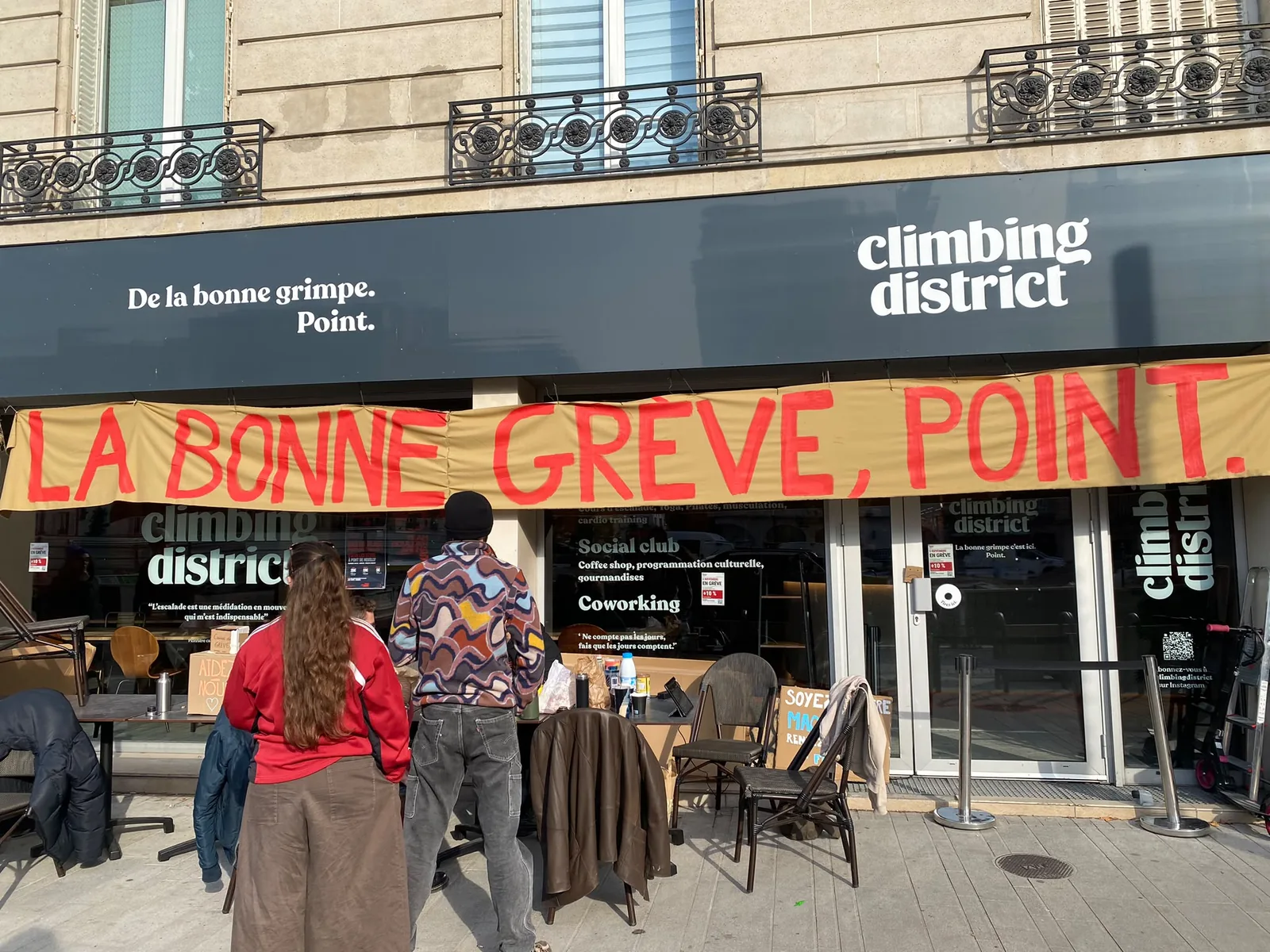
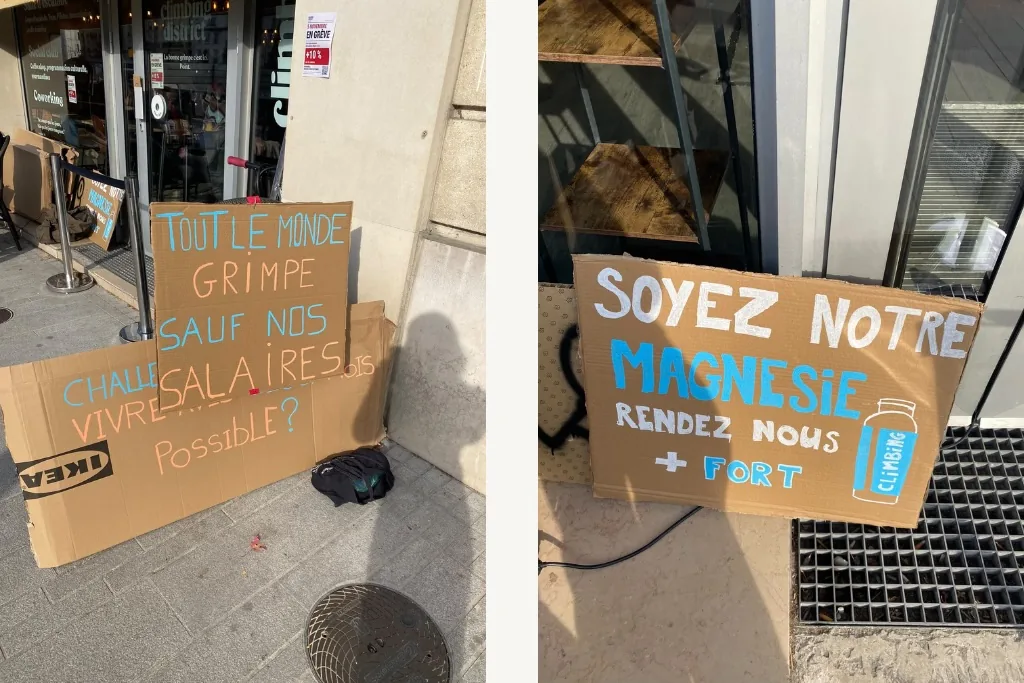
“You’re on strike? A real strike?” On the morning of Thursday, November 5, outside Climbing District in Neuilly-sur-Seine, the question seems out of place. Neuilly-sur-Seine, in Hauts-de-Seine, is one of France’s wealthiest towns. Strike banners stand out here. The climbing gym’s staff arrived early to hang one out front. Then passersby began stopping. Some told them to get back to work. Others went so far as to flip them off.
An older man who seems less hostile asks how much they make. One employee answers: about €1,500 a month. “But is that legal?” he asks, surprised. Alongside the insults, the strikers also find people willing to listen. Customers stop to talk, accept a cup of tea or coffee, and ask how they can help. These are the moments the employees choose to focus on. They come as a relief: the conversations give staff a chance to explain what’s been happening behind the closed doors. And to be heard.
“We’ve all kind of become jacks-of-all-trades”
Climbing District’s Neuilly location isn’t an isolated case. On Thursday, November 5, about 40 employees walked off the job, according to estimates gathered by Vertige Media. Five of the chain’s six gyms in the Paris region closed (not including the gym operated in partnership with Annette K—Ed.); only Climbing District Saint-Lazare stayed open. This isn’t the company’s first labor action, but this time the walkout was on a much larger scale. And, crucially, it lasted longer: on Friday, November 6, employees extended the strike. Staff finally began returning to work on Saturday, November 7, after further talks. Those interviewed now say dialogue is possible, though they don’t consider all their demands met.
“We’ve got 10 more tasks to do, the same pay, and we’re still expected to bring in just as much revenue.”
A Climbing District employee
Before the banners went up, the workload was growing and colleagues were leaving. In the many accounts collected by Vertige Media, the same problems keep coming up: pay unchanged since 2024, expanding responsibilities, and staffing stretched too thin. Camille*, a Climbing District employee, says she has had to mop up after floods, help deal with the septic tank, and wash load after load of towels. “We’ve all kind of become jacks-of-all-trades,” she says. To her, that range of duties goes well beyond the job she was hired to do. Working the front desk no longer means just greeting customers, explaining pricing options, or serving at the bar. Staff also have to take on more maintenance and, for some, plan events that used to be handled by employees in other roles. “Now we’ve got 10 more tasks to do, the same pay, and we’re still expected to bring in just as much revenue,” says Maxime*, another striking employee at the chain.
The company has been struggling financially for several months. As we previously reported, Climbing District SAS reported losses of €3.05 million in 2025, up from €1.70 million in 2024, and €14.2 million in debt at the end of 2025. Looking back during a phone interview, Maxime says the staff redoubled their efforts after a difficult summer. By late September, sales results had improved. But instead of celebrating with management, employees learned that the leadership was leaving. On October 3, Climbing District’s co-founders stepped back from day-to-day management, while remaining shareholders and involved in strategic planning. Julien Watry, head of the investment fund Pléiade Venture, and Clément Lorin then took over.
The transition leaves an already exhausted staff facing more uncertainty. What’s the plan? Are some gyms at risk? Beyond an introductory email, the new leaders have offered no answers about what lies ahead, Maxime says. Camille, for her part, describes poor communication and a rough start. Both stress, however, that the problems predate the new management. “There were management mistakes and bad decisions before,” she says. The handover has simply made the issues more urgent.
This article is free to read.
That’s possible thanks to donations from our readers.
Without their support, it wouldn’t exist.
If you can, please support Vertige Media.
A nationwide call for action on November 5, focused in part on higher wages, offers a possible date. A member of the CSE, the social and economic committee that represents employees, suggests joining in. But shutting the gyms without talking first is out of the question. During the weeks of October 19 and October 26, the committee’s five members meet with staff at each location. Meanwhile, several employees talk with their co-workers about which demands to make and whether to take collective action. Problems they had been facing on their own gradually become a shared concern.
Storming the Bastille
At a special CSE meeting on October 30, employee representatives present those demands to the new management. Flyers distributed for the strike list current gross monthly pay: €1,900 for front-desk staff and €2,150 for assistant managers, with no raises in two years, according to the flyers’ authors. The poster calls for a 10 percent raise. A more detailed document also calls for compensation for the added duties, higher bonuses, and recognition of experience and length of service.
The case for raises goes beyond inflation. Assistant managers say their responsibilities increasingly resemble those of gym managers, without equivalent pay. Filling vacancies when employees leave has also become nonnegotiable: on an already stretched team, a single absence or vacation can sharply increase everyone else’s workload. Our reporting indicates that the initial talks led to progress on filling vacancies and addressing individual employees’ situations. But talks stalled over base pay. A fallback proposal focused on meal vouchers. Management’s response, delivered Monday, November 2, proposed increasing their monthly value by €50, split evenly: an extra €25 from the employer and €25 from the employee.
For some staff, that extra employer contribution addresses neither stagnant pay nor the added workload. They acknowledge the concessions, but say their central demand still hasn’t been adequately addressed. The discussions go beyond negotiating a specific amount. Employees say they want working conditions that let them do their jobs properly again: time to welcome customers without rushing from one task to the next, the ability to take time off without leaving colleagues to shoulder all the work, and clarity about how their pay can increase.
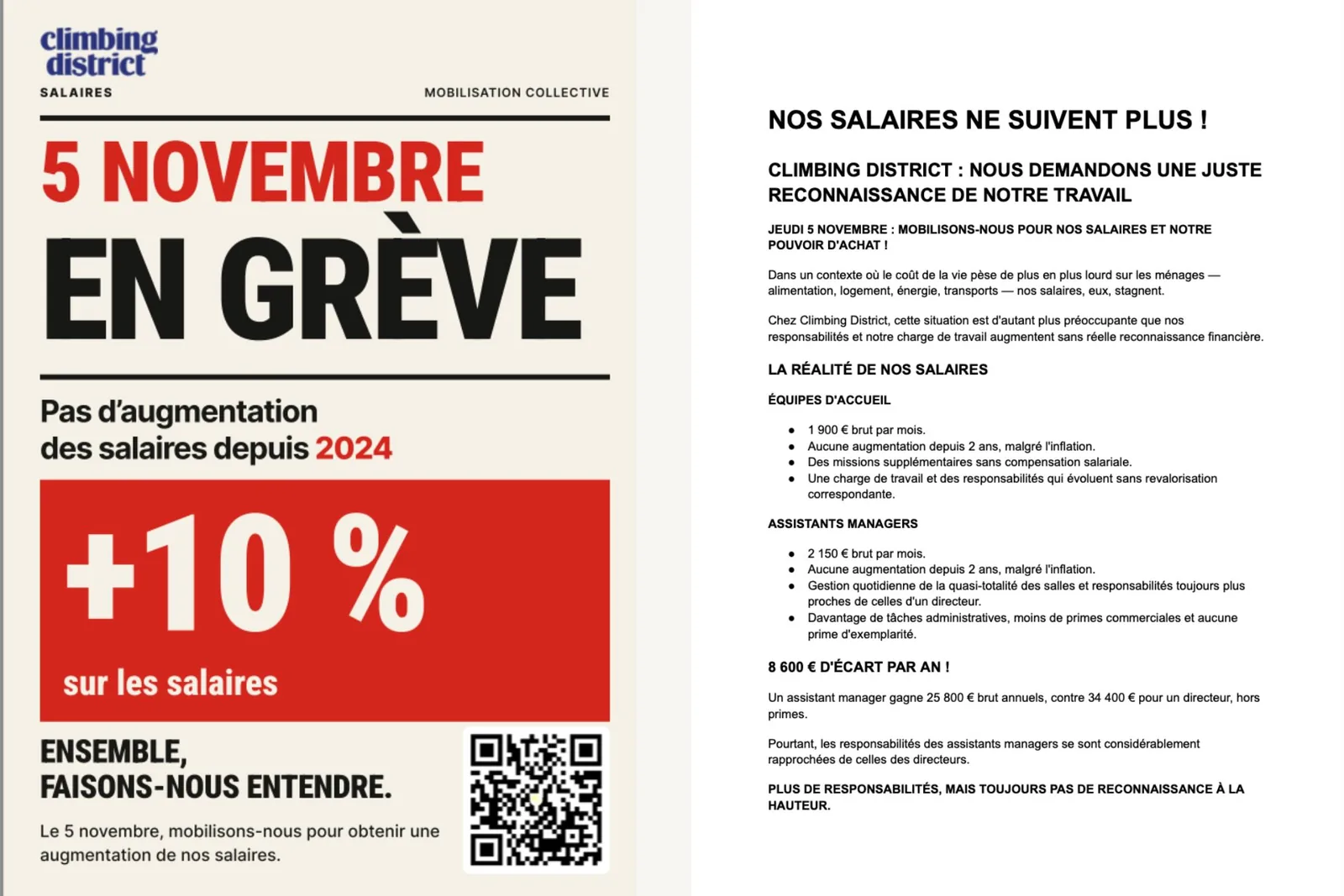
Management’s responses make the rounds among co-workers. Management is notified the day before the walkout. On Thursday, five Climbing District gyms close. On the picket lines, explaining the closures is part of the effort. The flyer thanks customers for their understanding and stresses how much the staff care about their gyms. That attachment is important to the employees’ accounts. Camille says she chose this job to return to a community she enjoyed and spend her days interacting with people. That also makes the worsening conditions they describe hard to accept: a place where employees once loved coming to work has become a place they leave wondering how they’ll make it through the month.
“Now that everyone is listening to each other, the real negotiations can begin.”
A Climbing District employee
The turnout, then, doesn’t entirely surprise her. She knew discontent was widespread. But there was no guarantee that staff at several gyms would walk out at the same time, then stay on strike. They had to talk, agree on a plan, and accept lost pay. When interviewed on Friday, November 6, Camille estimated that she had already lost about €150. Phone calls were no longer enough to decide what came next. Employees gathered at Bastille.
About 30 people attend a staff meeting late Thursday afternoon, initially without management. For roughly two hours, employees discuss the difficulties they face and vote on their demands. Those present that evening describe a calm, constructive meeting where hearing from co-workers helps them understand the problems at other gyms and feel supported. Raises and pay adjustments tied to inflation are central to the discussions, along with increased staffing. Employees want lasting solutions: more staff to ease scheduling pressures, but also compensation that reflects the work they’ve already done.
The two executives then join the meeting. According to accounts collected by Vertige Media, the discussion remains civil, but the financial constraints they describe and the options they propose, particularly bonuses, don’t address the demand for higher base pay. “We want to pay you more, but we can’t”—that is how employees sum up what they heard. Those present say the executives explained the lack of cash on hand and constraints tied to investors. Asked the next day what had come out of that first evening, Camille is blunt: “We didn’t get anything we asked for.” Employees decide to strike again Friday.
The second day of the strike is about Climbing District alone, rather than supporting the national action, and employees continue talking things through at length. Most believe that staying on strike has made their concerns heard. They point to another round of talks with management scheduled for that day. After the meeting, the CSE says management has shown “goodwill.” “They helped us understand that their backs were against the wall, too,” Maxime says after talking it over with all the employees who took part in the strike.
Most importantly, management makes commitments. Our reporting indicates that the executives announced that the bonus system would be revised to make it fairer, but did not formalize that commitment. Still, by Friday evening, what they had said was enough to reopen dialogue with employees. “One of our main demands comes down to this: ‘We don’t earn enough, even though we’re making money for the company,’” Maxime adds. “They understood and told us they felt the same way. Now we feel much more on the same page. We understand their situation much better, and they understand ours.” On Saturday, November 7, the gyms reopen and employees return to work.
A Truce, for Now
Climbing District employees say they have entered “a second phase.” “Now that everyone is listening to each other, the real negotiations can begin,” Maxime says. Before returning to work, strikers had asked for written commitments and deadlines, not just expressions of understanding. As for timing, employees tell Vertige Media that, as they understand it, management has committed to this coming January. The question of written commitments remains unresolved. Employees will judge the progress made by what happens next: how will their daily working lives change, and how quickly? Contacted by Vertige Media, Julien Watry, Climbing District’s current CEO, said management was still talking with staff and that he would “get back to us later.” So far, management has not detailed its responses to the demands or provided any timeline. For employees, returning to work does not mean giving up. They say they have created an opening.
“I think we’ve managed to build an incredibly powerful movement, with people standing together and looking out for one another. And that’s going to bring all the Climbing District gyms back together.”
A Climbing District employee
Their strike is also part of a broader pattern of labor action beyond Climbing District: actions were reported on November 5 at Climb Up Aubervilliers, at Climb Up Gerland in southern Lyon, and at Arkose Pantin in Seine-Saint-Denis. These actions do not yet amount to coordination across chains. But the parallel disputes raise a question: as the climbing industry consolidates around large chains, could employees at different companies also organize together?
At Climbing District, the two-day strike has strengthened ties among staff and opened a new round of talks with management. It has not, however, secured the strikers’ central demand: a raise. For Maxime, though, what matters most for now is something else: “I think we’ve managed to build an incredibly powerful movement, with people standing together and looking out for one another,” he concludes. “And that’s going to bring all the Climbing District gyms back together.”
* First names have been changed to protect the anonymity of those interviewed.