My daughter Charlotte was the one who told me about the ad. We were having coffee when she brought up the backlash from female athletes. Then she grabbed my phone and pulled up posts from women in the climbing community. “Climbers are getting in on it too, Dad. Check this out.”
In the ad for Novig, an American sports betting platform, actress Sydney Sweeney appears nearly naked, strategically covered by balls and other sports equipment. “Just sports. Nothing else,” the campaign promises. The props, however, seem to serve mainly as a way to conceal her nudity. Australian swimmer Ariarne Titmus, a four-time Olympic gold medalist, criticized the ad for using a woman's body to sell something supposedly about sports.
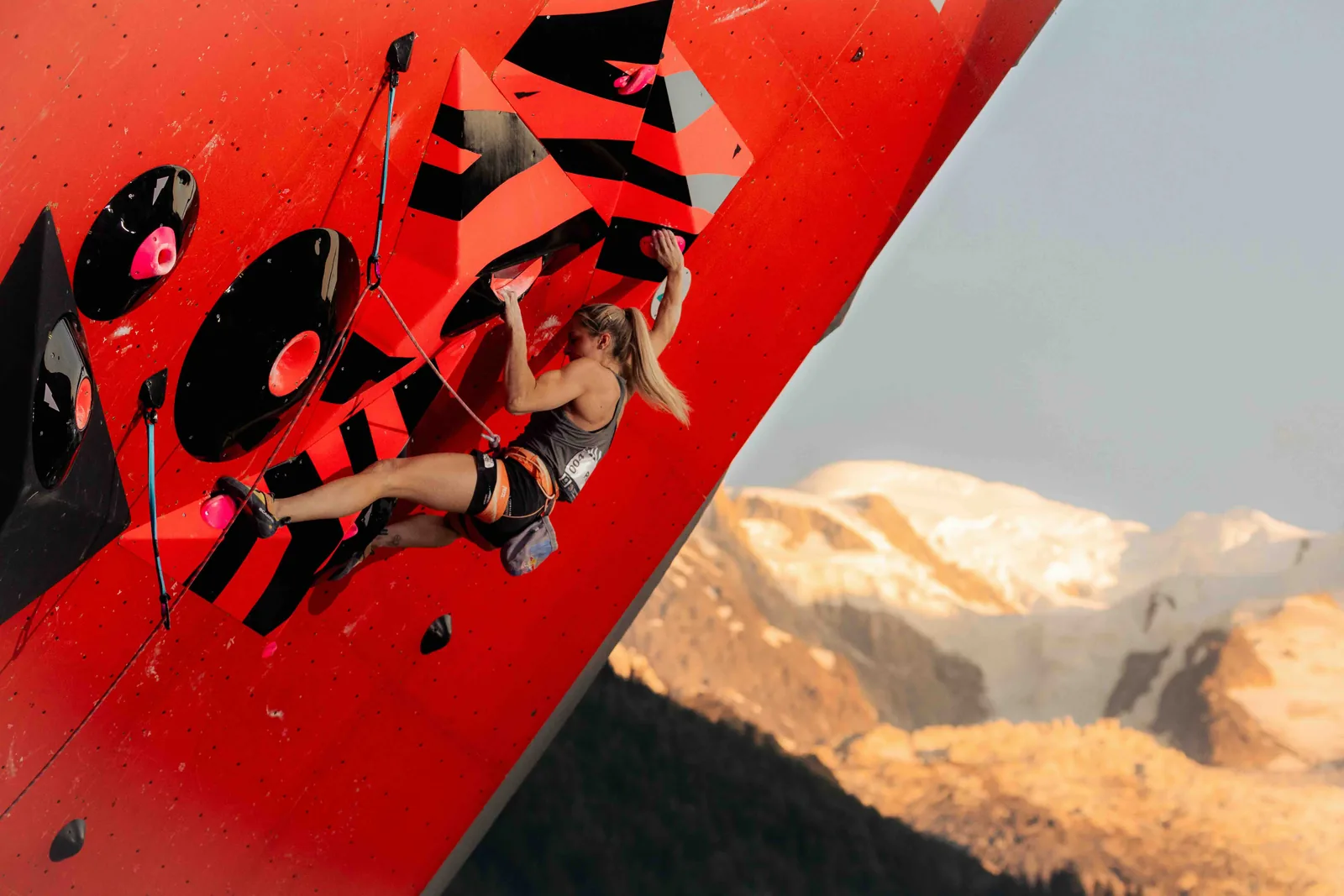
Female athletes responded by posting their own training footage and competition highlights. British sprinter Amy Hunt addressed the actress directly: “Sydney Sweeney, this is what women in sport look like.” Climbers joined in, sharing footage of desperate moves, fingertips clinging to tiny holds, and hours of effort for a few feet of rock. They had plenty to show.
Some people pointed out that Novig sells sports bets and that Sweeney never claimed to represent female athletes. Fair enough. But the company borrowed the language and imagery of sports to put a woman's body front and center. And once again, female athletes felt compelled to show what they could do. That was what struck me as I watched the videos Charlotte had found.
The Visibility Trap
Climbing history is full of women who have pushed the sport forward. In 1993, Lynn Hill made the first free ascent of the Nose on El Capitan, succeeding where some of the best climbers of her era had failed. In November 2024, Barbara Zangerl flashed Free Rider on the same wall, climbing the entire route without a fall on her first attempt, using information about the moves she had received beforehand. It was a historic first for El Capitan. In June 2026, Janja Garnbret climbed Bibliographie, a 5.15c (9b+) route at Céüse, France, becoming the second woman to climb that grade after Brooke Raboutou.
I could keep going. But why should we need a list of historic ascents to talk about women climbers without focusing on their appearance? A woman doesn't have to make climbing history to deserve our attention. And respect shouldn't depend on how hard she climbs, or how many routes she sends.
“What we normalize in climbing doesn't exist in a vacuum,” she told me. “It shapes what we see as acceptable.”
Hannah Morris
This disconnect between women's accomplishments and the way they're portrayed predates Instagram. A study published in 2025 examined climbing magazines from the 1970s through the 2000s and found that female climbers were often missing from their pages. Some advertisements featured women tucked into sleeping bags or tied up with ropes. When they weren't being overlooked, their bodies were sometimes being used to sell gear. Those old magazine pages tell us a lot about how the climbing industry learned to portray women.
Social media has changed that. Female climbers can now share their own stories and ascents without waiting for a magazine or sponsor to take an interest. But there's a catch. For professional climbers, making a living increasingly means producing videos, posting regularly, and building an audience. Researchers Katariina Rahikainen and Kim Toffoletti have documented this digital labor, including the care sponsored female climbers must take to avoid online controversies that could alienate followers.
In 2019, American outdoor apparel company Eddie Bauer was looking to sponsor a female climber. Katie Lambert, then a member of the brand's athlete team, recommended several candidates. But Eddie Bauer had a requirement: at least 20,000 social media followers. The women Lambert suggested had around 15,000. None was selected. Their climbing ability wasn't enough.
This article is free to read.
That’s possible thanks to donations from our readers.
Without their support, it wouldn’t exist.
If you can, please support Vertige Media.
What makes this even more frustrating is how the climbing industry talks about women who do succeed on social media. In 2023, Reel Rock, the popular climbing film series, promoted Queen Lines, featuring Anna Hazelnutt, already known for her hard trad ascents, where climbers place their own removable protection, and Tom Randall. Hazelnutt was described as an “Instagram star,” while Randall was presented as an established climber. Yet Randall had more followers than she did. Climbing magazine called out the double standard, and Reel Rock subsequently changed its description.
On one hand, sponsors want numbers. On the other, women who build a following risk being dismissed as “influencers,” a label that is often used as a put-down in climbing, while men with equally large online audiences are still seen primarily as athletes. Female climbers need visibility to land sponsorships, but too much of it can undermine their credibility. It's hard to win when the rules work against you either way.
Hazel Findlay has spoken about this contradiction. In her response to the Novig campaign, the British climber reflected on wanting to be taken seriously for “what I can do with my body, how I think and how I approach things, rather than for how my body looks to men.” Her point matters. Female climbers should be free to choose how they present themselves without having their appearance determine how seriously they're taken.
a third-party service is contacted only when you request this content.
None of this means anyone gets to lecture Sydney Sweeney about how she chooses to pose. She agreed to the campaign and has a financial stake in it as a strategic partner and shareholder in Novig. But here we are in 2026, and apparently you can still make a sports ad without showing a single female athlete. All you need is a woman's body.
What We’re Teaching Girls
This isn't just about professional climbers. As I watched the videos Charlotte had shown me, I kept thinking about girls who are just discovering climbing, the role models they see, and whether they can imagine themselves belonging in the sport.
I spoke with Hannah Morris, a climber and creator of a YouTube channel dedicated to climbing. “What we normalize in climbing doesn't exist in a vacuum,” she told me. “It shapes what we see as acceptable.” The attitudes women face don't disappear when they walk into a bouldering gym.
“Women defining themselves rather than others defining them.”
Ulyana Horodyskyj Pena
In 2024, UNESCO highlighted declining sports participation among teenage girls, identifying factors such as a lack of female role models, safety concerns, and negative body image. In the United Kingdom, a survey of 4,000 teenagers found in 2022 that 43% of girls who had previously enjoyed sports had lost interest after primary school, compared with 24% of boys. Fear of being judged and a lack of confidence were among the main reasons.
Of course, one advertisement isn't going to make a girl quit sports. There are the comments made at practice, the constant comparisons between bodies, the jokes nobody calls out. Girls don't leave all of that behind when they start climbing. You can hang a picture of a female champion on the wall of a gym and still let a sexist remark ruin a beginner's session. What we show matters. So does what we allow.
Ashlee Hendy, an Australian climber and mother, sees progress in the backlash against Novig. When she was younger, she told me, an ad like this probably wouldn't have prompted such a strong response. This time, hundreds of female athletes spoke up. “And that's definitely a win for my daughter.” I share her optimism, though I wish the next generation of women didn't have to keep fighting the same battles.
Hannah Morris told me what she hopes a young girl will think when watching one of her videos: “I want to try like her. I want to be brave like her. I want to go on adventures like her. I want to be proud of my body the way she's proud of hers.” Rather than, “I want to look like her.”
She wants girls to feel inspired to try things, not pressured to look a certain way. That's the difference between a role model who makes you want to do more and an image you're expected to live up to.
Brands, climbing gyms, and the media all have a responsibility here. Who gets chosen to represent a company? Whose story makes the cover of a magazine or becomes a climbing film? We in the climbing media love telling stories about records falling and groundbreaking ascents. But we also need to pay attention to women climbers when they aren't making history. As climbing writer Katie Ives told me, “We still have a ways to go.”
And as men, we can do more than applaud women's achievements and then look the other way when someone makes a sexist comment at the crag or in the gym. Supporting women in climbing means speaking up when it matters, without trying to speak for them.
Scientist and climber Ulyana Horodyskyj Pena summed it up for me: “Women defining themselves rather than others defining them.” That day, Charlotte wasn't asking me to explain what women should think or do. She was simply handing me my phone and asking me to listen.
Thanks, Charlotte, for showing me those posts. I hope the next time we talk about women climbers over coffee, it'll be about their adventures, their ideas, or what they're hoping to accomplish. Not because another advertisement has once again reduced women's sports to what women look like.