
Passion is a convenient currency. Everyone swears it’s priceless, which makes it easy to keep asking for more. For years, that arrangement felt almost natural in climbing. People got into it because they loved it, because of the lifestyle, because they felt part of a culture—not because they saw themselves as customers. The place mattered, of course, but first as a home for a community, not as the basic unit of a business model. Then climbing moved indoors, became a more formalized sport, and went commercial. Its scale, its audience, and its pace all changed. What had been a relatively tight-knit scene not long ago became a service industry, complete with memberships, recurring-revenue targets, fixed costs, branding strategies, and management trade-offs. Academic research makes the connection clear: As climbing draws a wider range of participants and takes new forms, it also shifts toward organized sport, while commercial forces change its very nature.
On both sides of the Atlantic, these aren’t isolated incidents. They’re signs of a structural conflict.
The problem, then, isn’t—or isn’t just—that business is somehow tainting a passion that was supposedly pure until now. The problem is more insidious: The business needs the passion. It needs employees who still believe in the gym, routesetters—the people who design and build the climbs—who do more than just follow instructions, a community that keeps coming back, and an atmosphere that doesn’t make every visit feel like a transaction. In short, it needs something that goes beyond the sale. And that’s where the arrangement gets dangerous. Once passion becomes an economic resource, it can also become an excuse for management. Research by Jae Yun Kim and colleagues shows that when a worker is seen as “passionate,” underpaying or mistreating that person becomes more socially acceptable. Erin Cech describes the same pattern: Passion doesn’t pay. It mainly lets employers expect more without offering better compensation.
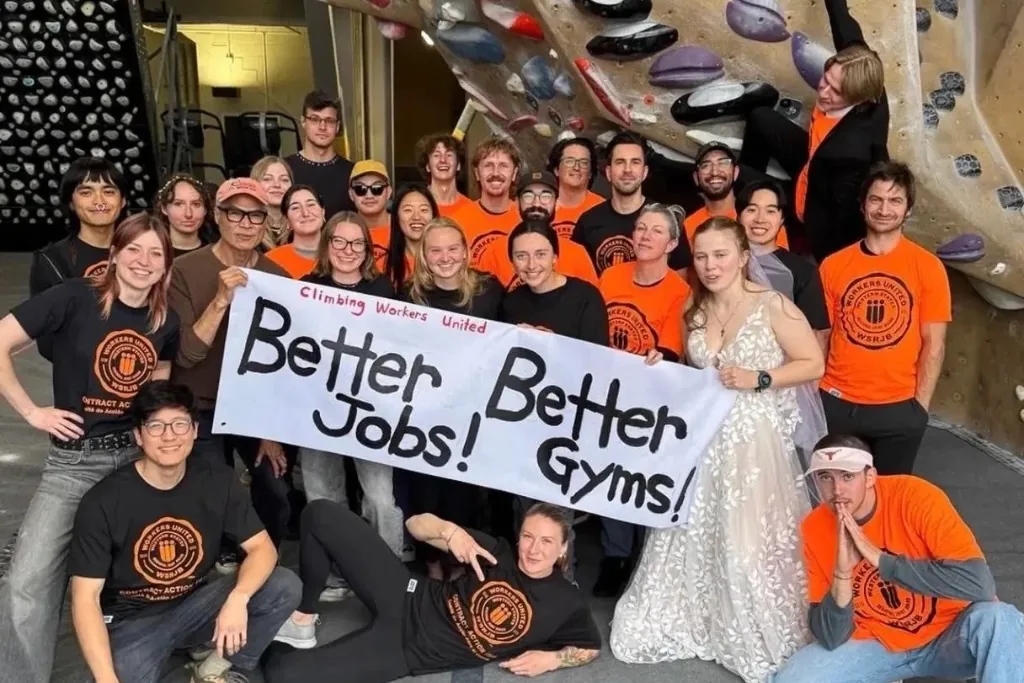
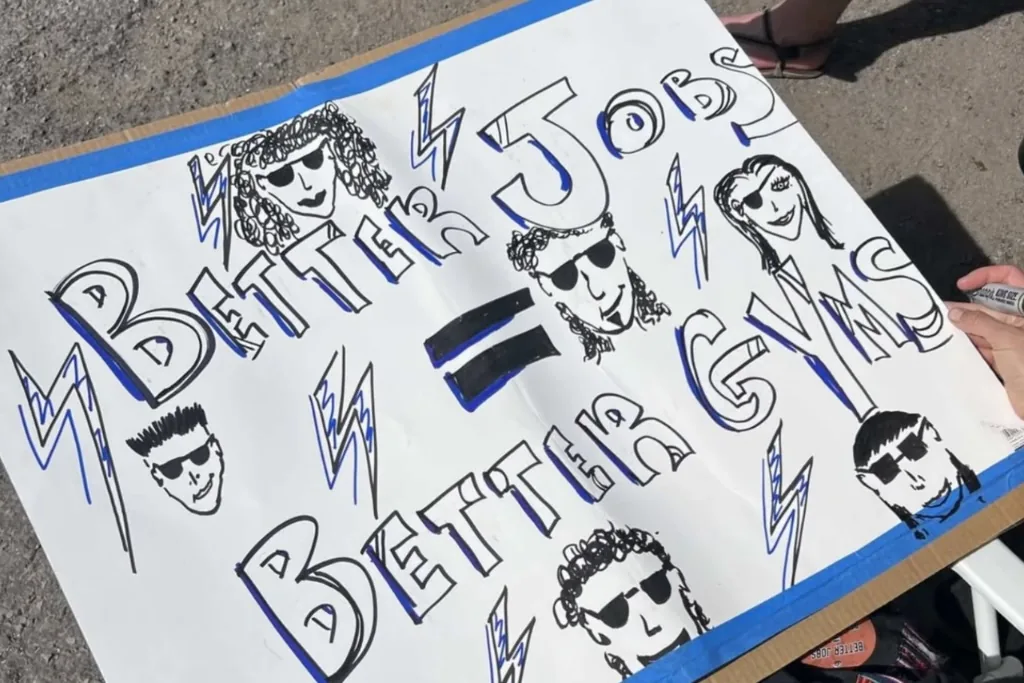
That’s why the recent conflicts deserve more than a cursory discussion of a few “workplace problems.” In France, the strikes in 2025 and the March 11, 2026, labor action at Climb Up Angers weren’t simply expressions of local anger. They brought systemic issues back into focus: low pay, commercial pressure, targets workers considered unattainable, how work is organized, the quality of the customer experience, and increasingly standardized practices. In Angers, a statement from the strikers went so far as to spell out an obvious truth that the industry sometimes prefers to treat as a slogan rather than an obligation: “Climbing is a community before it is a market.” In the United States, things are no calmer. Union organizing in climbing gyms has gained significant ground in recent years. By the end of 2025, the Climbing Workers United campaign reported that 24 gyms had unionized through Workers United, with another five gyms in Minnesota unionized through the UFCW. And in March 2025, routesetters at Touchstone in California launched what was described as the nation’s first routesetter strike. In other words, on both sides of the Atlantic, these aren’t isolated incidents. They’re signs of a structural conflict.
That conflict isn’t limited to the relationship between employers and employees. It also raises a quieter but no less consequential question: Who has the right to profit from the value a community creates? The controversy over USA Climbing’s National Training Center is a case in point. More than 100 gyms have protested the project in its current form—not because they oppose a national training center, but because they object to the commercial gym that would be open to the public. Their argument is straightforward: They introduce most newcomers to climbing, train competitors, and provide material support for the governing body’s mission. USA Climbing, for its part, is standing behind a major project backed by $15 million from the Utah Legislature, to be operated with Momentum Indoor Climbing. The project is billed as capable of drawing roughly 400,000 visitors a year and generating more than $225 million in economic impact over 10 years. Again, the question isn’t whether to love or hate the project. It’s what the project reveals: At what point does an institution charged with organizing and supporting a sport become a competitor in its market?
In France, Karma La Villette tells much the same story in a different setting. As early as 2021, the UDSE was criticizing the FFME’s proposed federation-run gym as “unfair competition,” accusing the federation of overstepping its role by opening commercial gyms and running food-service operations. The FFME, by contrast, defended its strategy of diversifying revenue. Its general assembly approved a loan for the project after the federation explained that the new income would help fund all of its activities. The gym finally opened on January 8, 2026. Here, too, the debate is about more than one more climbing wall in Paris. It’s about the boundaries between fulfilling a governing body’s mission, showcasing the sport, and competing in the market. In other words, it’s about the point at which the institution no longer just sets the rules but also becomes a player.
The industry can certainly learn to make more money from its services. In fact, it has to if it wants to survive.
There’s another reason these tensions keep surfacing: The business climate has gotten tougher. In North America, the Gyms & Trends 2025 report describes a difficult year for many operators: fewer openings than in 2024, more closures, a net growth rate down to 4.7%, and revenue and foot traffic “largely flat or down” at many existing gyms. One operator with multiple locations had a blunt assessment: “The boom times are over.” But the same report also shows that opportunities for growth remain, especially in youth programs. It’s a reminder of a simple point: Profitability doesn’t happen on its own. It takes work. And on that front, a study of climbing-gym business strategy reaches a conclusion so practical it’s almost disarming: A gym’s competitive advantage comes from its employees, its routes—the climbs set on the walls—and its management. Not brand storytelling alone, not ever-larger facilities, and not the assumption that a growing market will take care of the rest.
This may be where climbing is paying the price for its own transformation. Not because it has become “too commercial,” the lazy line people reach for when they don’t want to think any harder. But because it now has to answer a more demanding question: How do you turn a culture into a viable business without burning through what made it valuable in the first place? A gym can sell memberships, classes, coffee, birthday parties, training, and events. But what it really sells is harder to put in a spreadsheet: a reason to come back, a sense of belonging, an atmosphere that feels genuine, a promise kept. The industry can certainly learn to make more money from its services. In fact, it has to if it wants to survive. But it will discover—and is already discovering—that treating passion as just another expense has consequences. You can’t demand the loyalty that keeps people coming back. Or the commitment that holds a staff together. And the future of the climbing-gym industry may well depend on how it handles that gap.