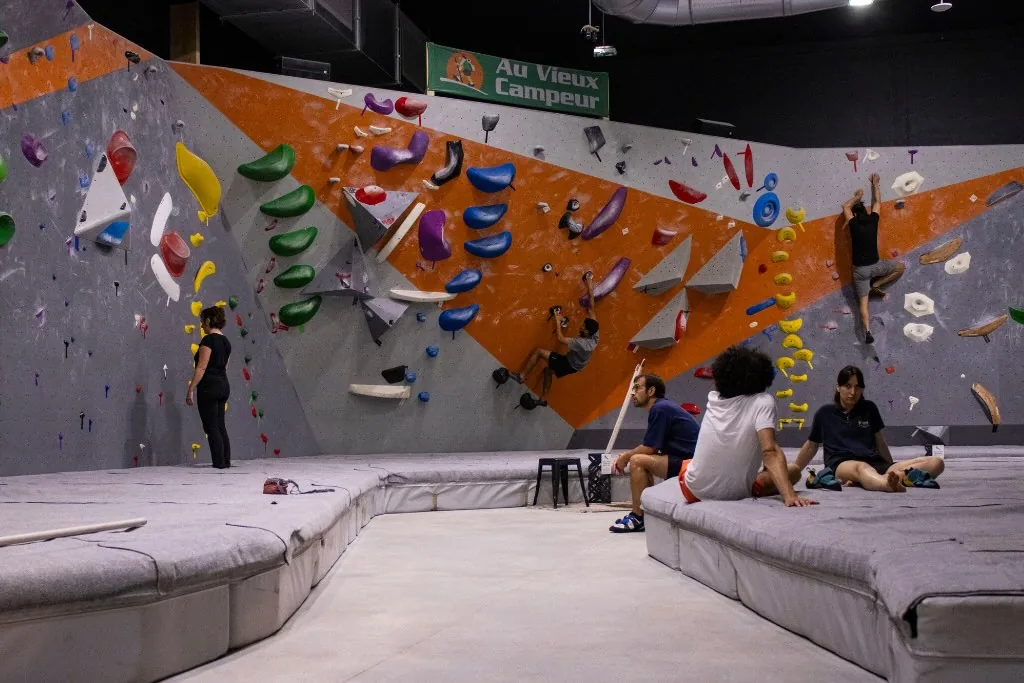

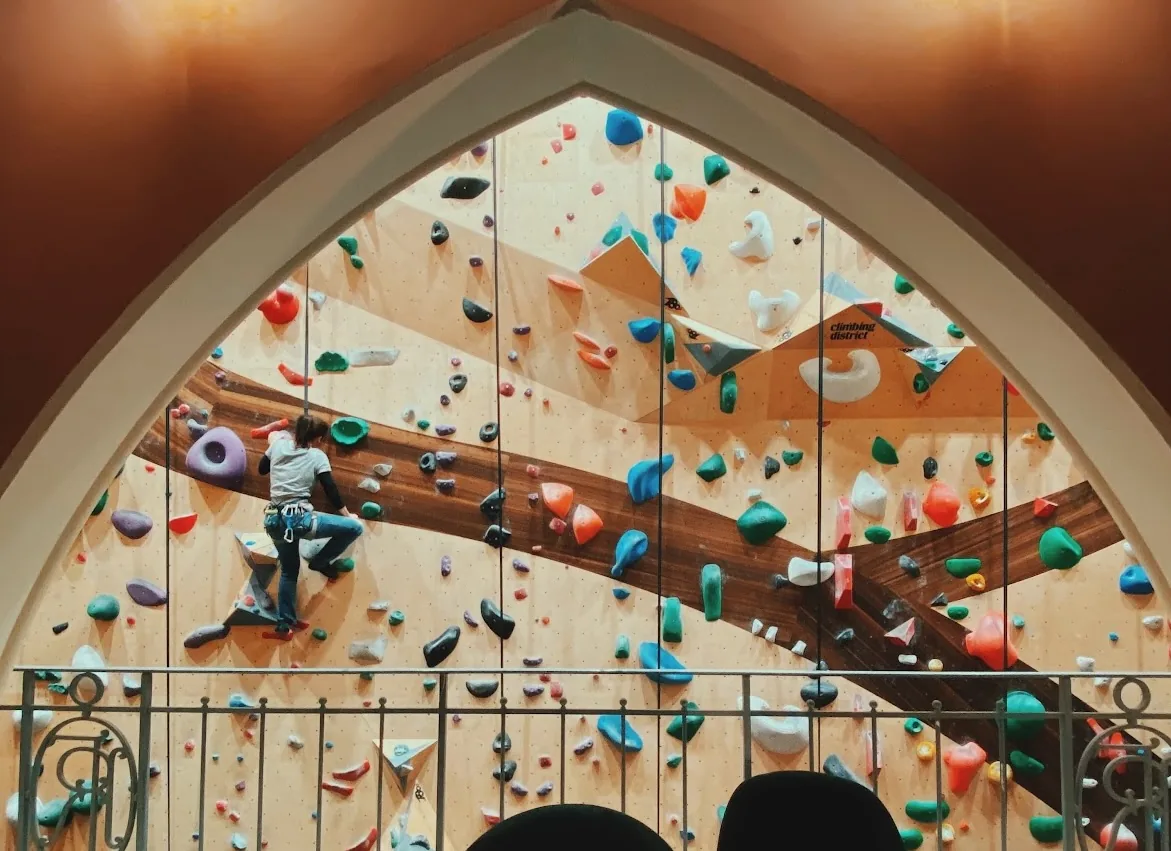
In September 1959, Time magazine described an America flush with cash and crazy about bowling. In Edison, New Jersey, two brothers had just opened a massive, 112-lane bowling center stretching the length of two football fields. Near Chicago, a competitor went so far as to hire a full-time sociologist to keep customers coming back. Elsewhere, operators got creative: child care, free morning lessons—anything to fill the slow hours. With automatic pinsetters driving the boom, the industry was running at full tilt, sometimes around the clock. In just four years, the U.S. went from 60,000 certified lanes to more than 87,000. Yet even amid all that success, signs of oversupply were emerging. In Los Angeles, eight bowling alleys packed into a few-mile radius were locked in a ruthless price war. Nearly 70 years later, France’s commercial climbing gyms are coming off their own decade of frantic expansion. They may be about to learn the same hard lesson: a sport can be more popular than ever, yet a local market can still have too few customers to make all its facilities profitable.
Beer, Pizza, and Democracy
Back then, American bowling revolved around its leagues. Nothing fancy: amateur competitions among factory coworkers, neighbors, and members of local organizations. You claimed the same time slot every week and faced the same teams. Over time, rivalries developed, routines took hold, and the bar knew how many thirsty customers to expect. For owners, these were ideal customers: loyal and willing to spend.
In 1995, political scientist Robert Putnam published “Bowling Alone,” an article that became a classic of American social science. His finding: between 1980 and 1993, the number of Americans who bowled rose 10%, while league participation plummeted 40%. Putnam saw that as a sign of weakening civic life in the United States. What interested him about leagues was the way they brought people together for months at a time—people who might never have met otherwise. They talked about work, the neighborhood, politics. Those repeated interactions built what he called “social capital”: the trust and everyday habits of helping one another that make community life possible beyond family and close friends.
A thousand paid visits could mean a thousand people trying it once—or a hundred regulars visiting ten times each.
Operators, for their part, had a more financial reason to miss those weekly gatherings. According to Putnam’s research, league members consumed about three times as much beer and pizza as nonleague bowlers. Losing those leagues meant putting a valuable customer base at risk. Turns out participatory democracy could boost the average tab, too.
Operators hadn’t waited for leagues to start declining before diversifying their businesses. Food service, arcades, and events became standard offerings. A prime example of that shift is U.S. industry leader Lucky Strike Entertainment (successor to longtime bowling operator Bowlero—Ed.), which has become a diversified entertainment company. Bowling now generates just 45% of its consolidated revenue, less than the combined share of food and beverage sales (35%) and other entertainment (20%).
The parallel with climbing isn’t a stretch. In December 2025, Arkose president Grégoire de Belmont told Le Monde that, by his own estimate, 80% of his customers saw climbing as a leisure activity, “just like going to the movies or bowling.” His challenge: turn those occasional visits into a habit, when people who come to try climbing don’t necessarily become members.
Beyond the colorful holds on the walls, gyms now offer a whole range of services: bars, cafes, yoga classes, birthday parties, and corporate events. That puts the regular who trains three times a week in the same space as a group of friends trying climbing for the first time and an HR department in the middle of a team-building exercise. But those groups don’t all contribute to the business in the same way. A day pass offers a higher margin per visit, private rentals fill off-peak hours, and memberships deliver recurring revenue. For operators, the trick is to accommodate all these customers without confusing foot traffic with actual profitability.
This article is free to read.
That’s possible thanks to donations from our readers.
Without their support, it wouldn’t exist.
If you can, please support Vertige Media.
Lately, even those side businesses have started to falter. According to data from Union Sport & Cycle, revenue from food service and retail fell 11% in 2025, while revenue from team-building events dropped 12%. Diversification, it turns out, doesn’t insulate gyms from shrinking household purchasing power or corporate budget cuts.
To understand what’s really happening in the market, attendance alone isn’t enough. You would need to look at membership renewal rates, how often people actually come in, and the share of first-time climbers who return six months later. After all, a thousand paid visits could mean a thousand people trying it once—or a hundred regulars visiting ten times each. Operators have some of those numbers, but they keep them confidential.
The Hangover
France has seen this kind of unchecked expansion in sports before. Long before climbing, the country went on a tennis-court building spree. In 1970, the French Tennis Federation (FFT) counted 167,110 registered members and 5,492 courts. By 1986, those totals had climbed to nearly 1.4 million members and 29,500 courts, according to the federation’s archives. Clubs grew, municipalities built courts, and the national government joined in with its “5,000 Courts” initiative. Yannick Noah’s 1983 French Open win helped fuel the boom.
Supply and demand were moving in opposite directions. Federation membership peaked in 1986, but the building spree continued until 1992, bringing the total to 33,655 courts—4,155 additional courts built while participation was falling. In 1999, the FFT still counted 32,726 courts for 1 million members. Those courts weren’t entirely empty: casual play helped make up for the loss of registered players, and public facilities don’t face the same profit requirements as private businesses. But eventually, the bills came due: resurfacing, fencing, lighting. Facilities don’t need less maintenance just because membership drops. Local governments kept covering the costs of projects approved at the height of the boom.
Regardless of national participation trends, it always comes down to a local question: how many facilities can the market actually support?
Unlike tennis in the 1980s, though, urban climbing is funded mostly by private capital. And the bills start arriving right away. From day one, gyms face steep rents for large urban spaces, build-out costs, floor padding, heating bills, payroll, and debt payments. They also have to keep paying routesetters to create new boulder problems—short climbs done without ropes. A gym can still look busy while slipping below break-even, squeezed by rising operating costs and falling revenue.
The industry’s financial problems became hard to ignore in July 2026, when Vertige Media reported that Climb Up Investissements and four companies operating five of the group’s gyms had entered court-supervised restructuring. A year earlier, cofounder François Petit had already acknowledged a 10% drop in visits and a 12% decline in revenue at the chain’s established locations, even as newer gyms continued to post gains. To fund that expansion and get through the pandemic, the chain had taken out several bank loans, along with a government-guaranteed loan under France’s PGE program. But in the group’s financial results, growth at new locations isn’t always enough to mask declines at older ones—or reassure investors expecting payments on schedule.
The real competition, after all, is local. In an underserved area, a new gym can attract customers who previously had nowhere nearby to climb. But in a saturated metro area where several chains are competing for the same business, a new gym often does little more than draw climbers away from its neighbors. What looks like growth on the newest arrival’s books means fewer visits at the competitor down the street. Complicating matters, rents, energy bills, payroll costs, and household spending decisions vary from one neighborhood or city to the next.
Those local differences force operators to make a strategic choice. Some industry heavyweights are sticking with a war of attrition, pouring money into risky investments in the hope of outlasting their rivals and capturing the market once the downturn passes. Chains such as Bloc Session are taking the opposite approach. As Le Monde reported, the chain favors smaller spaces, a back-to-basics approach, and locations outside Paris, away from the fiercest urban competition, to keep fixed costs to a bare minimum.
The slowdown has a clear counterpart in North America. According to Climbing Business Journal, 53 gyms opened in 2025 across the United States, Canada, and Mexico, down from 60 in 2024. Meanwhile, 12 gyms closed for good, up from eight the year before. The total number of gyms is still growing, but the business is under pressure: in a survey of 240 facilities, most operators reported steadily rising expenses and flat or declining revenue.
Regardless of national participation trends, it always comes down to a local question: how many facilities can the market actually support? Ignoring the lessons of earlier sports booms, the commercial climbing industry has raced to build more facilities, and the limits of that strategy are now plain to see. The question is no longer which chain will add the most square footage, but which gyms will survive shrinking margins. Like bowling and tennis before it, climbing is entering its most challenging phase yet: a maturing market and a shakeout.