
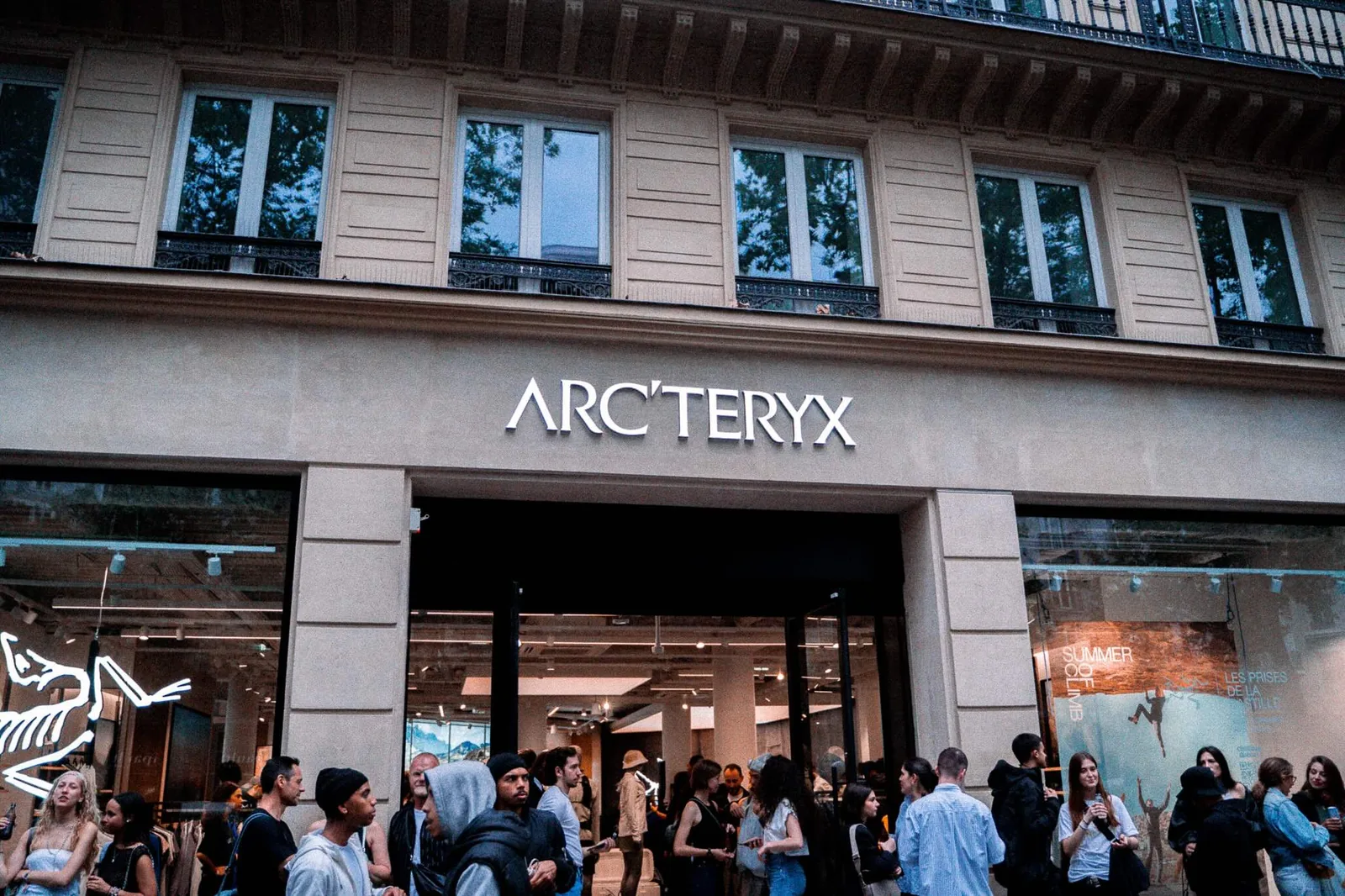
Paris, October 17, 2026. A bicycle burns outside the smashed windows of an Arc’teryx store on Boulevard de la Madeleine. Inside the looted shop, the illuminated skeleton of a prehistoric bird, the Canadian brand’s logo, is still glowing. Someone has scrawled across the storefront: “ARC’TERYX FOR EVERYONE! SUCK IT!” The scene, photographed by Kiran Ridley for AFP, unfolds on the sidelines of protests over the rising cost of living.
The next day, Vogue Business lists the brands whose stores were hit: Burberry, Christian Dior Parfums, Louis Vuitton, Kenzo, Salomon, Arc’teryx, Lacoste, and Celine. Other businesses were looted too, from cellphone stores to shops selling Pokémon cards, as Le Parisien documented. But the American publication is covering the impact of the unrest on the fashion industry. And on its list, Arc’teryx no longer looks out of place.
That alone is remarkable. Founded in Vancouver in 1989 by climbing enthusiasts, the company made its name with technical gear designed to withstand some of the harshest conditions in the mountains. Its jackets rank among the most expensive in the outdoor industry, but price alone doesn't explain why they're now worn by celebrities, featured in fashion magazines, and sold in stores next door to some of the world's leading luxury brands.
For a Few Dollars More
In April 2020, Hypebeast, an influential American streetwear publication, ran a lengthy feature on Arc’teryx. The headline set the tone: “Arc’teryx Couldn't Care Less About the Hype.”
Dan Green, then the company's vice president of design, explained that Arc’teryx wasn't trying to win over streetwear fans. “We're not overtly fashionable, and we're not following micro trends,” he said. In his view, adapting the products to suit this new audience would mean sacrificing what made them appealing in the first place. The magazine seemed impressed. It noted that there's something inherently fashionable about not caring about fashion. A publication devoted to tracking trends was telling its readers why ignoring them was so interesting.
That contradiction runs through the way fashion media have told Arc’teryx's recent history. In 2020, Hypebeast reported that Virgil Abloh, the founder of Off-White and then artistic director of Louis Vuitton's menswear collections, had used Arc’teryx clothing in an Off-White runway show without the Canadian company's permission, according to Arc’teryx itself. Four years later, Vogue Business described the episode as a “collaboration.” What began as an unauthorized appearance on a runway had gradually been retold as a meeting of creative minds.
By March 2026, Vogue no longer needed to explain any of that backstory. In an article about actor Jacob Elordi's outfits, an Arc’teryx Beta jacket appeared alongside loose-fitting pants, loafers, and a Bottega Veneta bag. Under the heading “Peak Performance,” the magazine broke down the look and invited readers to shop each piece. A technical rain jacket now sat alongside an $8,900 handbag, with no explanation needed.
The newsletter that lifts you higher
Every Wednesday: the editorial team’s column, the best articles, and plenty of surprises to help you climb higher — in mind and in spirit.
Sociologist Agnès Rocamora has studied how fashion media build and dismantle reputations. In Fashioning the City, she shows, among other things, how the press helps establish Paris as the world's fashion capital. The clothes that get photographed, the celebrities associated with them, and the stories told about them all help determine what's considered worthy of admiration.
Elordi's jacket still keeps the rain out just as effectively. But appearing in Vogue gives it another kind of value. Its technical performance becomes a matter of taste, even a marker of social status. And much of its appeal comes from the fact that it wasn't designed with fashion in mind.
Arc’teryx hasn't missed the shift. In October 2024, CEO Stuart Haselden told Vogue Business that the brand's appeal came from its continued commitment to mountain athletes. By designing products around their needs, Arc’teryx could also attract consumers who would probably never use them for the same purposes.
“Between the mountains and the city, we chose the mountains.”
Xu Yang, Arc'teryx Director for Greater China in 2020
It's an arrangement that works for everyone involved. Fashion magazines get an authentic outdoor brand to celebrate, and Arc’teryx reaches customers far beyond the mountaineering community. Of course, it still needs somewhere to sell them its jackets.
Luxury by Association
In spring 2024, Arc’teryx opened two standalone stores in Paris. The first was on Rue des Francs-Bourgeois in the Marais, the second on Boulevard de la Madeleine. The brand had positioned itself among fashion boutiques, upscale retailers, and stores catering to international shoppers.
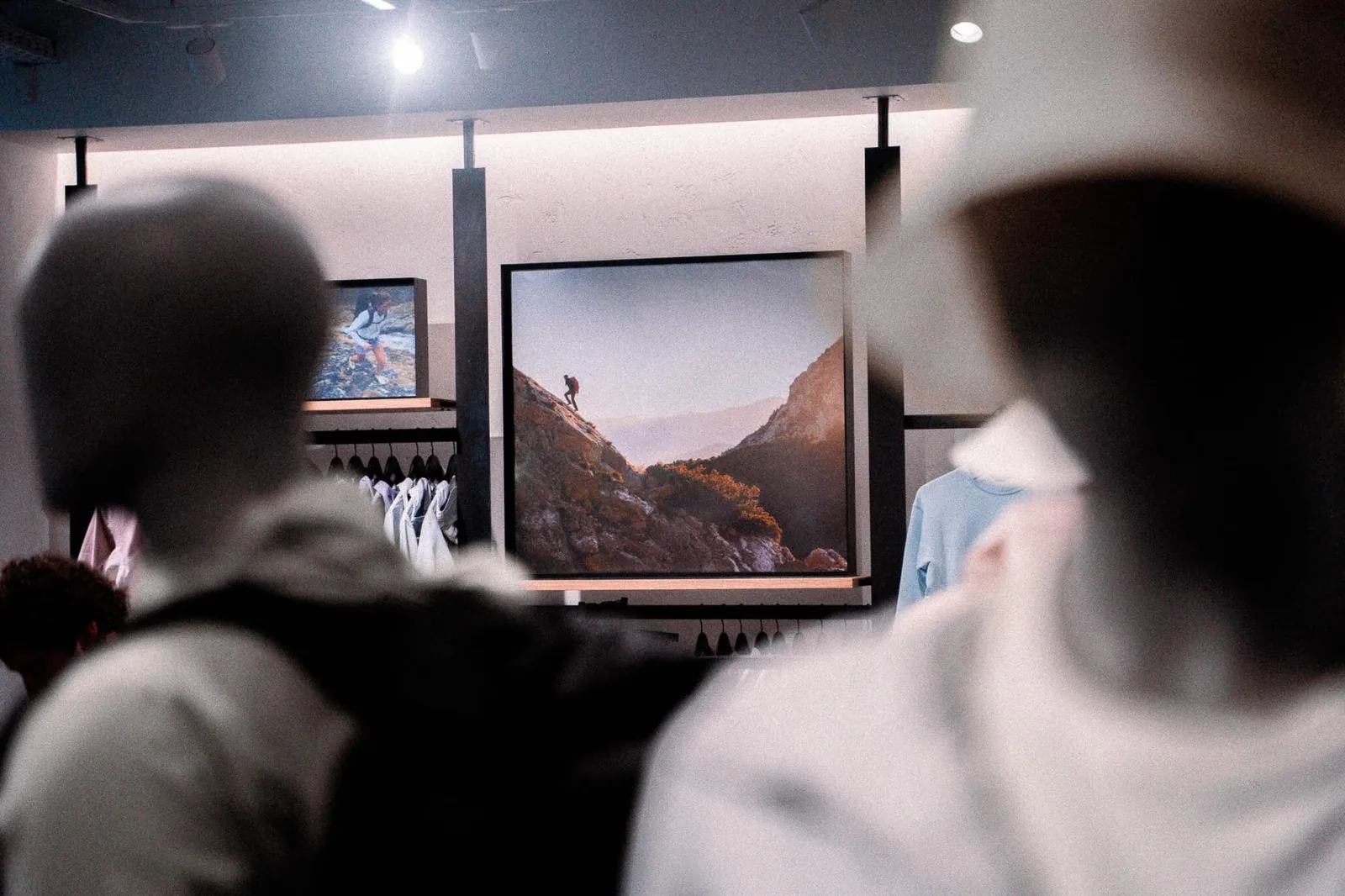
Those addresses send a message, too. In their research on the Marais, Anne-Cécile Mermet and Maria Gravari-Barbas show how retailers draw on the neighborhood's cultural identity and heritage to enhance their own image.
Arc’teryx isn't the only outdoor brand seeking that kind of company. Right next door to its Marais location, Salomon, which shares the same parent company, Amer Sports, opened a concept store dedicated to its Sportstyle line. Even Au Vieux Campeur, the historic outdoor retailer based in Paris's Latin Quarter, now has a space inside the Printemps Haussmann department store devoted to what it calls “Outdoor Lifestyle.”
In January 2026, the retailer went a step further, partnering with concept store Merci to launch Au Vieux Campeur – Congés Payés, a clothing and accessories collection inspired by its history. “No climbing gear or hiking boots here,” the new brand's website makes clear. Instead, customers will find everyday clothing and accessories designed to capture the spirit of Au Vieux Campeur long after they've left the trail. The retailer is now selling the memory of a vacation its customers may never have taken.
It's a revealing example of how outdoor culture has entered the fashion industry. The outdoor aesthetic now has a market of its own, independent of the activities that inspired it. Arc’teryx is part of the same shift, backed by the resources of a fast-growing international brand. In 2024, it opened a large store on Broadway in New York's SoHo neighborhood. In 2026, it joined Chanel, Prada, and Louis Vuitton at Oakridge Park, an upscale shopping center in its hometown of Vancouver. These locations also make straightforward business sense. They offer visibility and foot traffic. And having a store near luxury fashion houses doesn't automatically make Arc’teryx a luxury brand.
In China, however, the company has been much more explicit about its ambitions. In September 2020, Xu Yang, then the brand's managing director for Greater China, laid out his retail strategy in an interview with the Shanghai Observer. He summed it up in three words: Better, Bigger, Lower. Better locations, bigger stores, and retail spaces on more visible floors of shopping centers. He specifically wanted Arc’teryx in the most prestigious shopping districts, “on the same floors as luxury brands.”
This was just five months after Dan Green's interview with Hypebeast. While the company's design chief was explaining why Arc’teryx wasn't interested in chasing streetwear trends, another executive was outlining plans to move in alongside luxury brands in Chinese malls. The two ambitions aren't necessarily incompatible. Making clothing for mountaineers doesn't prevent Arc’teryx from selling it to wealthy consumers who live far from the mountains. If anything, the brand's technical reputation gives those customers another reason to buy. But as Arc’teryx opens more stores in major cities, how does it continue to convince people that it belongs, first and foremost, to the mountains?
The Work of Staying Authentic
In that same 2020 interview, Xu Yang offered a surprising answer: “Between the mountains and the city, we chose the mountains.” He explained that he wanted the brand to inspire more than a desire to shop. In his view, life in major cities makes people long to return to the mountains.
Four years later, Arc’teryx opened a four-story, 25,800-square-foot (2,400-square-meter) store in Shanghai called the Arc’teryx Museum. Inside, visitors encounter landscapes inspired by the coastal mountains of British Columbia, immersive installations, and exhibits dedicated to the company's history. Working with UCCA Lab, which is associated with a major contemporary art center in China, the brand explores the evolution of its Alpha SV jacket and the paleontological origins of its logo.
Visitors can now discover the history of Canadian mountaineering in the middle of Shanghai, between shopping trips. It's a significant development. Arc’teryx no longer relies solely on its reputation among climbers and other outdoor athletes. It now has physical spaces where it can tell its own story, showcase its innovations, and present its clothing as objects worthy of preservation. The mountains have become part of the shopping experience.
Amer Sports openly embraces this combination of sporting heritage and commercial expansion. In its 2025 annual report, the group distinguishes between the growth potential of major cities such as Paris and that of stores in alpine destinations, including Zermatt and St. Anton. The latter are intended to maintain relationships with outdoor communities and reinforce what the company calls its “authentic brand positioning. Maintaining a connection to the mountains has become a strategic priority, just like securing the right retail locations.
That doesn't necessarily mean the authenticity is fake. Arc’teryx still designs equipment for demanding outdoor pursuits, and athletes continue to contribute to both product development and the brand's reputation.
Climbers helped build its reputation, but they are no longer the only ones who determine its value.
Besides, the idea that mountain culture was once pure until fashion came along and corrupted it deserves closer scrutiny. In L'Esprit de l'alpinisme, sociologist Delphine Moraldo reminds us that “excellence is a historical, social, and cultural construct.” For decades, the standards defining a “good mountaineer” were largely established by men from privileged backgrounds, who favored particular approaches to climbing and particular ideas about what the activity should represent.
Long before gorpcore, the fashion trend that brings technical outdoor clothing into everyday streetwear, mountain culture had its own ways of signaling status. Of course, that status comes at a price. On Arc’teryx's French website, the Beta jacket is listed at €400, while the Alpha SV costs €900. The latter is hardly a gimmick. Independent testing by OutdoorGearLab praises its weather protection and durability, while finding it too heavy and expensive for most applications.
Still, spending that much money isn't necessarily about meeting a technical need. A jacket designed to withstand extreme conditions can also be purchased for its fit, its reputation, or the social status it conveys.
On Chinese social media, the brand is even mocked as one of the “three treasures of middle-aged men,” alongside the premium liquor Moutai and fishing gear.
In China, that last dimension has become especially significant. In an investigation into Arc’teryx's strategy, Jiemian News describes a brand that has become a status symbol, right down to the way it sells its products. One-on-one consultations, lines of customers waiting to get in, products resold at huge markups: some of these practices have more in common with luxury fashion houses than outdoor equipment stores.
On Chinese social media, Arc’teryx has even become the butt of a joke. It's described as one of the “three treasures of middle-aged men,” alongside premium Moutai liquor, a Chinese spirit distilled from fermented sorghum, and fishing equipment. The joke, documented as early as 2022 by Meiri Renwu, says plenty about the kind of customer the brand has come to represent.
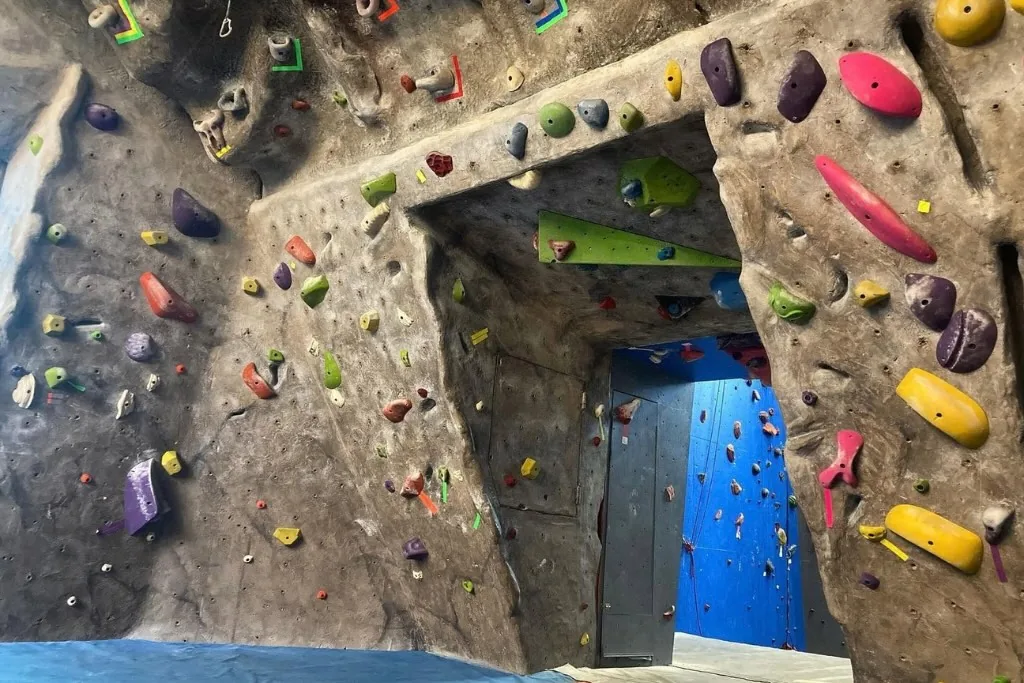
And clothing as a marker of status fits into a sport where social class differences are hardly absent. In a 2024 investigation published by Vertige Media, sociologist Olivier Aubel pointed to the presence of high-earning executives among certain segments of the indoor bouldering community, where climbers tackle short routes without ropes.
That obviously doesn't make climbing a sport reserved for the wealthy. But in a community where how people climb, the places they frequent, and what they choose to buy already help distinguish different social groups, clothing can become another way of signaling where someone fits in.
The price of an Arc’teryx jacket isn't a barrier to entering a climbing gym. It does, however, help the company target consumers who can afford to spend several hundred euros on a piece of clothing, even when its technical capabilities far exceed their actual needs.
The mountains remain central to Arc’teryx's identity. But the status associated with them can now be sold to people who neither practice the activities that built the brand's reputation nor face the conditions its products were designed for.