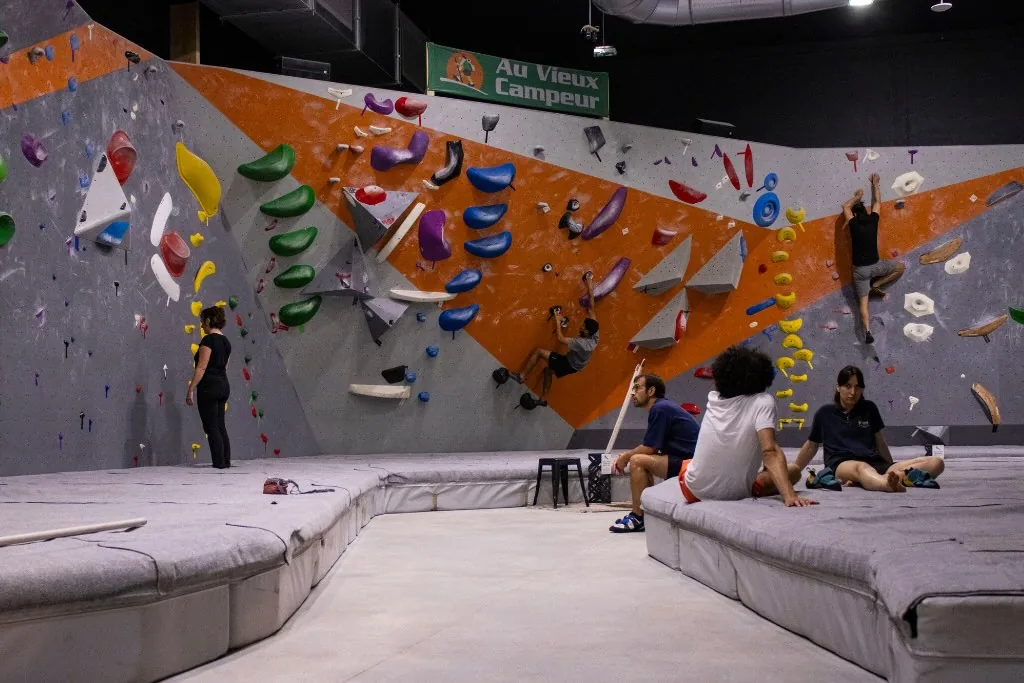

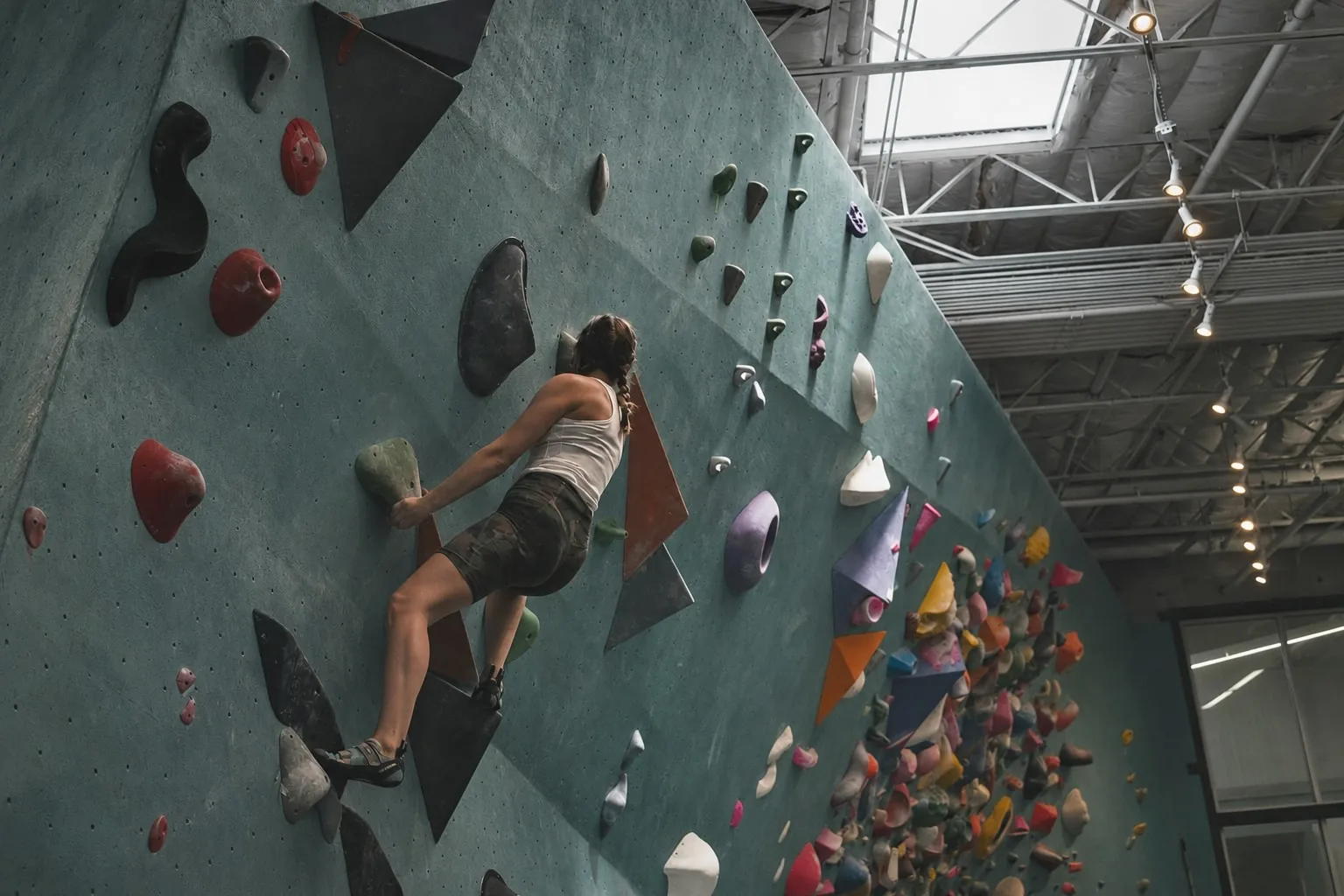
It's 11 p.m. on Tuesday, September 22, and the ClimbHer Network gathering is winding down in the basement of Arkose Nation, a climbing gym in Paris. Eight women, all entrepreneurs, are still there. Organized by Climbing Bitches, the event bills itself as "the quarterly gathering for women moving climbing forward." But that night, the conversation turns to someone who isn't in the room. Her name is Emma, better known on Instagram as @pastropemmable. A climber and content creator, she's also become a familiar face in the Paris climbing scene. Just four days earlier, she organized Boss Ladies World at Climbing World, a new gym in southern Paris. Emma had been invited to ClimbHer Network but couldn't make it. In her absence, the conversation gets personal. The criticism builds until someone says, "All she knows how to do is show off her ass and fake eyelashes." According to multiple sources who confirmed the account to Vertige Media, the remark came from Nathalie Rabusseau, the managing director of Climbing Bitches.
"We Get Frustrated. We Bitch."
In the days that follow, several attendees tell Emma what happened. On September 25, she decides to go public with an Instagram carousel denouncing the remarks made about her, without naming the organization or its founder. The post reaches tens of thousands of people, draws hundreds of comments that are no longer accessible, and racks up nearly 7,000 likes. It also sets off an unusually heated controversy in the online climbing community.
That community knows Climbing Bitches well. The project began as a friendship between women climbers. On the company's website, Nathalie Rabusseau tells the story of how it all started: "I hit it off with two girls in my group. We kept meeting up at the gym, and one night, over a beer, we started a WhatsApp group. We needed a name. Around us, three or four guys were climbing one black problem after another [black indicates a difficult grade at that bouldering gym]. (...) Were we the only ones struggling? We got a little frustrated. We bitched, basically."
The project quickly gains momentum. In July 2023, Climbing Bitches becomes a French limited-liability company (SARL), with Nathalie Rabusseau now serving as its managing director. The company begins organizing events, conferences, and training sessions focused on gender and inclusion. Over time, Climbing Bitches starts describing itself as "an inclusive media outlet." Three years later, its Instagram account has more than 27,000 followers and serves as the company's main platform for communication and promotion. The comments beneath its posts are overwhelmingly enthusiastic: "Such a great initiative!" "This really warms my heart." "Thank you. It feels good to read things like this."
Flora*, one of Nathalie Rabusseau's friends who was involved in the project's early days, remembers how quickly things took off. "It started doing really well, really fast. So we got a little carried away. We were all caught up in it." But when the company was formally registered, neither of the two women who helped start the original WhatsApp group was listed among its shareholders. "I left because it was becoming way too much for me," Flora tells us. "At its core, this project started as a friendship. I never chose for it to become what it is today. That was never my goal."
"To me, she's completely blurred the lines between Climbing Bitches, the community, and herself, and she actively maintains that overlap. So I think she takes any criticism of Climbing Bitches very personally"
Marion, a climber committed to promoting inclusion and supporting minorities in the climbing community
Although the company has two other executives, Nathalie Rabusseau is the face of nearly all its communications. On the Climbing Bitches website, the company's story is told through its cofounder's personal experience, in the first person. The other shareholders rarely appear in its posts, while Rabusseau herself is front and center on social media. That emphasis on her personal image extends to the crowdfunding campaign launched in spring 2026. Titled "Climbing Bitches: The Inclusive Climbing Media Outlet," the campaign features just one person: Nathalie Rabusseau.
"She really emphasizes the community aspect, but it's mostly her face you see," says Diane*, a climbing industry professional and volunteer. "She's become a major presence in the scene. There's what I would call a cult of personality, which is part of social media in general, but it's especially strong in the community around Nathalie." Marion*, who also works to promote inclusion and support women and underrepresented groups in climbing, shares that assessment. "To me, she's completely blurred the lines between Climbing Bitches, the community, and herself, and she actively maintains that overlap. So I think she takes any criticism of Climbing Bitches very personally. In her public statements, she constantly talks about the community, but sometimes she slips and says 'I,' because it's all so directly tied to her as a person."
Her influence extends beyond the company itself. In 2024, Nathalie Rabusseau also founded Haut-delà des murs, a nonprofit association where she serves as treasurer. Its mission is to introduce climbing to people who have traditionally had limited access to the sport. The two organizations are legally separate, but they share a founder, a community, and a common ambition. Throughout its growth, one promise has remained central to Climbing Bitches' message: making climbing accessible to everyone, regardless of skill level, gender, or age. "Because climbing isn't an elite sport. (...) Everyone has the right to take part and enjoy themselves. Climbing Bitches: your safe place," the company's website still reads. That promise initially won over Laura*, an engaged climber whose climbing videos were shared on the Climbing Bitches Instagram account. "I got drawn in because she was sharing videos of my climbing sessions. I also liked the feminist side of the page, until I realized it wasn't what it seemed."
De-escalation, Threats, and Drama Queens
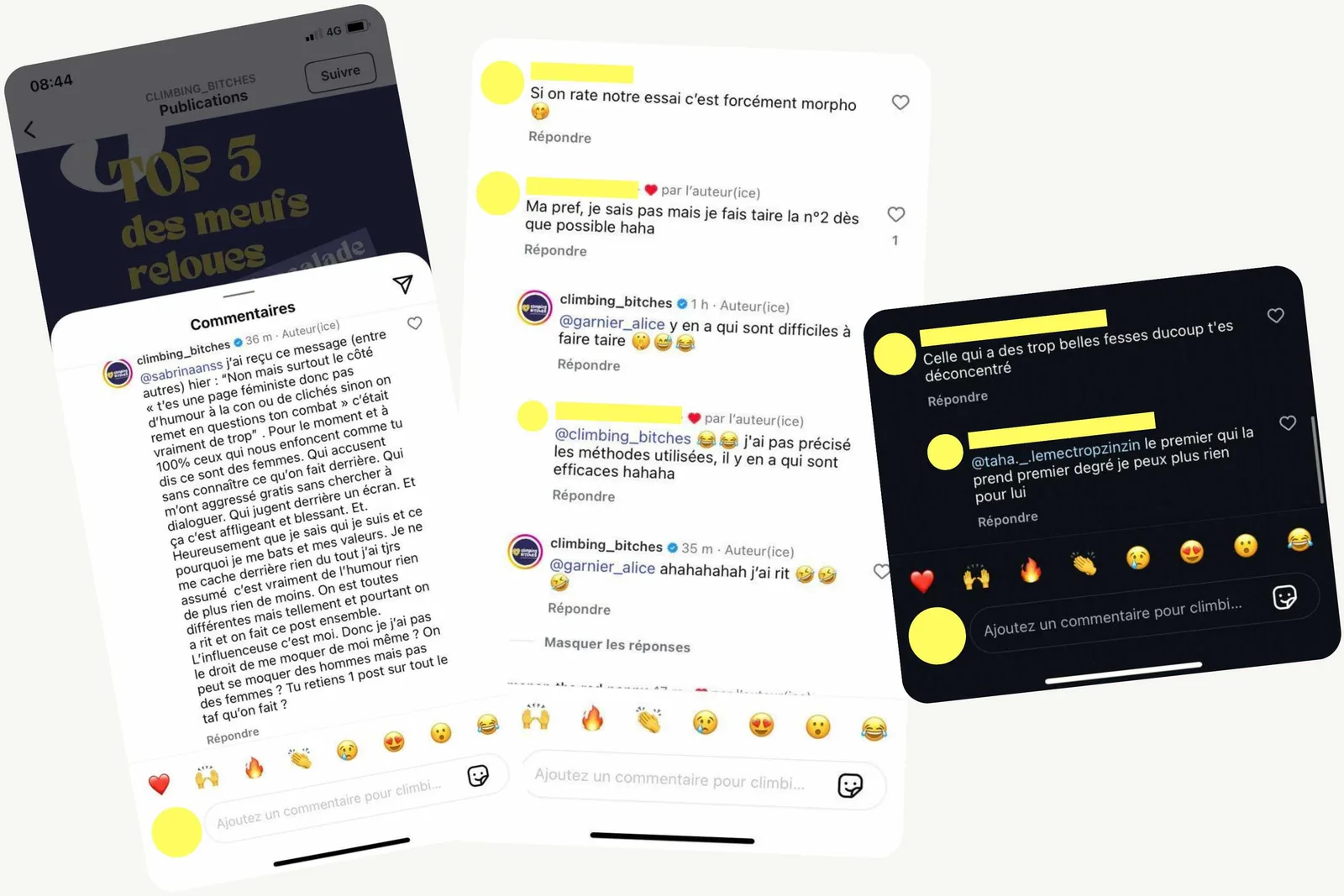
Criticism of Nathalie Rabusseau predates the ClimbHer Network event. "I've known plenty of people who got involved with her and then cut ties," says another witness who attended that evening. In March 2025, an Instagram carousel titled "Top 5 Annoying Women at the Climbing Gym" had already drawn mixed reactions. The post, which has since been deleted, featured a series of exaggerated stereotypes of women climbers. Several people we interviewed considered them sexist. Among the characters were "The one who acts like a drama queen every time she falls off a boulder problem" and "The one who complains nonstop that every problem is too reachy," referring to climbs whose moves favor certain body types or longer reaches.
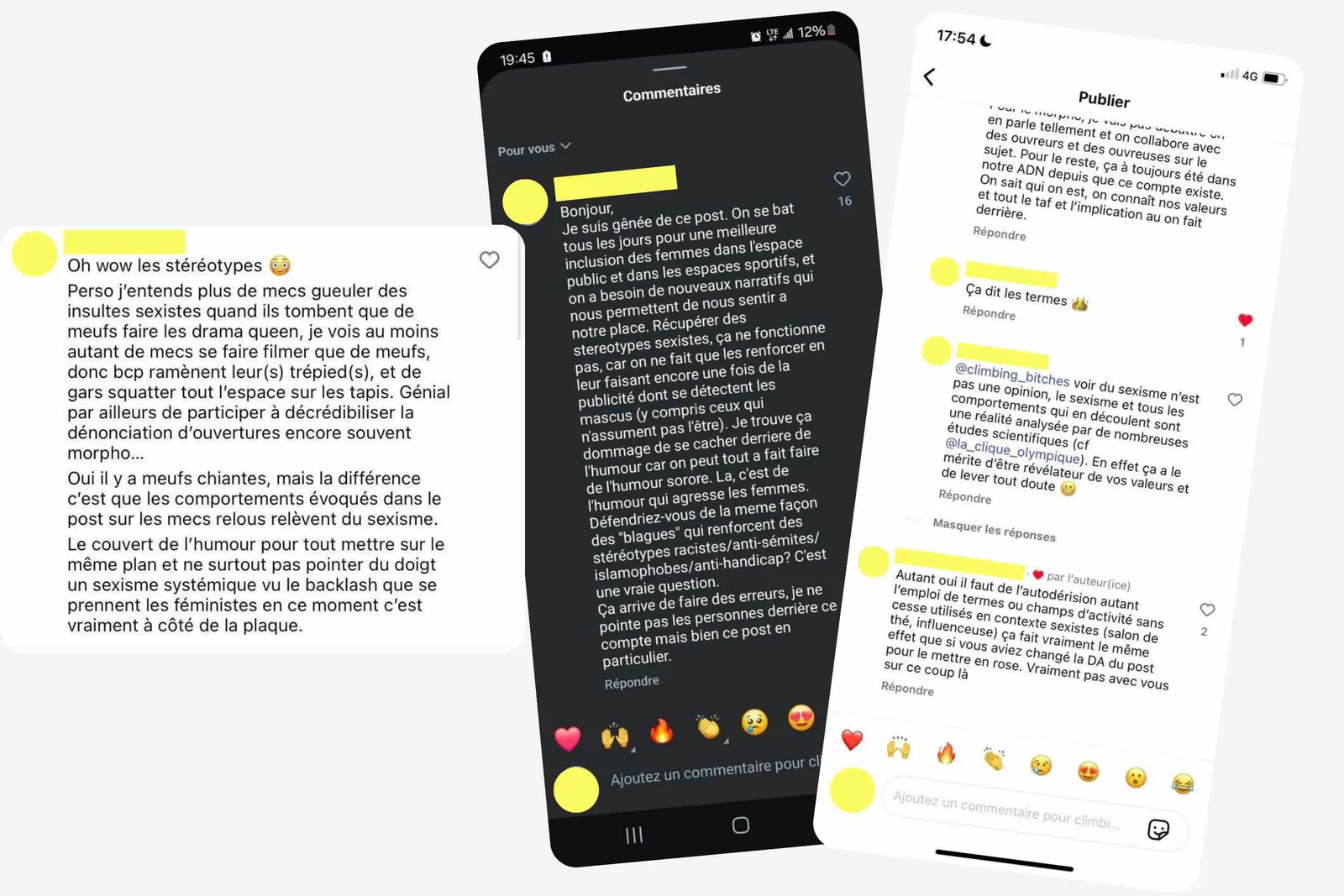
But it was the handling of the comments beneath the post that raised the most questions. "A lot of women commented to criticize the post. Nathalie deleted their comments but left up some pretty nasty ones from men," Laura* recalls. A screenshot reviewed by Vertige Media supports her account. One comment from a man that remained visible read: "The one with such a nice ass you can't concentrate." In another exchange, a female commenter said she wanted to "shut No. 2 up," referring to women who complain about problems being too reach-dependent. The Climbing Bitches account replied: "Some people are hard to shut up."
"This has been a major topic of conversation for two years, especially in activist circles. We were all hearing the same things, even though we didn't know each other. She has a reputation as someone people wouldn't recommend working with"
Laura, a climber active in the nonprofit sector
Responding to criticism, the account defended its sense of humor. "This kind of humor has been part of this account from the beginning. We talk about sisterhood, but then we put a woman on trial and judge her for no reason?" That defense contrasts with Flora's memories of the project's early days. She describes the humor as a mix of "little digs and meanness," with the "bitch" attitude reflecting, in her view, "a kind of jealousy toward certain women climbers."
Criticism can also be found on social media. But behind the scenes in the climbing community, it seems to circulate mainly among people who know one another. "This has been a major topic of conversation for two years, especially in activist circles," Diane* explains. "We were all hearing the same things, even though we didn't know each other. She has a reputation as someone people wouldn't recommend working with." That reputation, however, doesn't seem to have prevented Climbing Bitches from establishing itself in the industry. "When you know everyone, it's easier to get away with certain things," says Vincent*, who is also involved in efforts to make the climbing community more inclusive. "People started telling me about her behavior, and yet she was still showing up at events." "It feels like one big insider circle," he concludes. The company also benefits from a strong network of partners. Its Instagram account features collaborations with several brands, including Patagonia, Beal, Osprey, Le Vieux Campeur, and Volxholds, as well as climbing gyms such as Arkose Pantin, Climb Up Aubervilliers, and Bloc Session.
So why has so little of this criticism been voiced publicly? Several people we interviewed point to fear of retaliation, particularly legal action. Women climbers who are themselves involved in inclusion efforts describe threats they say they have experienced directly or learned about from others. "She kind of threatens to sue everyone," Laura* claims. "For two years, we've been seeing things and hearing about her threatening legal action," Diane* adds. According to these women, fear of the consequences has helped keep people quiet about the behavior they describe. It also explains why they asked to remain anonymous.
Laura*, who criticized the "Top 5 Annoying Women at the Climbing Gym" carousel, describes a more specific experience. "Before I even posted my criticism on Instagram Stories, I told her I no longer wanted my climbing videos shared on the Climbing Bitches account because of the post and the reactions to it. Once I spoke out on my own account, she sent me aggressive voice messages, saying she really hadn't expected me to do something like that." In Laura's view, criticism is turned back against the people who raise it. "It's really about making us feel guilty so we'll shut up, while never questioning her own behavior." Marion* describes a similar dynamic. "She directly compares us to the abusers we're speaking out against. It's a complete reversal of who's responsible!"
The Threat of a Defamation Case
C’est face à un autre mur que celui des prises colorées que se trouve aujourd’hui Emma : celui de la diffamation. Depuis la soirée ClimbHer et les propos qu'on lui a rapportés, la jeune grimpeuse vit dans la crainte des poursuites judiciaires. Lorsqu’elle décide de poster son carrousel sur Instagram, elle commence ainsi : « Aujourd’hui, j’ai appris quelque chose qui m’a profondément choquée et blessée », avant de rendre publique la phrase stigmatisante dont elle aurait été l’objet. Les répercussions de la publication ne tardent pas à se faire sentir, aussi bien pour Climbing Bitches que pour la créatrice de contenu.
Emma is now facing a very different kind of obstacle from the colorful holds on a climbing wall: the threat of legal action for defamation. Since the ClimbHer gathering and the remarks she was told had been made about her, the young climber has been worried about being taken to court. When she decides to publish her Instagram carousel, she opens with: "Today, I learned something that deeply shocked and hurt me," before sharing the stigmatizing remark she says was directed at her. The consequences of the post quickly become apparent, both for Climbing Bitches and for the content creator herself.
"Climbing Bitches has never been about fighting against anyone. It's a project that brings people together rather than dividing them. My approach is the opposite of hiding behind a cause to win people over, and that's not always easy for some people to understand"
Nathalie Rabusseau, co-founder and manager of Climbing Bitches
Contacted by Vertige Media, Nathalie Rabusseau answered our questions by email. She begins by addressing Emma. "At no point did I publicly make such remarks about her," she writes. She also describes the controversy as "internet drama." Yet on October 10, the Climbing Bitches cofounder had responded in a statement posted on Instagram. "I'm being openly accused of disparagement, insults, sexualizing women, perpetuating rape culture, and discrimination," she wrote. In the same statement, she announced that she had filed a defamation complaint, without specifying whom it targeted or which statements were the subject of the legal action. Speaking to Vertige Media, however, Rabusseau confirms that Emma is the target. "This is indeed the post that will be assessed by a court." She adds that "the decision to take the legal route is not an easy one." More broadly, the business owner insists: "Climbing Bitches has never been about fighting against anyone. It's a project that brings people together rather than dividing them. My approach is the opposite of hiding behind a cause to win people over, and that's not always easy for some people to understand."
Some Climbing Bitches partners have nevertheless decided to distance themselves from the company. The day after Emma's post, the Women Bouldering festival and the association Grimpeuses announced, "with regret," that they were ending their collaboration with Climbing Bitches. "We support women's freedom to dress however they want, without fear of being sexualized, harassed, or judged," the organizations' representatives wrote, in a clear reference to the controversy. Asked about the impact on her partnerships, Nathalie Rabusseau tells us she cannot say more "or speculate about the intentions of any of [her] partners." Later in her response, however, she acknowledges having had "uncomfortable questions and discussions (...) with many people," while maintaining that "communication hasn't broken down with anyone."
Inclusion as a Brand
Pierre, the co-manager of a climbing gym, hired Climbing Bitches to help promote inclusion. "We wanted to organize conferences or panel discussions about issues affecting the climbing world, including feminism," he explains. His team turned to Nathalie Rabusseau because of the feminist image associated with her company. According to Pierre, the event left them deeply disappointed. "There was practically nothing about women's inclusion in climbing during the panel discussion. We spent more time talking about the need for more blue and red boulder problems, which can be relevant to women, but here it was being discussed in general terms." He continues: "We were all genuinely baffled by how the event was handled. When I realized I'd paid for a panel discussion only to end up with a certain number of social media posts and likes, it left a bad taste in my mouth."
Investigative reporting takes time. And that time comes at a cost.
This investigation took several weeks of conversations, fact-checking, seeking responses from those involved, and rewriting. This work is possible because Vertige Media is funded by its readers.
To help us continue reporting independently on climbing, you can support Vertige Media starting at a few euros a month.
"Climbing Bitches is a commercial business," Nathalie Rabusseau explains in her written responses to our questions. "I took a chance on making a living by combining my media expertise with my passion for climbing. Since its creation, Climbing Bitches has highlighted climbers from all backgrounds. Inclusion isn't a one-off initiative. It's in our DNA." Later, she adds: "All you have to do is look at the Instagram account to see the diversity of climbers represented there."
On the Climbing Bitches website, a yellow button leads visitors to roughly 40 blog posts. At the time of writing, the six most recent articles all mention brands. Nearly half of the posts are dedicated to product recommendations or reviews. Five articles address inclusion, highlighting inspiring women climbers or initiatives such as Grimpeuses and the Women's Bouldering Festival. On Instagram, 12 of the account's 50 most recent posts feature brand partnerships or mention partners, roughly a quarter of its content.
When concrete inclusion initiatives do take place, they are more often carried out through Haut-delà des murs, the nonprofit Nathalie Rabusseau founded in 2024. Its mission is to give people with disabilities, people facing financial hardship, and those experiencing social isolation opportunities to discover and practice climbing. "Haut Delà Des Murs, a nonprofit association under France's 1901 law, grew out of the Climbing Bitches community. It is now independent and run by volunteers, bringing climbing to people who wouldn't normally have access to the sport," Nathalie explains in her response to Vertige Media. But if the vast majority of inclusion-focused projects are carried out by the nonprofit, what does that say about Climbing Bitches' own commitment to the cause, given that the company claims to share the same ambitions?
"She often says she's out there doing the work to promote inclusion, but ultimately there isn't much content about that work on the ground," Marion* observes. According to Marion, that commitment is also invoked to deflect criticism of Climbing Bitches. "As if that somehow made it impossible to criticize the way she operates." And yet, on its website, Climbing Bitches still promises a "safe place." In her email, the company's cofounder offers this clarification: "What matters most is encouraging dialogue, not stirring up emotions to win people over to a particular ideology. Everyone has to take a step toward the other person if they hope to connect. Sometimes we stumble. What matters is getting back up." Q.E.D.
First names marked with an asterisk have been changed to protect the anonymity of the people interviewed.