

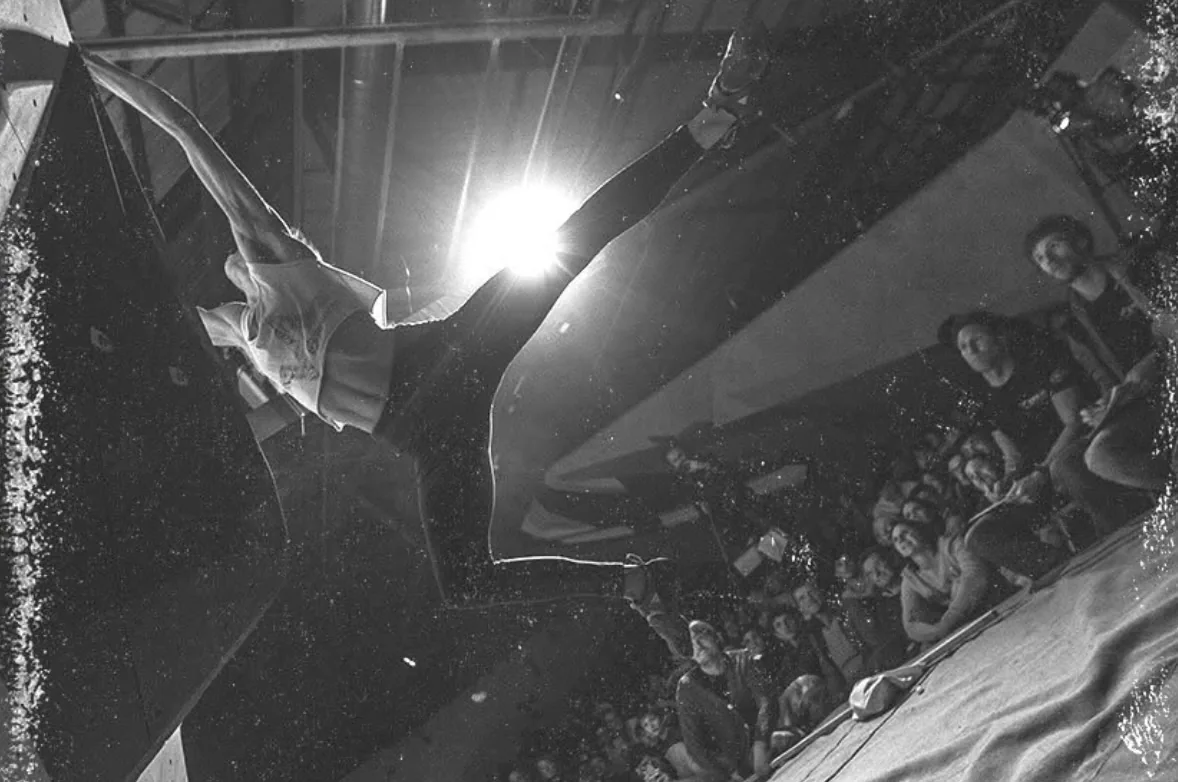
Two climbers finish the same boulder problems—short climbs done without ropes—but don’t necessarily end up tied in the standings. The tiebreaker? A train ticket or a boarding pass. On November 27 and 28 in Brussels, Master of Fire (MOF) will no longer judge competitors solely on raw strength and technique. It will also score their carbon footprints before they even set a climbing shoe on the mats. For its fourth edition, the bouldering competition, organized by Le Camp de base, an independent gym in Ixelles, is rolling out its Mobility Index. The idea is as simple as it is unsettling: Adjust each athlete’s qualifying score with a multiplier based on their travel. You can pick up as much as 15% in bonus points—or, if flying is your thing, lose just as much.
The idea didn’t come out of nowhere. In previous editions, organizers already restricted prize money to athletes who had skipped flying. That hard-line rule soon ran up against real-world complications: Organizers had to make an exception for a Japanese athlete who flew in but stayed in Europe for a full month. Florian Delcoigne, cofounder of Le Camp de base, now calls that workaround “not entirely consistent.” After a few months of thinking it through, he traded the all-or-nothing restriction for a formula applied to the entire field. His aim: to write the climate emergency directly into the competition rules, alongside the clock and zone holds—designated holds worth partial credit.
New Rules of the Road
Before climbing, every competitor has to come clean about their round-trip itinerary, transportation choices, distance traveled, and length of stay. The calculator then compares those emissions with a specific benchmark: making the same trip alone in a gas- or diesel-powered car. Do better than that solo driver and you earn points; do worse and you drop in the standings. Trains, bikes, and carpools become perfectly legal performance enhancers. Flying, meanwhile, costs you points—though a longer stay can soften the penalty. Whatever the circumstances, anyone who flies gets no bonus.
But because it rewards effort rather than the lowest total emissions, the calculator produces some odd results. Someone who lives near Le Camp de base and walks five kilometers (about three miles) will get a pittance. An athlete who travels 1,500 kilometers (about 930 miles) across Europe by train will hit the full 15% jackpot, despite having emitted far more CO₂ than the local who walked. Better yet: Driving 800 kilometers (about 500 miles) alone in a gas- or diesel-powered car carries no penalty. That’s because the calculator uses that exact setup—one person in a combustion-engine car—as its baseline, regardless of distance. “Yes, we accept that, and it does point to some of the system’s limits,” Florian Delcoigne tells us by phone.
“Le Camp de base and unsanctioned competitions really are testing grounds.”
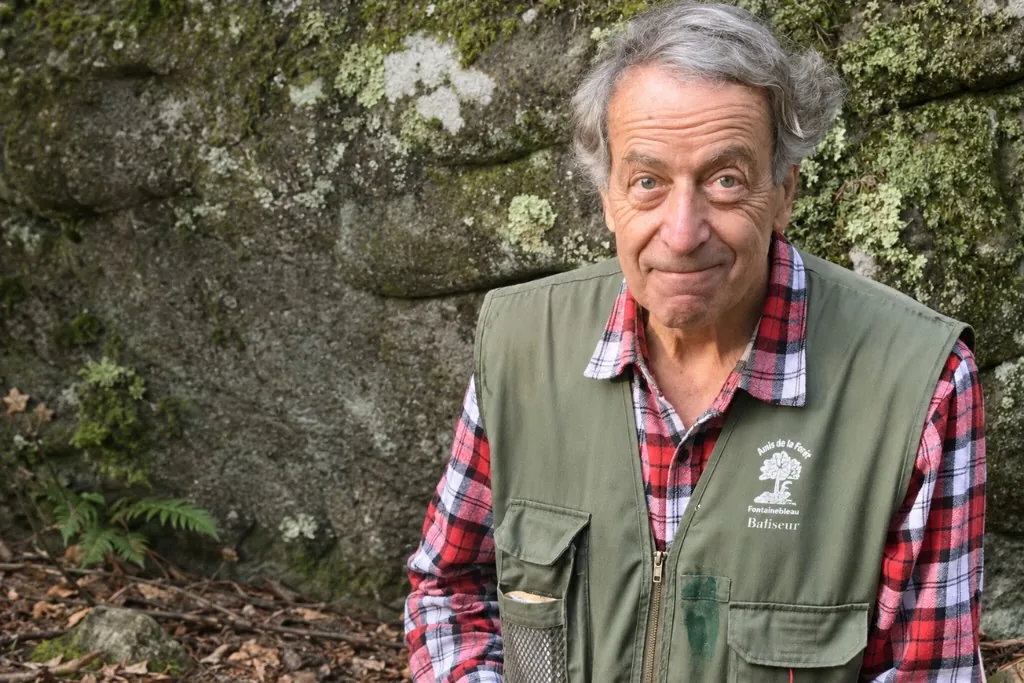
Florian Delcoigne, cofounder of Le Camp de base
The cofounder first worked on a formula based on total emissions. He considered it more consistent and transparent in numerical terms, but a poor fit for what he hoped to achieve. “People are going to come from farther away anyway,” he says. Better to encourage them to limit their impact than punish them for how far they travel. Driving alone became the benchmark, a compromise shaped by climbers’ social and financial circumstances. “We need to get people out of cars and onto trains. Maybe in two years, the train will be the benchmark, and we’ll be getting people off trains and onto bikes.” One major blind spot remains: Not everyone lives 10 minutes from a high-speed rail station or has the time or money to turn a competition weekend into a long train trip. Florian Delcoigne readily concedes that his rule creates new socioeconomic inequities. But to him, the idea that sports are a level playing field is a little naive.
This article is free to read.
That’s possible thanks to donations from our readers.
Without their support, it wouldn’t exist.
If you can, please support Vertige Media.
Preferential Treatment for the Climate
That’s the real taboo here: questioning the sacred idea that only performance should count. Only the top six athletes in each category advance from qualifying to the final. With this green multiplier, a climber who cruises through the problems could get knocked out of the top six by a weaker climber who makes the right call and takes the train. What do you tell the athlete who loses a spot in the final because of the rulebook? “First, that the rules are spelled out when you sign up,” Florian Delcoigne says firmly. Second, that equal opportunity at the start is a sporting myth. “The idea that sports are fair [...] and that [the result] comes down to performance alone is, I think, fundamentally an illusion,” he says. An athlete’s bank balance, home address, relationships with routesetters—the people who design the climbs—and the clout of their federation already shape performance. “We’re just adding one more factor,” he says. The difference is that this bias is spelled out in black and white. The cofounder openly advocates “preferential treatment” to help the climate.
But the revolution stops at the final: Once the six finalists in each category are chosen, the Mobility Index disappears. Two reasons for backing off: clarity, in a sport whose standings already give spectators headaches, and entertainment. When it comes to crowning the winners, the Brussels gym wants strength and technique alone to decide. “We’re here to have fun and put on a show, after all,” Florian Delcoigne points out. So travel emissions can decide who gets into the final, but not who wins the medals. That contradiction sums up the dilemma: how to shake up the sport without spoiling the fun.
Another twist: No one is checking anyone’s travel. How does Le Camp de base verify the trips athletes report? “I don’t check,” Florian Delcoigne says bluntly. It’s all on the honor system, just like qualifying, where athletes record their own completed climbs. That kind of freedom is unthinkable on tightly controlled federation circuits. It lets independent events go rogue. “Le Camp de base and unsanctioned competitions really are testing grounds,” he argues. They’re places to tinker, make mistakes, and adjust without asking the International Olympic Committee for permission.
A Rough Landing
But why make the standings so complicated if the planet still pays the same price? In a report published in February 2025 on cutting emissions in French soccer and rugby, the Shift Project pointed out the obvious: In sports, most emissions come from travel. Greener travel is a start, but the bigger opportunity is to rethink how often events are held and where.
“Is this what we want sports to look like, and is it still something we can sustain?”
Florian Delcoigne, cofounder of Le Camp de base
Master of Fire has a contradiction of its own. A round trip by train pollutes less than a flight, sure, but it still creates unnecessary emissions compared with competing down the street. And athletes are only the tip of the iceberg. There are also spectators, technical crews, equipment, and sponsors. Florian Delcoigne hears that criticism even from people close to him, some of whom accuse him of giving an inherently energy-intensive international event a green makeover. “Maybe we are greenwashing,” he concedes. The organizer even acknowledges that his system could have the opposite effect from what he intended: “Could this increase MOF’s carbon footprint while bringing the issue to a wider audience? I don’t know.” He accepts that uncertainty, arguing that the experiment should also prompt people to question travel habits beyond this one Brussels competition. Still, organizers are stepping up their efforts to get a clearer picture: In 2024, barely a quarter of the 600 competitors bothered to fill out the travel survey, leaving organizers to make rough guesses about the rest. This year’s post-competition emissions tally will show where things stand, though it will be hard to tell who actually traded a plane ticket for a train ticket because of the rules.
Ultimately, the experiment raises a much more relevant question for our little world of climbing: Do we still need to fly the circuit’s stars around the world every weekend to put on a successful event? “Is this what we want sports to look like, and is it still something we can sustain?” Florian Delcoigne asks. Even Master of Fire’s own existence is up for discussion. The Brussels event, paused in 2025 to allow time to open new facilities, is now prompting a closer look at the relentless pace of major sporting events. That’s consistent with the openly political stance the Ixelles gym has long taken. In spring 2026, it refused to host a round of the European Youth Cup—forcing the event’s cancellation—after negotiations with the Belgian federation broke down over the conditions for the Israeli delegation’s participation. For Florian Delcoigne, testing different rules—with all the contradictions that entails—is exactly what an independent organization is supposed to do.
The real test of the Mobility Index won’t be on the mats in Belgium. It will be whether climbers change how they travel—and perhaps, eventually, whether the sport’s competition calendar changes, too. If a simple points calculator gets people questioning the need for so many international competitions, Le Camp de base will have solved a far tougher problem than any set on its walls.