
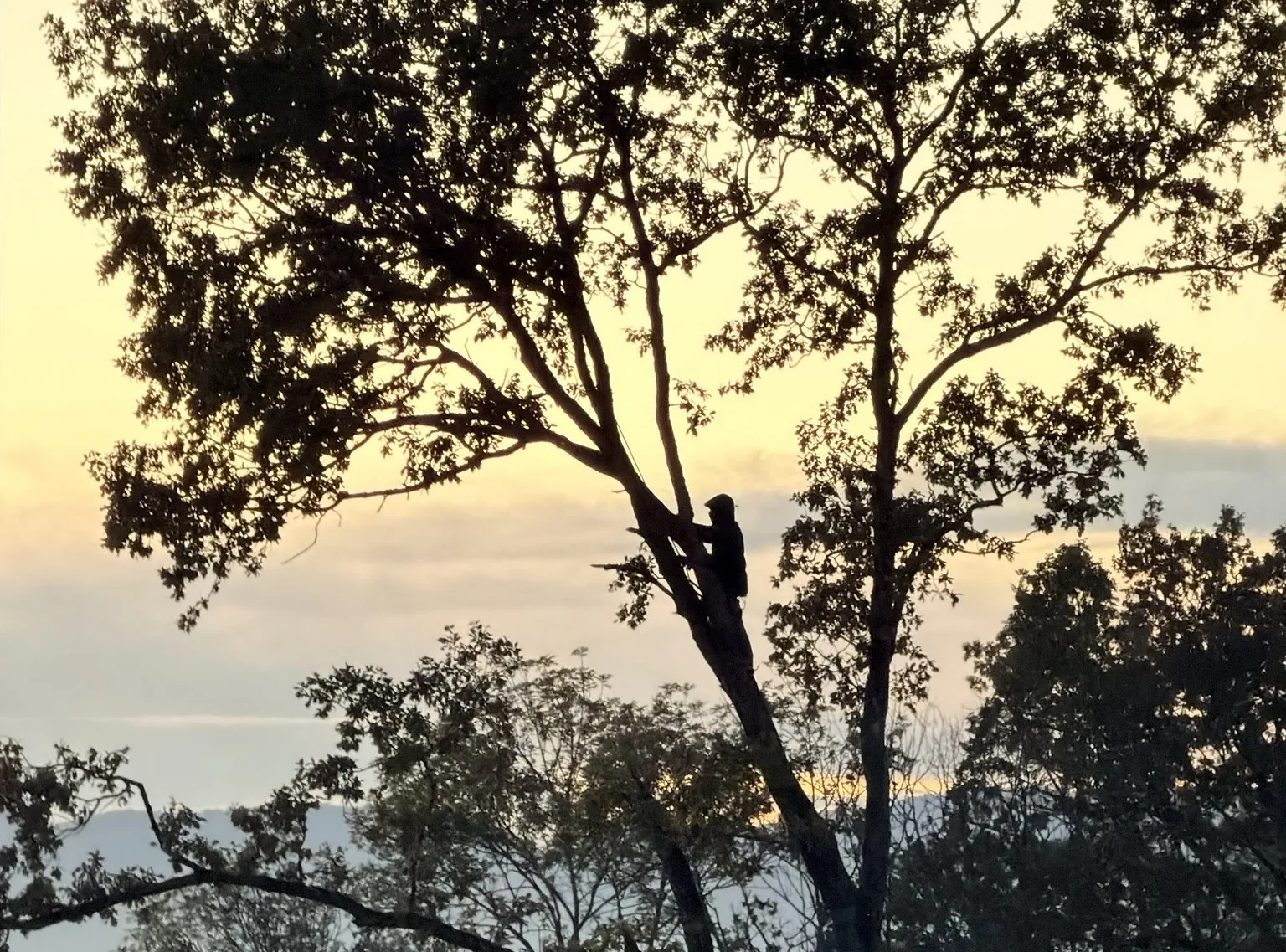
Andrea slept well. Yet it was a very cold night in the Chablais forest. When the young woman wakes up, she’s almost surprised she didn’t notice the 43-degree chill. Looking over the edge of her hammock, she’s just as surprised by the stillness around her treetop camp. Usually, nearly 65 feet below her, the National Mobility Support Unit (CNAMO) patrols the ground, looking for a way to remove her. Andrea is a “squirrel,” and this morning she’s celebrating her tenth night of resistance.
Outrage All Around
More than 25 people like Andrea have taken turns occupying the trees for nearly two months to protest the proposed A412 highway. Amedea, an Eiffage subsidiary, is behind the project, which would force residents to give up their property and cut through more than 100 hectares of forest—roughly 250 acres. With logging machinery advancing, the squirrels have retreated to the few oaks still standing. “We felt really helpless watching how fast they were cutting down the trees,” Andrea says. To talk about it, she joins Sebi, a squirrel who has been there from the start. From the trees, he witnessed the “monstrous” clearing that began on September 7. “I couldn’t believe it when I saw six tree-cutting machines working at once across several areas,” he says over the phone. “They tore everything up. It was really hard to watch. Every time a tree fell, people cried.”
On the ground, Jérôme knows that feeling well. A farmer directly affected by the proposed route, he has become one of the leading voices of the Stop A412 coalition. Since long before the machines arrived, he has been fighting in court and in the media to make the case that this highway project makes no sense.
Can you believe it? After the summer we just had, we’re cutting down one of the few places left where we can escape the heat.
Jérôme, farmer and activist opposing the A412 project
The 10.3-mile stretch of highway connecting Machilly and Thonon-les-Bains, in Haute-Savoie, is supposed to ease regional traffic and improve access to some isolated areas. “Except plenty of impact studies show that’s not true,” he says. More troubling, the project keeps moving forward despite numerous challenges. The public prosecutor has called for work to be suspended, the city of Geneva has filed a legal challenge, and several environmental groups are also challenging the permit issued by the local prefect’s office. “It’s an environmental travesty,” Jérôme says emphatically. “And meanwhile, 80 hectares of forest and 70 hectares of farmland are disappearing. Nearly a third of that land is in wetlands. Can you believe it? After the summer we just had, we’re cutting down one of the few places left where we can escape the heat.”
Opponents also dispute the project’s promised benefits. Among their arguments against the highway are induced demand—the gradual increase in traffic that follows the construction of a new road—and congestion that simply shifts elsewhere.
This article is free to read.
That’s possible thanks to donations from our readers.
Without their support, it wouldn’t exist.
If you can, please support Vertige Media.
Things have changed since the logging machines went to work. Now people are seeing the trees fall. The powerful images circulating on social media have left others as stunned as Jérôme. Now “ordinary people” are protesting alongside him. “People who had never gotten involved before are showing up,” the farmer continues. “They take time off work or stop by after dropping their kids at school. This project has a lot of people outraged.” On October 30, Vincent Bouillard and Xavier Thévenard, both past winners of the UTMB ultramarathon, announced their support for the campaign against the A412 by organizing a run along the highway’s planned route.
Branching Out
Andrea hadn’t really occupied a ZAD before, either. Short for “zone to defend,” it’s a site where protesters camp to block a development project. But after seeing images of the logging, she rushed to Chablais to climb onto the machinery. “It slows them down a little,” she says. “But they get you off in 15 minutes. Then you spend 20 hours in police custody.” She realizes that occupying a tree works better. Over in Ardèche, Coco had the same reaction. Watching the logging on her phone became unbearable. When she sees a call for people to join the protest, she grabs some gear and shows up at the foot of a tree. Coco has never occupied a tree, but she climbed plenty as a kid. Andrea did a little rock climbing in middle school, but “working with ropes really isn’t her thing.”
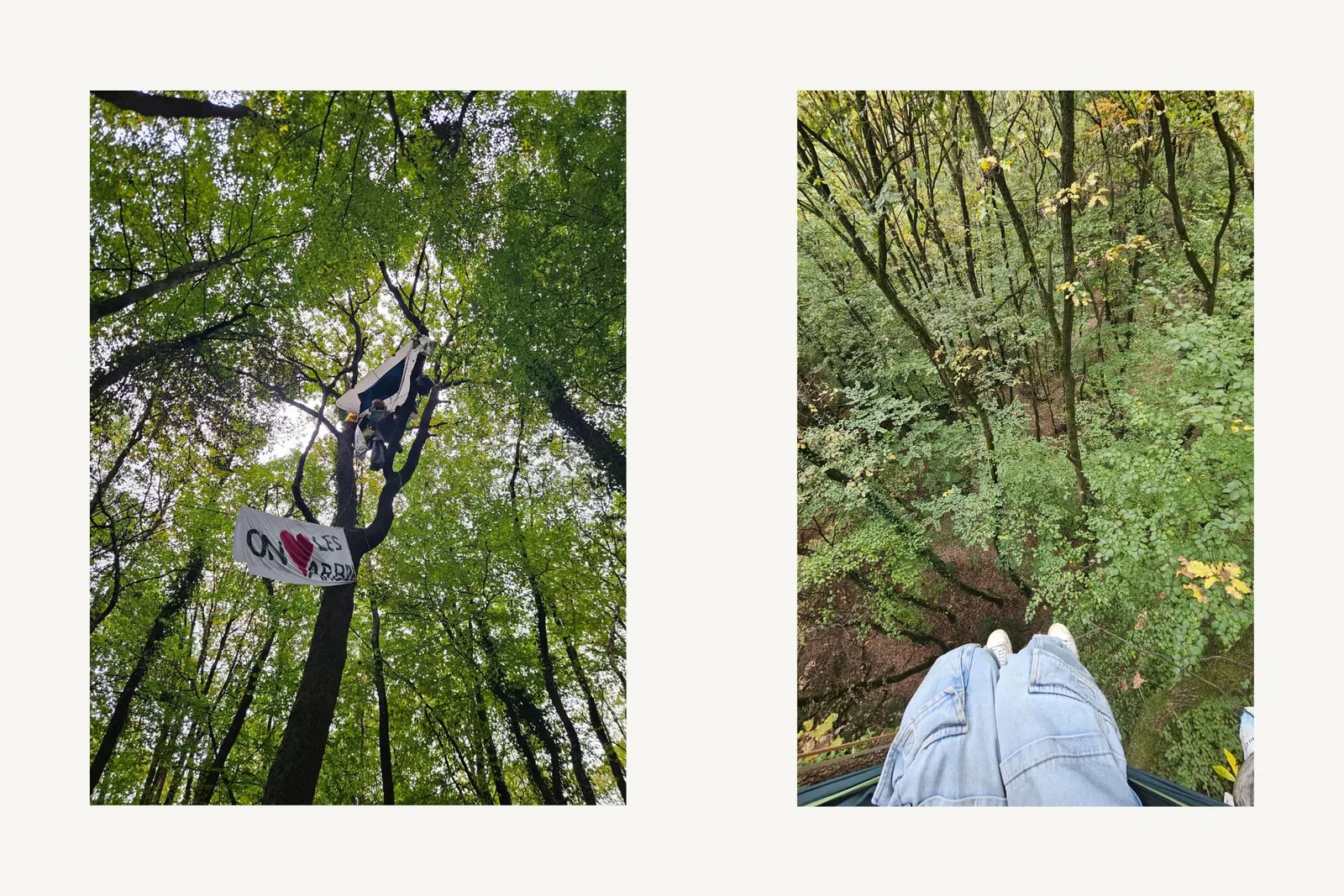
No matter: Both women say half an hour of training is enough. Rope-access workers, specialists who work while suspended from ropes, and experienced climbers teach the two young women to jug a rope—climb it using mechanical ascenders—and tie Prusik knots, friction hitches that grip a rope. They also learn the basics of living about 80 feet up an oak. Coco discovers a daily routine “where even the smallest task takes time”: getting out of the hammock, putting on shoes, moving among the branches. It’s hard to spend more than three nights in a row up there. Andrea has two young children, so she has to come down. When she heads back up, it’s raining. Water runs down her safety line, soaking her hammock, sleeping bag, and clothes.
I’ve done plenty of tree-sits, but I’ve never seen people put in so much danger.
Sebi, a squirrel opposing the A412 project
To get through the hardships and shake the often outlandish labels the mainstream media have slapped on them, the squirrels get organized. Since the widely covered protests against the A69 (a proposed highway between Toulouse and Castres—Ed.), the National Tree Watch Group (GNSA) has established a presence across France. Its founder is Thomas Brail, known as “France’s most famous squirrel.” The organization gives Coco, Andrea, Sebi, and the others access to tried-and-tested advice. The basics? Solar panels to keep them self-sufficient, stockpiles of water and nonperishable food, and techniques for evading removal. Those tactics have earned the respect of their fellow activists and made the squirrels some of the most formidable opponents of projects that devastate ecosystems.
Even with that tactical know-how, holding out can be a struggle. Andrea and Sebi remember a police operation at the Castors site in Bons-en-Chablais. A negotiator comes by and asks them to come down. They refuse. In the hours that follow, officers cut up their hammocks and tarps, puncture their water containers, and take their blankets. “With no food or protection, we had to come down,” Sebi says. He also describes two trees being felled just a few yards from the one he was occupying. “One of them could have fallen on me,” he says. “I’ve done plenty of tree-sits, but I’ve never seen people put in so much danger.”
For the Love of the Forest
Sebi is one of the local squirrels. He first took part in a tree-sitting protest in 2003 in Grenoble, opposing construction of the Stade des Alpes. Through books and news reports, he was influenced by the major forest-defense movements in the United States in the 1970s and the anti-road protests in the United Kingdom in the 1990s. Those decades of resistance have given tree-sitters a certain mystique. “A lot of the time, we feel helpless up in our trees while all hell breaks loose below,” Coco says. “But then people remind us that we’re symbols.” Looking down, she sees the evidence: dozens of people bring her “gear, food, and really high-quality clothes.” She says people in the forest have figured out how to organize themselves. “People’s attitudes are changing,” she says. Andrea points to the growing number of young people at the ZAD as proof.
When you sit in a tree, you’re holding on to what you’re fighting for. As the slogan goes: We are nature defending itself.
Coco, a squirrel opposing the A412 project
As the logging machines advance relentlessly, the activists know they’re slowing the work and seriously hampering police operations. But now, forced back into the last few dozen hectares of forest still standing, they also know the fight will be won by changing minds. “Even if they start pouring concrete, there’s no denying that the movement has grown,” Sebi says. “More and more people are standing up against projects like this. We’re tipping the balance of power in our favor.” That’s enough to keep the squirrels in their trees for another night. And all winter, if necessary. “Despite the devastation around us, we’re still determined. From where we sit, we feel the loss of what they’re cutting down even more,” Sebi says, mentioning the area’s black woodpeckers, long-eared owls, tits, and bats. “Up here, you also notice more of the pollution people create,” Coco adds, mentioning lights, airplanes, and car horns. “When you sit in a tree, you’re holding on to what you’re fighting for,” she continues. “As the slogan goes: We are nature defending itself.”
Even when others insist their fight is doomed, the squirrels still believe they can win. Whatever happens, Andrea says, “this experience will stay with me for the rest of my life.” Through the cold, the rain, and the danger, she intends to cherish the forest and the trees that remain. “Because afterward, we’ll keep fighting,” she says quietly. “But we’ll be up against nothing but rocks.”
To keep up with the squirrels’ fight against the A412, follow their newly launched Instagram page.