
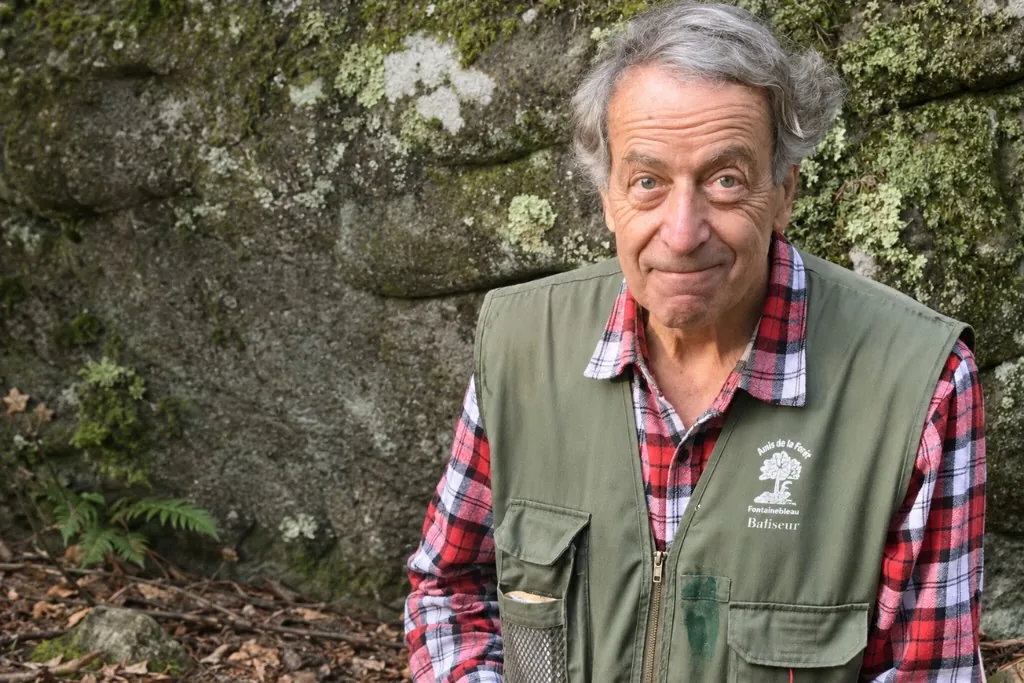
On May 19, 2026, Jean Cabane boards a high-speed TGV train to Grenoble with some unusual baggage: rock disks, leather, pof—the pine resin traditionally used at Fontainebleau—and a bag of chalk. At 78, the retired senior physician isn’t heading out to climb. He’s meeting Yahya Rharbi, a researcher at France’s National Center for Scientific Research (CNRS), and Vincent Verdoot, the rheometry specialist (the measurement of how a material flows or deforms—Ed.) at Université Grenoble Alpes. They’re determined to answer one question: Does this familiar powder help our fingers grip the rock, and if so, why? “They gave me a tour of the lab,” he tells Vertige Media. The three men then shut themselves in a room to work out experimental protocols that could help answer the question. The meeting produces no verdict, but it marks an important step in an investigation that began several months earlier in the Fontainebleau forest.
Cabane has been coming here since childhood, back when he camped with the Scouts and climbed “in big, clunky boots.” After years of mountaineering and a career at AP-HP (the Paris public hospital system—Ed.), he retired and, in 2014, joined Friends of the Fontainebleau Forest. While marking the 25 Bosses trail, he got a close look at the damage: erosion, worn trails, and white streaks on holds—the features climbers grip or stand on. “I’ve never used chalk myself, but I see people using it more and more,” he says, noting traces even on beginner circuits, or marked sequences of climbs. His dislike of those white marks and his love of the forest have turned the question into an obsession. Whether the science will prove him right is still an open question.
Smoke and Mirrors
His first instinct as a doctor was to dig into the research: the mechanics of friction, sweating, skin physiology, environmental impacts. The findings are mixed, to say the least. “There aren’t a whole lot of studies, and some even contradict each other,” he says. First, the basic question: Does chalk actually work? We know it absorbs sweat, but its effect on friction also depends on the skin, the rock, and how much you use. Studies on different types of rock show that results vary widely depending on surface roughness and moisture. That’s enough to challenge the idea that chalk works miracles.
“I’m not some anti-chalk fanatic. What I want is a solution that works for both sides.”
Jean Cabane
Cabane suspects chalk’s main job is simply to regulate moisture on the skin, but he’s not making any firm claims: “That may not be its only role. I don’t know.” That’s what he wants to measure. Working with the Fontainebleau Alpine Club, he also surveyed climbers. Their responses revealed wildly different habits: hands they felt were too sweaty, constant reapplication, and, among a few diehards, a stubborn loyalty to pof. The survey offered a close look at their habits, but still no evidence of chalk’s actual effectiveness or toxicity. The environmental picture is clearer, though incomplete. In 2020, a Swiss team led by Daniel Hepenstrick found very high concentrations of chalk on boulders, even where the rock looked spotless. In lab tests, the substance hampered the growth and survival of several moss and fern species. But those findings can’t be generalized to all of Fontainebleau, where heavy foot traffic and erosion also damage the soil. Cabane readily acknowledges that the study “points us in the right direction, but it’s not enough to be certain.”
The newsletter that lifts you higher
Every Wednesday: the editorial team’s column, the best articles, and plenty of surprises to help you climb higher — in mind and in spirit.
Then there’s health. In their questionnaire responses, climbers describe skin that feels tight and sometimes burns, especially with alcohol-based liquid chalk. Cabane suspects a “rebound” effect in sweating, though he has no evidence for it yet. Odile Aubrun, a specialist in skin care formulations, likewise knows of no study documenting the phenomenon. It’s one more possibility for Cabane to explore: “That’s one of the things I wanted to test.” And what about climbing gyms? In late 2025, one study was already flagging rubber particles shed as climbing shoes rub against surfaces. Then, in February 2026, a Romanian study measured staggering spikes in PM2.5 and PM10 (fine and ultrafine airborne particles that can penetrate deep into the respiratory tract—Ed.). That’s reason to worry about indoor air quality, but not enough to pin the blame on chalk alone.
“Progress is within reach.”
Jean Cabane
What seems to bother Cabane most, though, is chalk’s almost sacred status. Reaching for chalk has become a Pavlovian reflex. He goes so far as to call it “addiction”—a deliberate provocation, not a medical diagnosis. “I’m not some anti-chalk fanatic, ” he clarifies. “What I want is a solution that works for both sides.” On the sandstone cliffs of Saxon Switzerland, chalk is banned outright. So it is possible to climb without it. “The hardest part is challenging preconceived notions,” the retired doctor says. Starting with his own.
And … Poof!
To get from talk to hard numbers, he had to improvise. At the École des Mines in Fontainebleau, staff cut him rock disks five centimeters—about two inches—in diameter. He buys leather from a saddle maker, picks up some pof at a store, and heads to Grenoble to test the materials’ resistance to force, with and without chalk, in dry and wet conditions. In June, Vincent Verdoot breaks out his beakers of chalk and salt water. The salt water stands in for sweat. They measure the mixtures’ viscosity as they flow—a long, long way from actual contact between a finger and a boulder. Then, in September, a setback: other projects take over the lab. Cabane gets things moving again in the fall, still facing an uncertain schedule and searching for money to fund the work.
Still, he keeps thinking up alternatives. Rather than quibble over how much chalk to use, why not rethink the surface that actually touches the rock? Climbing-shoe soles give him an idea: “Why not have climbers wear thin gloves that let them feel the holds and get a good grip, while giving them the traction of resin-infused rubber?” The comparison makes sense to gear manufacturers, including Jean-Charles Laugt, climbing product manager at Simond: “In fact, I often say chalk is a climbing shoe for your hands.”
He writes to La Sportiva, Salomon, Michelin. He talks about keratin, nitrile, and the microscopic structures on geckos’ feet. A prototype is still a long way off, and whether such a glove would be better for the environment remains unproven. But “progress is within reach,” he insists. For now, though, the priority is to understand the chemistry at work between the ridges on our fingertips and the rock. We ask him bluntly about the contradiction: Why try to replace a product that hasn’t even been shown to be harmful? What if he has it all wrong? Cabane doesn’t flinch. “If that’s what the experiment shows, I’ll accept it. But I don’t think it will.” That’s the point of the scientific safeguards: using rigorous protocols to try to disprove his hypotheses. “Until the experiment has been done, the question remains open,” he concludes. No arguing with that.