
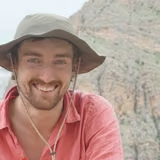
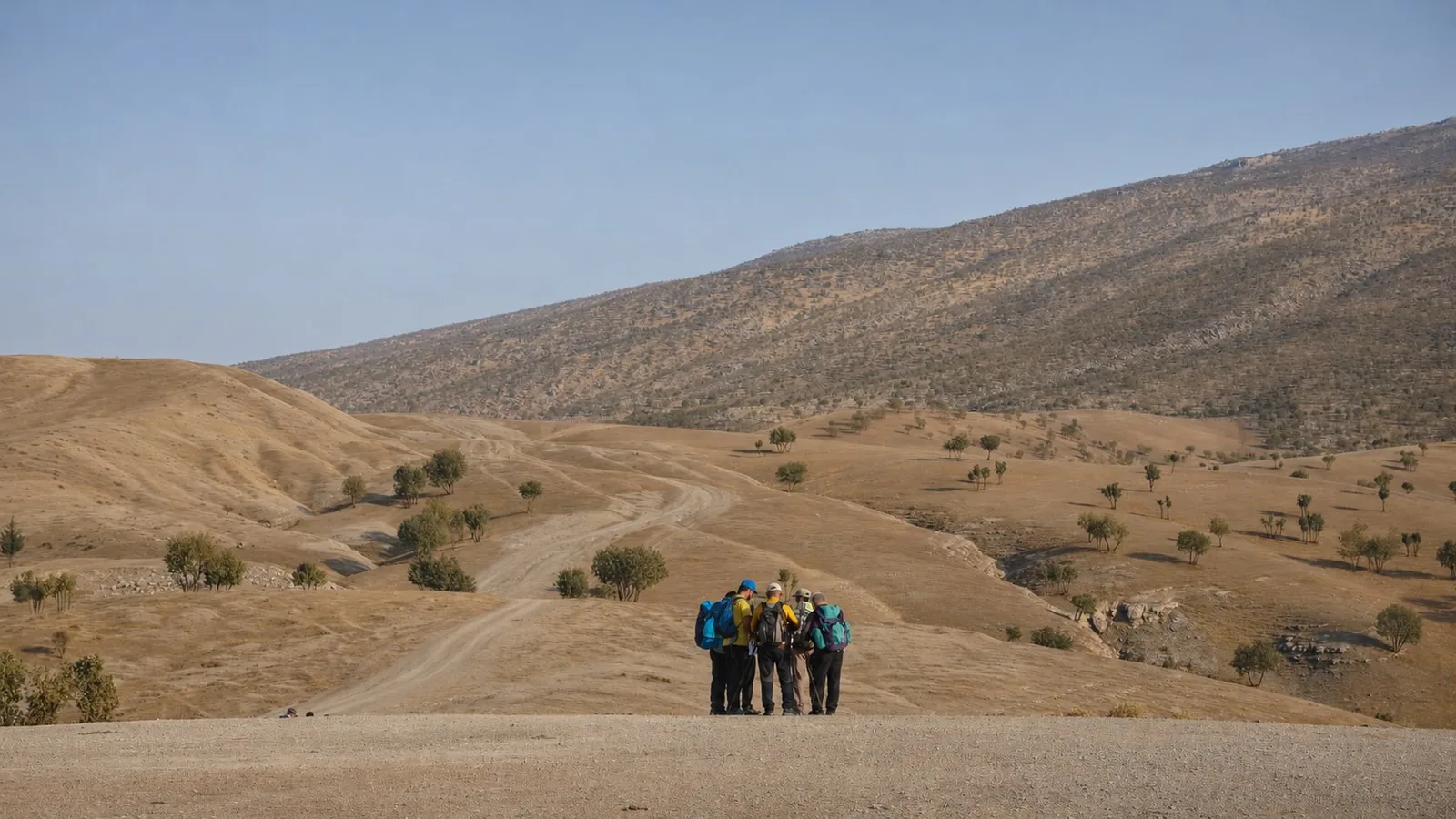
It's an early November morning, and the alarm goes off at dawn. Breakfast is quick: hot soup and black tea. There's a relaxed feeling to the morning as everyone wakes up together, but they're also eager to get moving. Daniel, Mewlud, and his family have one goal today: to climb Mount Halgurd, the highest accessible peak in Iraq. Rising roughly 11,800 feet above sea level, the massive stone summit stands against the morning sky. Today, they'll make their way up its rugged slopes. Halgurd is a giant in a region much of the world still knows little about: Iraqi Kurdistan.
Dancing on the Slopes
Kurdistan is a nation without a state, a vast territory spread across four countries: Turkey, Iran, Syria, and Iraq. According to the latest census figures, the Kurdish population exceeds 50 million, yet only the autonomous region in northern Iraq has formal political recognition. Mostly mountainous and close to the Turkish and Iranian borders, Iraqi Kurdistan is dominated by Mount Halgurd, which rises to 11,834 feet (3,607 meters), making it the highest accessible summit in Iraq. Nearby Cheeka Dar reaches 11,847 feet (3,611 meters), but its summit lies under Iranian control and remains off-limits.
The Kurdish people have always had a special relationship with the mountains. Places to live, travel through, seek refuge, and sometimes worship, these landscapes have been inhabited and cultivated for generations. Villages, homes, and shelters dot the mountains and valleys, providing a place for shepherds, travelers, political activists, peshmergas (members of the Kurdish armed forces), and kolbars (Kurdish cross-border porters who carry goods between Iraqi and Iranian Kurdistan and frequently face repression). For generations, these mountains have sheltered people whose connection to the land sometimes takes on a spiritual dimension. As the familiar saying goes, "No friends but mountains."
This article is free to read.
That’s possible thanks to donations from our readers.
Without their support, it wouldn’t exist.
If you can, please support Vertige Media.
Others come simply to enjoy the outdoors. Since 2005, the Kurdistan Mountaineering and Climbing Federation (KMCF), led by Hemen Mensor, has brought together several hundred members involved in everything from hiking and rock climbing to mountaineering and expeditions. Headquartered in Erbil, the capital of Iraqi Kurdistan, the federation has clubs in the region's major cities. A new hiking trail recently opened in Duhok. In Soran, an indoor climbing wall is under construction to introduce younger generations to the sport. In Sulaymaniyah, members are developing single-pitch sport climbing routes, which can be completed in one rope length, as well as longer multipitch climbs. Recently, several members completed a multipitch trad climb, using removable protection rather than relying on fixed bolts—a first for this style of climbing in Iraqi Kurdistan. Together, these projects show how much momentum the federation has built.
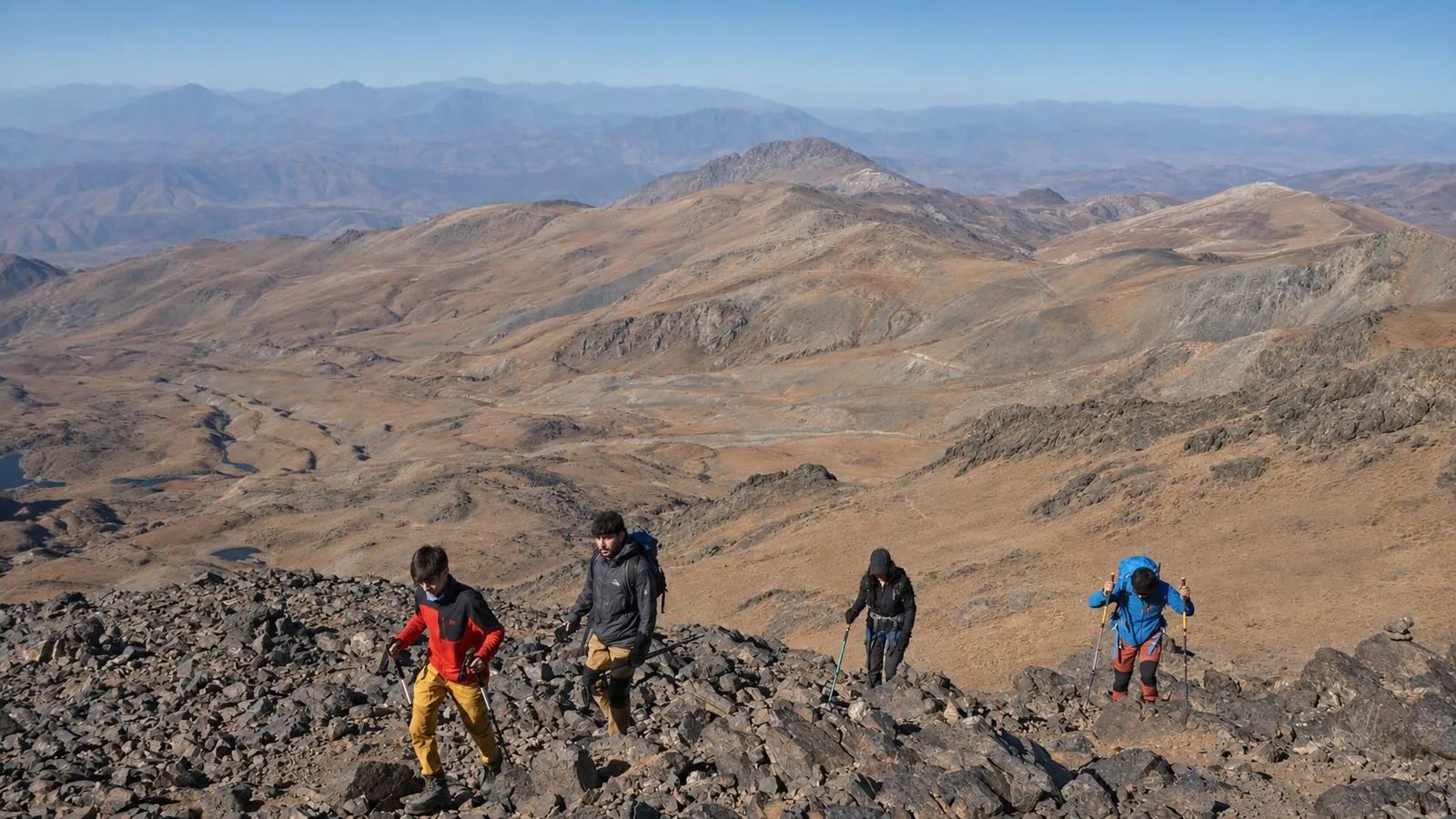
Mewlud and Daniel, both mountain guides and coordinators with the federation's Soran branch, are preparing to climb Mount Halgurd, whose name literally means "the highest" in Kurdish. As they plan the route and pack their bags, they explain that reaching the summit requires both a permit and the company of someone from the area. After chickpea soup, piping-hot çay, and a few rounds of warm flatbread, they set off on a two-hour drive, passing through regular checkpoints staffed by peshmergas in traditional clothing. Then the climb begins. There are five of them this morning. The landscape is almost entirely rock, with what little vegetation remains having been eaten by goats. As they gain elevation, the hours pass with personal stories and anecdotes shared along the trail.
Living Under Drones
As they hike, Daniel, a guide who knows the region intimately, points out traces of its history. Nearly everything along the route has a story to tell. At the first mountain pass, a handful of rusted shell casings lie scattered across the ground. Some still bear Iranian markings. They date back to the Iran-Iraq War, fought between 1980 and 1988. Others are American. A little farther on, below the trail in a field of loose rock, lies an old minefield. "More leftovers from the war," Mewlud explains. "You just have to stay away from it. As long as you know it's there, you're fine!"
"Every time I go into the mountains, I thank them. I think about them. They watch over everyone who lives there and fights for us, for our freedom"
Faïza, a Kurdish climber
Even today, the mountains mean something different here. They're not just a place for adventure, family expeditions, or tackling a north face. They're not simply landscapes where the effects of climate change are especially visible, or remote places to escape everyday life. They're also guardians of memory and freedom. And they're battlefields, places where people hide and fight back against oppression and the denial of their nation's existence. Even as recreational activities and modern mountain sports become more common on these slopes, Faïza, another member of the group, hasn't forgotten that history. As they walk, she explains: "Every time I go into the mountains, I thank them. I think about them. They watch over everyone who lives there and fights for us, for our freedom. That's my own kind of spirituality. I can't really explain it."
They reach the summit in the early afternoon. For some, it's their first time. For Faïza, Mewlud, and Daniel, the climb has become familiar. Still, the reason they keep coming back hasn't changed. "Just for the pleasure of being up here, away from social media," they say. Halgurd is only one example of a much broader reality. Turkish and Iranian authorities regularly use drones to target areas suspected of being occupied by the Kurdistan Workers' Party (PKK), which is designated a terrorist organization, or the Democratic Party of Iranian Kurdistan (PDKI). These strikes sometimes leave visible scars on the landscape, including in areas not far from the hiking route. "Even so, these are struggles worth fighting," Daniel says. "These men and women are fighting for our freedom, for the freedom of the Kurdish people and for international recognition."
But these struggles for justice and liberation are seen as threats by neighboring countries, where Kurdish identity receives little or no recognition. That's why these movements face such severe repression. In this context, spending time in the mountains cannot be separated entirely from the region's political realities. Near the borders, some areas remain difficult to access, and those restrictions directly affect where people can go. Hiking, climbing, and simply moving through the mountains take on meanings that go far beyond recreation.
For the Kurdish people, though, this struggle is increasingly about something else, too: hope, freedom, and the possibility of a future without violence. In the mountains, you can hear them singing. Sometimes, even with drones threatening overhead, they dance. Because the days of humiliation are over. Because here, freedom is no longer something people are willing to beg for. They demand it at the top of their lungs. And they live it.
Jin Jiyan Azadî
As another expression of that freedom, more and more Kurdish women are taking part in mountain sports through women-only outings. These participants, along with the federation's representatives and members more broadly, have long advocated for a more inclusive role for women in society. Their efforts reflect a larger vision of a free, independent, and feminist Kurdish society. In 2006, when Kurdish women in Turkey first chanted "Jin Jiyan Azadî" ("Woman, Life, Freedom"), a slogan inspired by the anti-patriarchal ideas of Abdullah Öcalan, the leader of the PKK, they helped establish the foundations of a movement. It was a fight for Kurdish independence and recognition, but also for a form of feminism centered on collective rather than individual liberation: Jineolojî, Kurdish for "the science of women."
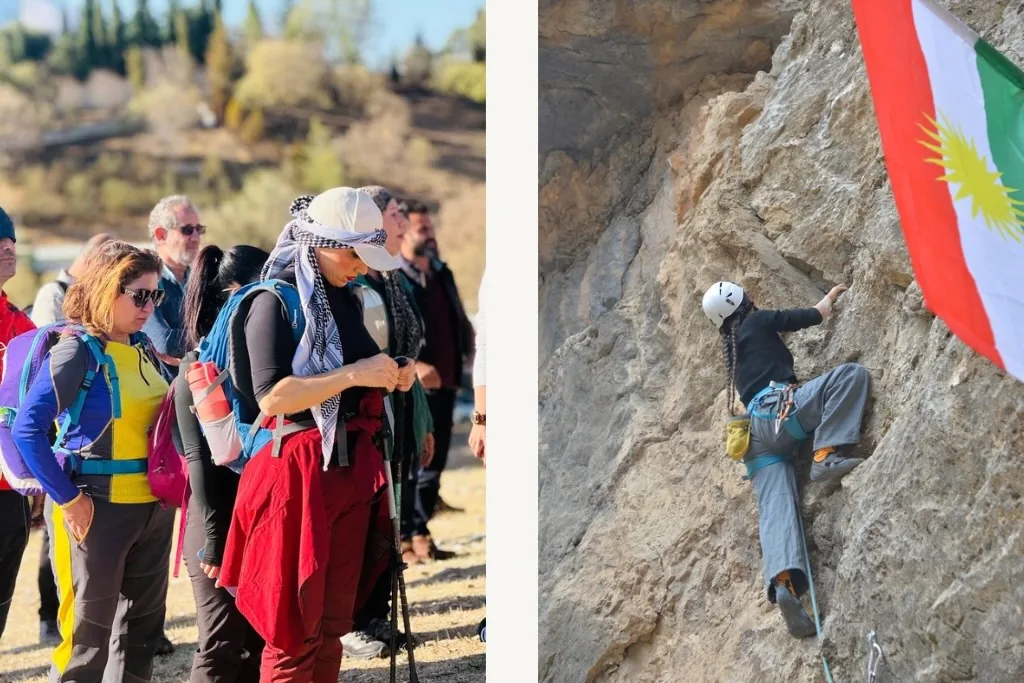
Across Kurdistan, women began organizing to defend their Kurdish identity. Whether through their involvement in the Kurdistan Workers' Party or their participation as full members of the Iraqi Kurdish armed forces, the peshmergas, women have taken on central roles in these struggles (as depicted in Girls of the Sun, a 2018 film by Eva Husson). These same beliefs have also shaped sports and outdoor recreation, turning them into spaces for collective action. When an orienteering race is organized, women-only groups form naturally. Kurdish women regularly choose the same approach for their mountain outings.
The pace and the relationships within these groups differ from those on a typical mixed-gender trip. Maybe everyone slows down because one woman has her period. Maybe they stop because the oldest member of the group suggests taking a break for a snack. Small moments like these reflect a broader sense of solidarity among the women. When Maroua, one of the participants, jokes, "Mélia, you've got a hole in your pants," nobody turns it into a sexual comment. That freedom to joke without worrying about how it might be interpreted gives the women more room to speak and move comfortably. They can even stop to pee without having to wander far from the group, laughing together as they go. Their stories may receive less attention and unfold more quietly, but these Kurdish women are no less powerful for it. They offer another way of understanding what freedom can look like.
Beyond this solidarity among women, the federation itself promotes a collective and inclusive approach to the outdoors. It regularly organizes and pays for bus transportation so that people facing financial hardship can take part. Whether it's an orienteering race or another mountain activity, the organization and its coordinators emphasize collective problem-solving, cooperation, and mutual support. In Kurdistan, heading into the mountains becomes a reason to come together. Setting out as a group, sharing plenty of tea, fighting for what matters, dancing, singing. And heading home after dark with hearts full of freedom.