

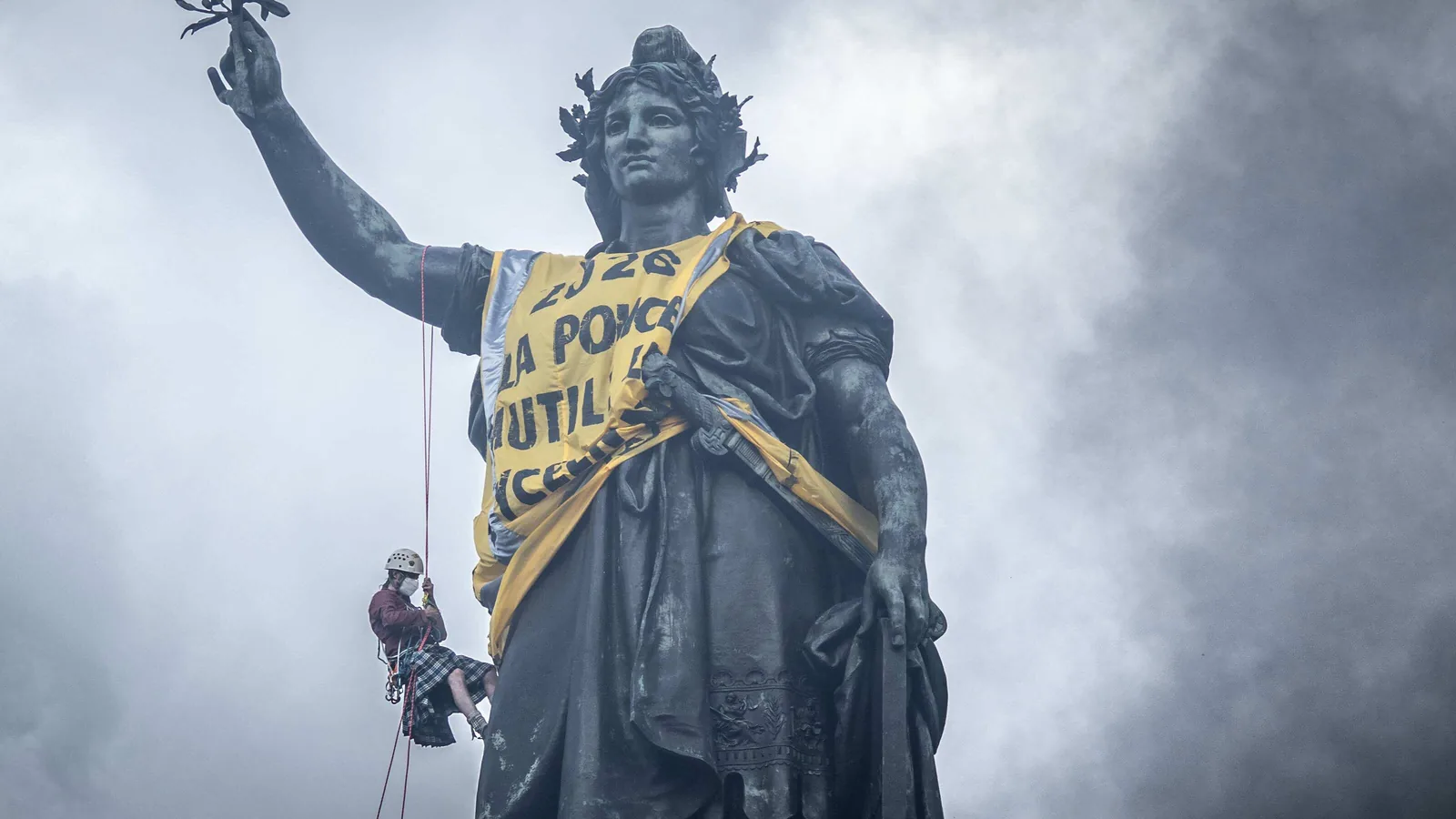
“Hang on a second. Let’s enjoy the moment.” The vest is in place on Marianne, and Camille is already getting ready to rappel, or descend on a rope. Api, his climbing partner, tells him to wait: The view is worth a pause. “It’s just a moment, but we don’t want to take those 10 seconds,” Camille recalls. Below them, Place de la République roars with crowds and chants. There’s probably a welcoming committee in uniform, too. “We’re not safe until we’ve left this square,” Api says. The two activists with Extinction Rebellion (XR), who spoke with us under the pseudonyms Api and Camille, didn’t choose Marianne just to add another climb to their list. For five years, their team has been dressing the bronze statue to draw attention to the demands of social movements. Climbing has become a political megaphone.
The People’s Route
It all started on July 2, 2021, when an XXL yellow vest appeared on the statue’s torso. That day, Extinction Rebellion and Earth Uprisings (a collective founded in 2021 to protect water, land, and all living things—Ed.) were holding “Great Peril Express,” a week of actions targeting the concrete industry and Lafarge cement plants. To mark the occasion, the activists revived an old project: The pattern and vest were ready, prepared during the Yellow Vest movement, but the vest had never been used. They saw their chance. “We said, ‘OK, you’ve already got everything planned. Let’s grab all the gear and go,’” Api says. Since then, the collective says it has climbed the monument 18 times. They know the route inside and out now, and they’ve even given it a difficulty grade, just like a climb on rock. “Basically, it’s 5.10a max, somewhere around there,” estimates Camille, who has been climbing for four years. It’s a classic climber’s instinct, but it also serves a practical purpose. “When we bring someone up there for the first time, they need some idea of what to expect.”
“These days, I climb more for activism than anything else. My motivation and my relationship with rock climbing are nothing like they used to be.”
Api, an Extinction Rebellion member
These aren’t solo feats. Every operation depends on a busy crew on the ground. “To put up a vest like that, we need at least 12 to 15 people. Two or three will climb high up, but we’re definitely not doing this on our own,” Api stresses. Sewing, communications, crowd management, legal support: No one goes it alone. Within XR, the climbers are actually “more of an informal group than a formally organized one,” Camille explains.
The two men came to the climbing team by different paths. Api has been rock climbing for 30 years. After a bad injury and a long rough patch, politics got him moving again. “These days, I climb more for activism than anything else. My motivation and my relationship with rock climbing are nothing like they used to be.” Camille, meanwhile, discovered indoor climbing and bouldering—short climbs without ropes—after finishing school and moving to Paris, just as he was getting involved in activism.
This article is free to read.
That’s possible thanks to donations from our readers.
Without their support, it wouldn’t exist.
If you can, please support Vertige Media.
Still, they’re careful not to confuse the method with the goal. “It’s not that we chose climbing as a way to be activists. Activism came first, and then climbing became a practical tool to get things done,” Api explains. Climbing itself isn’t the message. “Most of the time, if we can take the stairs, we’ll take the stairs,” he adds.
Ready-to-Wear Politics
Ukraine, immigration legislation, victims of Agent Orange in Vietnam, Palestine, or high school protests: Marianne’s wardrobe reflects the causes of the day. The outfits amplify what the crowd below is chanting, and the causes go well beyond environmentalism. Other collectives even place orders. “These actions don’t always start with Extinction Rebellion,” Api notes. “When people come to us, I can’t remember us ever turning a collective down.”
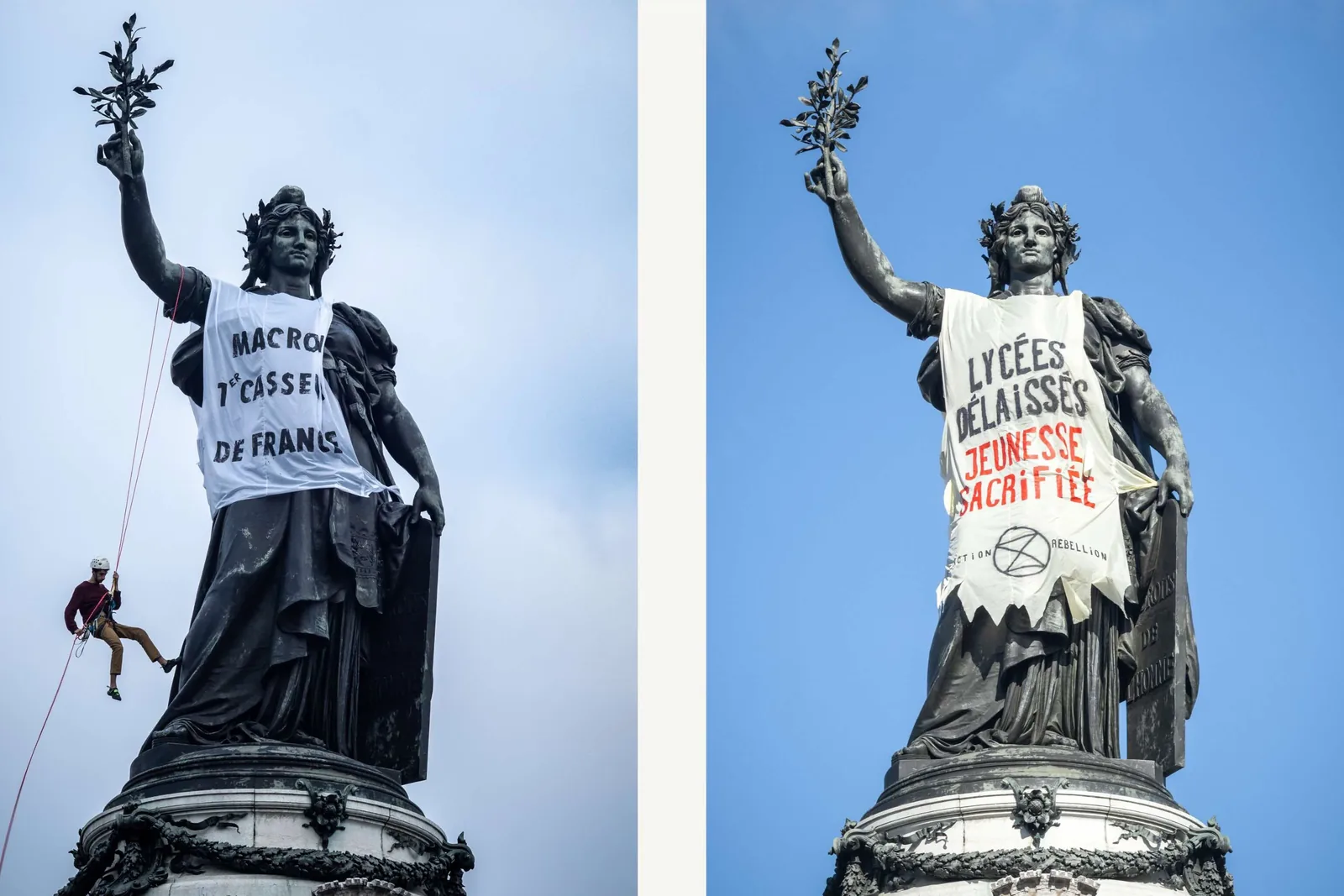
A focal point for Paris protest marches, Marianne stands for the authorities people want to hold accountable. As Camille puts it, “these symbols aren’t here just to decorate the city. They tell a story, and it’s precisely because they tell that story that we climb them.” The visual impact helps, too. “At XR, we rely almost entirely on media coverage of our actions,” Camille says openly. Taut ropes, neon helmets, climbers hanging in the air: Cameras love it. But how much attention a climb gets still depends on the protest on the ground, Api cautions. “It’s really an action that works alongside a movement.”
Once they’re back down, the activists keep track of how long the fabric stays up. According to Api, a tunic calling for peace in Ukraine stayed up for three weeks, while others in Palestinian colors were taken down in less than an hour. He thinks some of that comes down to chance, including whether an aerial lift is available to remove the fabric.
Neither climber is troubled by potential criticism that the group is taking over public space or threatening a historic monument. On the first point, Api rejects the idea that they’re hijacking anything. “We’re not hijacking protests.” As he sees it, the group is only amplifying anger that’s already there. “There’s already a crowd getting a message across.” On the second point, Camille dismisses the idea that they’re damaging anything. “All we do is put a vest on it.” Still, the entire Monument to the Republic has been listed as a protected historic monument since January 2021. The activists deny causing any damage, but whether these installations are legal is a separate question from whether they damage the monument.
The Hard Part: Police Custody
The team has the climbing down, but the mood at the base has turned much less friendly. Api remembers fairly relaxed bike cops in the early days. “We told them we were with Extinction Rebellion. They said, ‘Oh, OK, no problem.’ And they left.” Since then, the reception has become more tense, especially around “any messages supporting migrants and Palestine.” June 14, 2025, marked a turning point. During a rally in solidarity with Palestine, seven activists draped a “Free Gaza” tunic over Marianne. Api was part of the climbing team. Below, a large police presence surrounded the pedestal and pushed the crowd back. The climbers waited at the top. “There were seven of us up there at that point. We weren’t too eager to come down. We were wondering what was going to happen, especially since the crowd […] seemed ready to support us.”
“People are getting hurt […] and stepping back because they can’t take it anymore.”
Api, an Extinction Rebellion member
Police eventually climbed up to remove the activists and bring them down, using a lift as part of the operation. “They grabbed me while I was climbing,” says Api, who alleges that police used violence and fired tear gas during the operation. In an interview with Politis, another participant said she had been handcuffed, strapped in, and then pushed off the statue during her removal, striking a ledge and injuring her tailbone. After about 48 hours in police custody, the seven activists were brought before judicial officials and placed under court supervision: They were barred from protesting, entering Place de la République, or communicating with their co-defendants. At the August 19 hearing, prosecutors asked the court to acquit them of endangering others but sought convictions for resisting police against three defendants accused of violent actions toward officers—allegations the defense disputed. On September 10, 2025, all seven were acquitted. The court ruled the arrests unlawful, finding insufficient evidence to treat the activists as having been caught in the act of an offense.
For Api, the episode exposed “a huge gap between the law and the justice system on one side, and police repression on the other.” That shift has changed what their actions demand of them. “Above all, you have to be ready to spend your weekend in a cell.” Knowing how to tie a figure-eight, a standard climbing knot, is no longer enough. They also have to be ready for police custody and court. Now the team weighs every action before pulling out the gear. “Are we risking a crackdown that’s too severe for what we think we can achieve?” Camille asks.
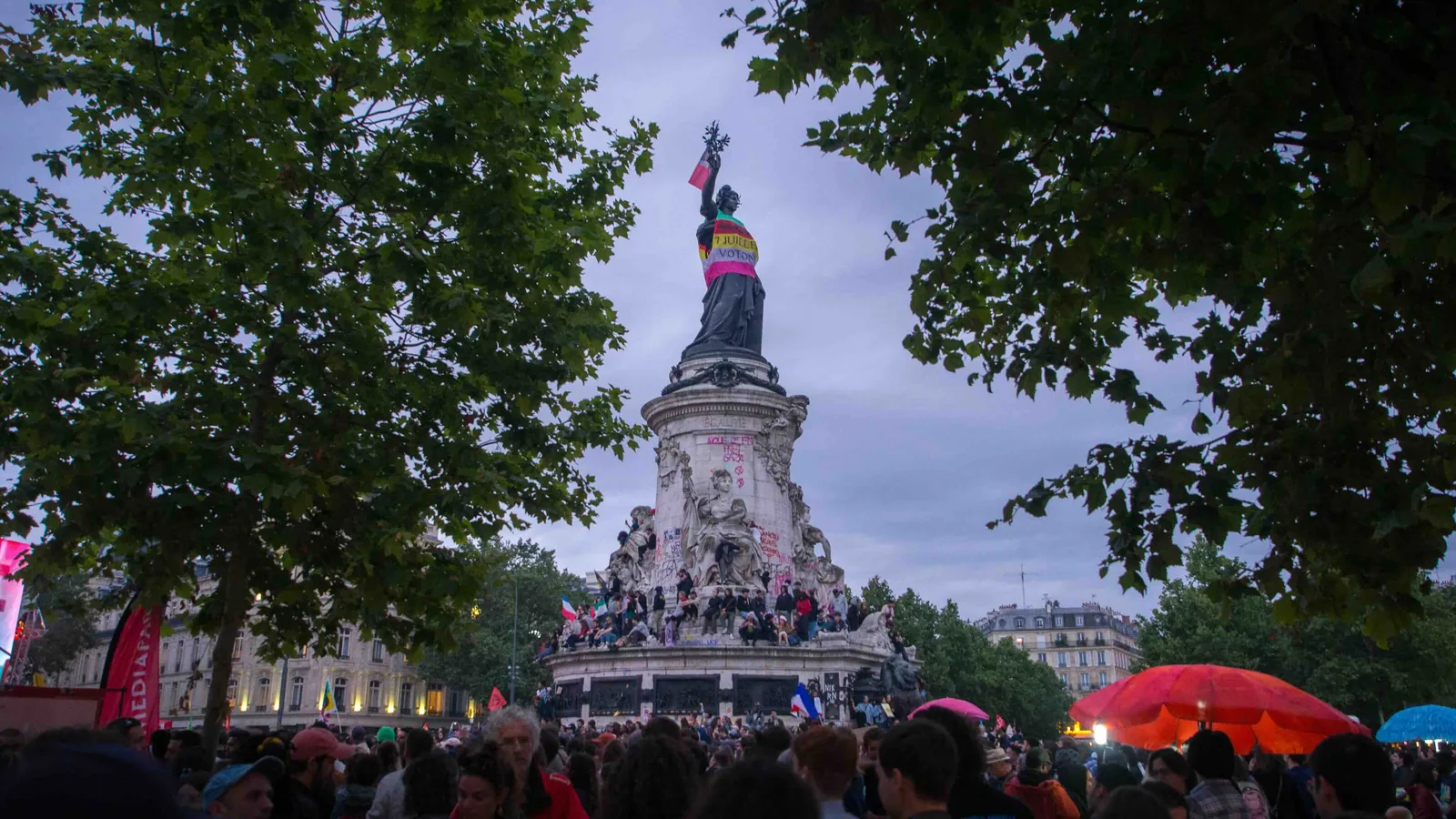
When they’re on the statue, police orders shouted from below make it clear this is no ordinary day of rock climbing. “You don’t usually have someone yelling at you over a microphone while you’re climbing,” Camille says. Api still remembers how happy he felt one May Day, watching passersby look up at their banner and smile. But that satisfaction no longer makes the anxiety go away. “Police violence is a huge issue,” Api emphasizes. “There’s often tension among us, too, because this pressure is hurting us.” Faced with physical blows and legal proceedings, the collective is split between those who grit their teeth and keep going and those who step back. “People are getting hurt […] and stepping back because they can’t take it anymore.”
Camille knows the feeling. His early climbs on Marianne brought his convictions and his passion together—“I was right where I was supposed to be”—but these days, he prefers to belay from the ground, controlling the rope to catch a climber’s fall, and train the next generation. “That doesn’t mean I’ll never do it again, but I’m definitely giving it more thought these days,” he continues. “I’m much more reluctant than I used to be.” Api is feeling the strain, too. “I think I’m starting to feel worn out.” Neither is giving up, but both are adjusting their roles on the climbing team.
Before we wrap up the interview, though, both men want to emphasize what keeps them going: the bonds they’ve built through these actions. “We build strong bonds with each other in those moments,” Api says, thinking of the hours of preparation as well as the nights in a cell. Camille sees it as the “team spirit” of climbing partners: the trust and care they show one another, including those who no longer climb. It’s a way, he says, to do more than protest—to “live out the society we dream of by taking care of each other.”