
“Yosemite Could Disappear If We Keep Going Like This”: The Commercialization and Ecological Degradation of an American Jewel

In the United States, revelations have shown that the Trump administration was considering a land exchange that would allow a private developer to build a road to a resort on the edge of Yosemite. For Michael W. Childers, a historian and the author of The Mountains Are Calling: Tourists and the Unmaking of Yosemite National Park, the project is part of a much longer history of the park’s commercialization and gradual privatization — and could accelerate its ecological degradation.

Vertige Media: A few weeks ago, an investigation by the American outlet NOTUS — now The Washington Sun — revealed that a private development could gain road access to Yosemite. What exactly do we know?
Michael W. Childers: A Las Vegas developer wants to build a resort just west of the park. To reach it, the company wants to build a private road across land belonging to Yosemite. The project is based on a land exchange: the developer would transfer one parcel to the federal government and receive, in return, a strip of land that would connect the resort to the park’s road network.
The issue goes beyond this particular land deal. It would allow a private development to use Yosemite as a commercial asset and continue the construction of ever-larger resorts around and inside national parks.
Vertige Media: What does this proposal tell us about current national park policy?
Michael W. Childers: It comes at a time when the Trump administration is cutting funding for the National Park Service — the federal agency responsible for managing America’s national parks — while seeking to expand the role of private interests in their management.
“Local communities need this activity, but tourism growth can degrade the place that makes it possible.”
The debate is about the very purpose of these places: should they generate revenue, or should they be preserved so that Americans can enjoy them? Federal administrations can directly change the Park Service’s budgets, staffing levels and priorities. For the past twenty-five years, we have seen the pendulum swing between conservation and the withdrawal of the state, making it harder to maintain the parks and protect their wildlife.
Vertige Media: Is the drive to make national parks profitable based on a genuine economic reality?
Michael W. Childers: Yes. The communities surrounding Yosemite — Mariposa, Lee Vining and Oakhurst — depend heavily on visitors. National parks generate several hundred million dollars for the American economy through lodging, campgrounds, restaurants, transportation and other forms of tourism spending. That is what makes the debate so difficult. Local communities need this activity, but tourism growth can degrade the place that makes it possible.
Vertige Media: When did private interests first begin trying to profit from Yosemite?
Michael W. Childers: From the very beginning. In 1859, James Hutchings settled in the valley, a few years after the military conquest of the territory and the forced displacement of Indigenous people. He built one of the first lodging facilities, welcomed tourists and tried to claim around 160 acres — approximately 65 hectares. The Supreme Court rejected his claim, but his business already established the central problem: making a private profit from a place that many people regarded as a shared public resource.

In 1864, the valley and Mariposa Grove — a grove of giant sequoias — were transferred to California in order to prevent this kind of private appropriation. The state, however, invested very little. In 1890, a national park was created around Yosemite without including the valley itself, which returned to federal control at the beginning of the twentieth century. By then, private businesses had already had time to establish themselves.
In the 1920s, the National Park Service granted all the park’s concessions to a single company, the Curry Company, which gradually built an entire commercial system: lodging, campgrounds, restaurants, gas stations and other services. This made things easier for the administration, but it also gave one company considerable power over the visitor experience.
Vertige Media: What did the Yosemite Grant signed by Lincoln in 1864 actually protect?
Michael W. Childers: First, we have to remember that the United States was in the middle of a civil war. And it was a terrible one. San Francisco was growing rich through the Gold Rush, and a local elite wanted to protect Yosemite, just as people had wanted to preserve Niagara Falls. These figures also provided significant financial support for the war effort, and California was important to Abraham Lincoln electorally. The Yosemite Grant was therefore both a conservation decision and a political decision.
“Commercialization influences the way a place is imagined and experienced.”
The Yosemite Grant was the text through which Lincoln transferred control of Yosemite Valley and Mariposa Grove to California, on the condition that these areas be preserved for public use, resort and recreation. It did not transfer full ownership. The idea of a “resort,” however, could encourage use by wealthier visitors.
Frederick Law Olmsted, who was asked to think about how the site should be managed, defended a more democratic vision. He argued that contemplating nature was essential for everyone, particularly after the Civil War. Yosemite was therefore supposed to be accessible to the widest possible public. Because California failed to provide the necessary resources, pressure for federal protection increased.
Yellowstone — the first federal national park in the United States, established in 1872 in the Rocky Mountains — followed and provided a model for this new approach to conservation.
Vertige Media: In connection with this therapeutic question, you write in your book about the revealing story of Galen Clark. Who was he?
Michael W. Childers: Galen Clark was a former farmer who had experienced a series of failures. After his wife died and he moved to California, he became ill with tuberculosis and believed that the mountain air might save him. He settled near Yosemite and came across Mariposa Grove, a collection of giant sequoias.
He obviously did not “discover” it: Indigenous peoples had known the grove for thousands of years. But he was the first white man to describe it extensively and draw public attention to it. Clark established a rudimentary lodging facility, guided visitors and later became the guardian of the valley and the sequoias when the site was transferred to California.
He had very few resources and had to protect, administer and promote the place at the same time. His story captures one of the tensions running through Yosemite’s entire history: he sincerely wanted to protect the trees, but he also helped make them accessible to an ever-growing number of visitors.
Vertige Media: How did this tension manifest itself during the twentieth century?
Michael W. Childers: Badger Pass, a ski area located inside the park, is a revealing example. In the 1920s, the person in charge of the concession discovered alpine skiing in Chamonix and wanted to bring it to the Sierra Nevada. He even imagined that the Winter Olympics could be held in Yosemite. That project failed, but a ski area was built in the 1930s.
After the Second World War, millions of Americans began travelling. The Park Service responded by building more roads, lodging and facilities. But the more the park was developed, the more visitors it attracted. In the 1970s, the Music Corporation of America — an American company active in film and television that later became Universal Studios — bought the concession company and tried to apply an entertainment-industry logic to Yosemite. It became the number-one enemy of environmentalists, who feared that the park would be turned into a theme park.
Commercialization therefore influences the way a place is imagined and experienced.

“Climbers remain associated with an alternative culture, but they also participate in the outdoor recreation economy. They are both advocates of freer access and actors in the commercialization of the park.”
Vertige Media: Have climbers escaped this process of commercialization?
Michael W. Childers: Not entirely. The debates over pitons, permanent protection and clean climbing raise the same question as the debates over development: how far can we intervene in a natural environment?
But climbing has also become a mass sport and a commercial activity. Yosemite created a climbing school. Royal Robbins and Yvon Chouinard developed companies such as Royal Robbins Clothing, Black Diamond and Patagonia. Climbing gyms later made the activity even more popular.
Climbers remain associated with an alternative culture, but they also participate in the outdoor recreation economy. They are both advocates of freer access and actors in the commercialization of the park.
Vertige Media: Does Yosemite really resemble the wilderness shown in climbing films and photographs?
Michael W. Childers: If you zoom out a little, the valley has already become a city. As early as 1977, some people were calling it “Yosemite City.” It is roughly eight kilometres long and five kilometres wide, and it can accommodate between 5,000 and 20,000 people per night.
There are lodges, campgrounds, restaurants, a grocery store, ranger stations, a museum, a cemetery and a school. Half Dome — one of the park’s most iconic formations — once received as many as 1,200 people a day on its cables. Visitors who were not prepared died, which led the Park Service to restrict access.
Even the Nose, made famous by climbing films, has become extremely crowded. In Free Solo, you can see Alex Honnold passing people who are camped out on the wall.
Yosemite remains extraordinary, but it is not a completely untouched wilderness. It is a highly developed and extremely crowded natural space.

Vertige Media: What place does Yosemite occupy among American national parks?
Michael W. Childers: It is not necessarily the most visited park. Great Smoky Mountains National Park — located in the Appalachian Mountains between Tennessee and North Carolina — often comes first, partly because a highway runs through it. But Yosemite is among the four most visited national parks in the country.
Its strength lies above all in its iconic status. Visitors are concentrated in its valley, unlike in Yellowstone, which is much larger, and the name Yosemite has become almost synonymous with the idea of an American national park. Yosemite has a particular symbolic power.
“Experiencing a landscape alone is not the same as moving through it among hundreds of thousands of people. That is no longer the experience of nature we claim to want to preserve.”
Vertige Media: What are the main ecological consequences of this level of visitation?
Michael W. Childers: Yosemite reached a peak of five million visitors in 2016. Over the past decade, annual visitation has generally been closer to four million. This creates air pollution from cars, noise pollution, the trampling of plants and increased pressure on wildlife. Bears have become dependent on human food, and interactions with visitors have led to the deaths of many animals.
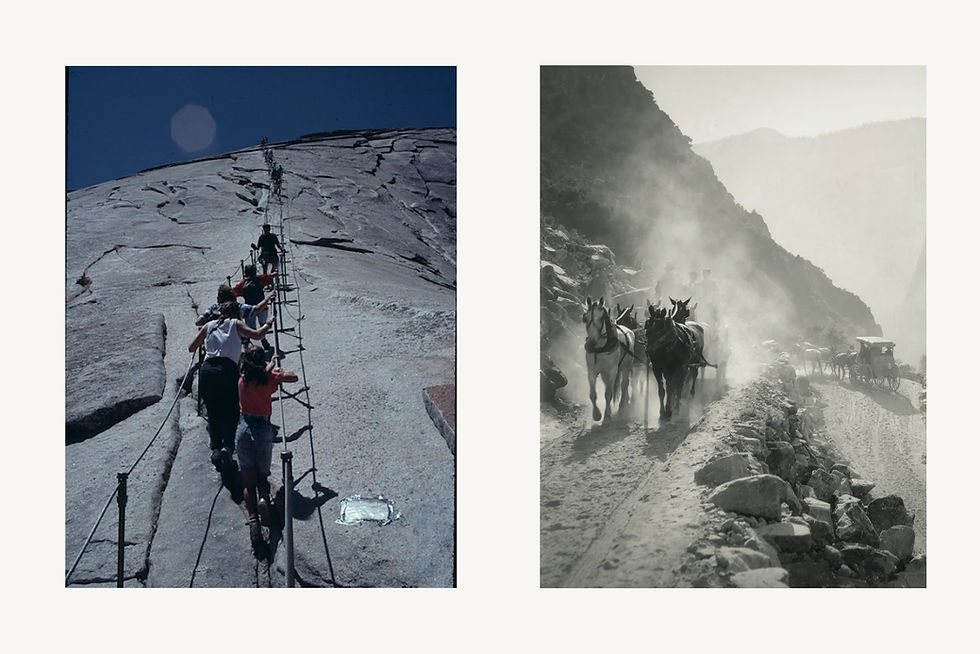
We also have to measure the impact on the experience of nature. Experiencing a landscape alone is not the same as moving through it among hundreds of thousands of people. That is no longer the experience of nature we claim to want to preserve.
Vertige Media: What should be done to protect Yosemite while keeping it accessible?
Michael W. Childers: First, the park needs more staff: rangers, people responsible for education and interpretation, and employees who can maintain the infrastructure. Yosemite was already understaffed before the Trump administration, and the staff cuts have made the situation worse.
We also need to restore a reservation system, at least during peak periods. The pandemic provided a real-life experiment. When the number of visitors declined, rangers observed a quieter valley, the return of birds and vegetation growing back. Reservations raise questions about equal access, but they are an essential tool for protecting the park.
We also need to change our own behaviour. For a century, we have said that the best way to protect Yosemite was to go there. We may have to accept that it is a place we visit once in a lifetime, and choose less famous destinations afterwards. Yosemite is one of the most iconic parks in the United States. Its fame is a strength, but it has also become its vulnerability.
Finally, we need to recognize the role of Indigenous peoples. For us, Yosemite is a destination; for them, it is their territory and their home. Including them in the management of the park is essential. These measures are urgent because if we continue as we have over the past twenty or thirty years, we may not be able to pass Yosemite on to future generations.


