

Jongwon Chon (a South Korean climber who won the overall World Cup bouldering title in 2015 and 2017—Ed.) spent much of the qualifying round with his hands in his pockets. In front of him, his younger brother, Yejun Chon, was tackling the first problems—the individual climbs in the circuit. There was no point in both brothers trying every problem: coordination moves for the younger brother, power moves for the older one. They stuck with that division of labor even when things got tense. While Yejun made attempt after attempt, Jongwon bided his time, watching his brother try to keep them both in the competition. At TBA, knowing when to stay on the ground can matter as much as knowing what to do on the wall. And that’s what makes this format so compelling to watch.
Shouts, saves at the last second, a gym going wild: on paper, none of this is new. Except TBA puts front and center what conventional broadcasts consistently leave out: the negotiations, the strategy, the swallowed pride, the blind trust. Everything that makes a session with friends great—and that elite competition struggles to capture within the Olympic format. On November 13 and 14, Climbing District’s Buttes-Chaumont gym hosted the event’s fifth Paris edition, following stops in Milan and London. With a record 217 teams registered, the event is firing on all cylinders. Sure, official partner Arc’teryx is writing checks for all that brand exposure. But a gear company’s money can’t buy a crowd’s enthusiasm. If TBA gets everyone invested, it’s because the competitive format works so well.
Death to the Solo Act
The rules would fit on a subway ticket. Two climbers make a team. In qualifying, each pair faces 20 problems of increasing difficulty. Four minutes per problem, with no scheduled rest between successful climbs. Only one climber has to finish the problem for the team to advance. If neither finishes, they’re out. It’s brutal, bare-bones, and crystal clear: even if you can’t tell a crimp from a sloper—a tiny edge from a rounded hold—you’ll know in three seconds who’s still in and who’s done. The format’s real appeal lies in the decisions it forces before anyone even touches a hold. Who goes first? Who saves their energy? Do you keep trying an approach that isn’t working, or hand it over to your partner? The decisive move no longer happens 10 feet off the ground. It happens a few seconds earlier, when the partners exchange a look on the mats.
You don’t have to understand climbing’s difficulty ratings to feel someone’s anxiety as they watch their partner attempt one last dyno—a leap between holds—with time running out
In a sport obsessed with individual achievement and worshipful of big egos, this rule changes everything. If one climber slips off, the other can make up for it. A hunch can be shared. The person on the ground isn’t just standing around: they study the moves, suggest corrections, and keep their partner calm. Listening, composure, and knowing when to step aside become competitive skills in their own right. For routesetters—the people who design the climbs—it’s a gift. Their work no longer just sorts out the strongest climbers. It creates dilemmas—and, with them, drama.
The newsletter that lifts you higher
Every Wednesday: the editorial team’s column, the best articles, and plenty of surprises to help you climb higher — in mind and in spirit.
That’s where TBA gets it right. Anyone who’s ever walked into a bouldering gym knows the endless debates at the base of a tricky problem. You rehash the last attempt, borrow someone else’s beta—their approach to the moves—and cheer on a stranger at the top of your lungs. You may face the wall alone, but climbing is a deeply social sport. TBA didn’t invent any of this. It just had the nerve to put that everyday gym banter and camaraderie in the spotlight. That doesn’t make the format forgiving. On the first problem of the pro final, each team gets exactly one attempt. The partners have to decide who takes that make-or-break shot. One mistake, and the team is out before it even reaches the next three problems. It’s cruel to athletes who sometimes never get a chance to show what they can do. But as storytelling, it’s ruthlessly effective: both climbers agree to the risk, but only one has to face the consequences on the wall.
Putting On a Show
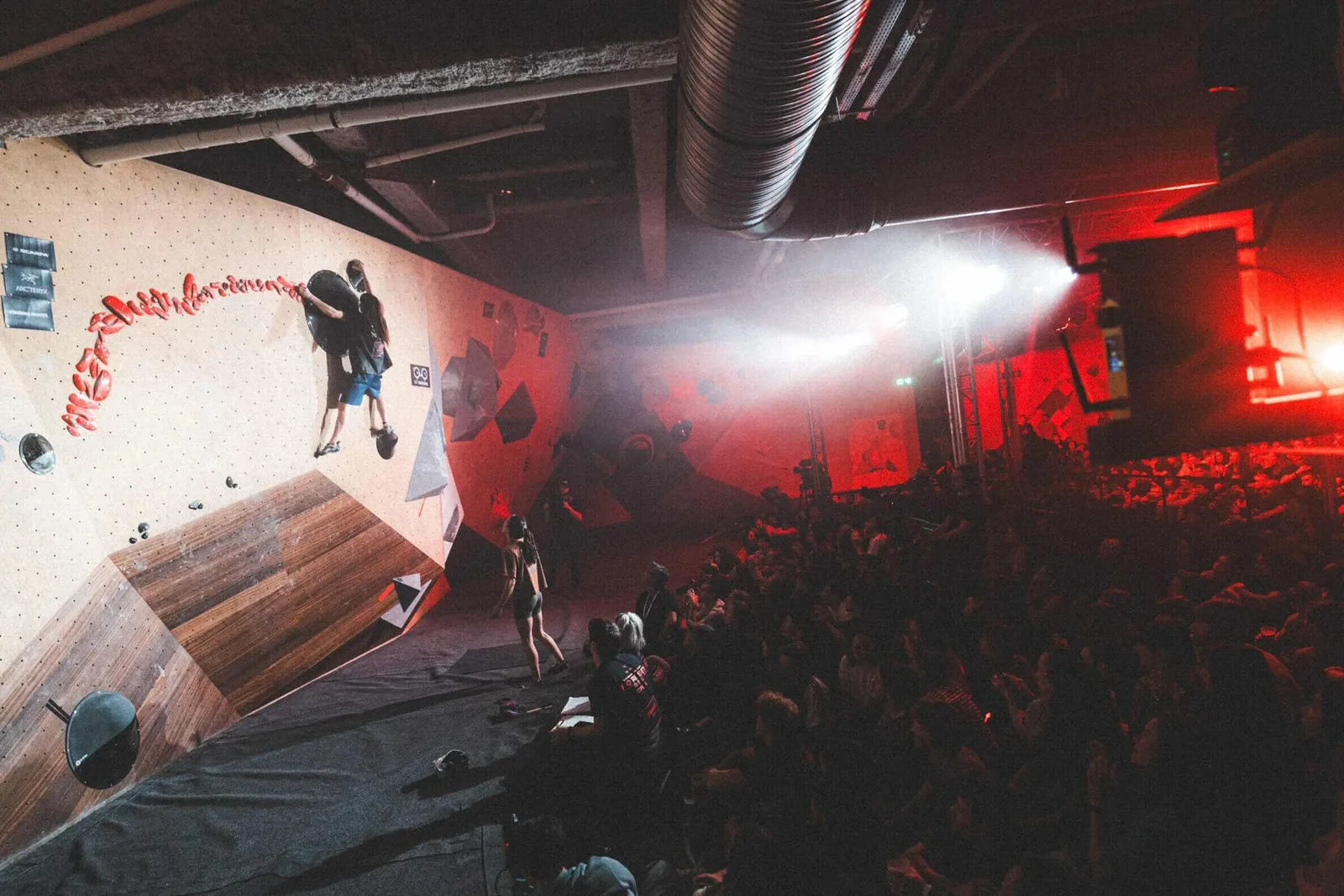
Light shows, DJ sets, fast-paced production, a crowd packed in right next to the athletes: everything is designed to get the room fired up. Purists can turn up their noses at all the flash, but making a sport easier to follow has never meant selling it out. Put the world’s best climbers on a blank white wall without giving viewers a story to follow, and you get a sleep-inducing pull-up contest. Here, the two-person team makes the stakes clear to anyone. You don’t have to understand climbing’s difficulty ratings to feel someone’s anxiety as they watch their partner attempt one last dyno with time running out. One choice, one attempt, the threat of elimination: the climbing is still just as technical, but it no longer shuts the audience out.
The event proves a bouldering gym can be more than a place to sell memberships and craft beer at the counter.
Let’s not declare a mainstream breakthrough just yet: without precise viewership numbers, no one knows who’s actually watching. But the streams on France.tv, YouTube, and Twitch, broadcasts in other gyms, and European stops make the ambition clear: reach far beyond that small Paris arena. Amateur climbers aren’t relegated to the role of extras who pay for the chance to cheer on the stars. In qualifying, everyone struggles on the same problems. Better yet, this year’s amateur finals took place in the main arena, right before the pros. Struggling with a move, then watching Zélia Avezou or Lily Abriat make it look ridiculously easy, erases the divide between your local gym crowd and the world’s best, if only for a night.
There are a few caveats, though. First, the competition itself: while the inaugural event in 2023 allowed mixed-gender teams in the amateur division, the 2026 rules no longer allowed them—a shame for a format that celebrates complementary strengths. Then there’s what happens behind the scenes. It’s hard to celebrate teamwork on the mats without noting that, just 10 days earlier, about 40 Climbing District employees had walked off the job to protest a wage freeze and skyrocketing workloads.
Still, despite that disconnect, the event proves a bouldering gym can be more than a place to sell memberships and craft beer at the counter. It can host an event with its own traditions, characters, and shared history—the kind you circle on your calendar. Jongwon Chon eventually put on his climbing shoes. In the final, the South Korean locked onto the last hold with one second left before the buzzer. He and his brother Yejun Chon ultimately beat Camille Claude and Corentin Laporte to win the event. The final ended in a tie, so the Koreans’ higher qualifying placement gave them the win. A victory that came down as much to the moves on the wall as to those minutes when one brother had agreed to stay on the ground.