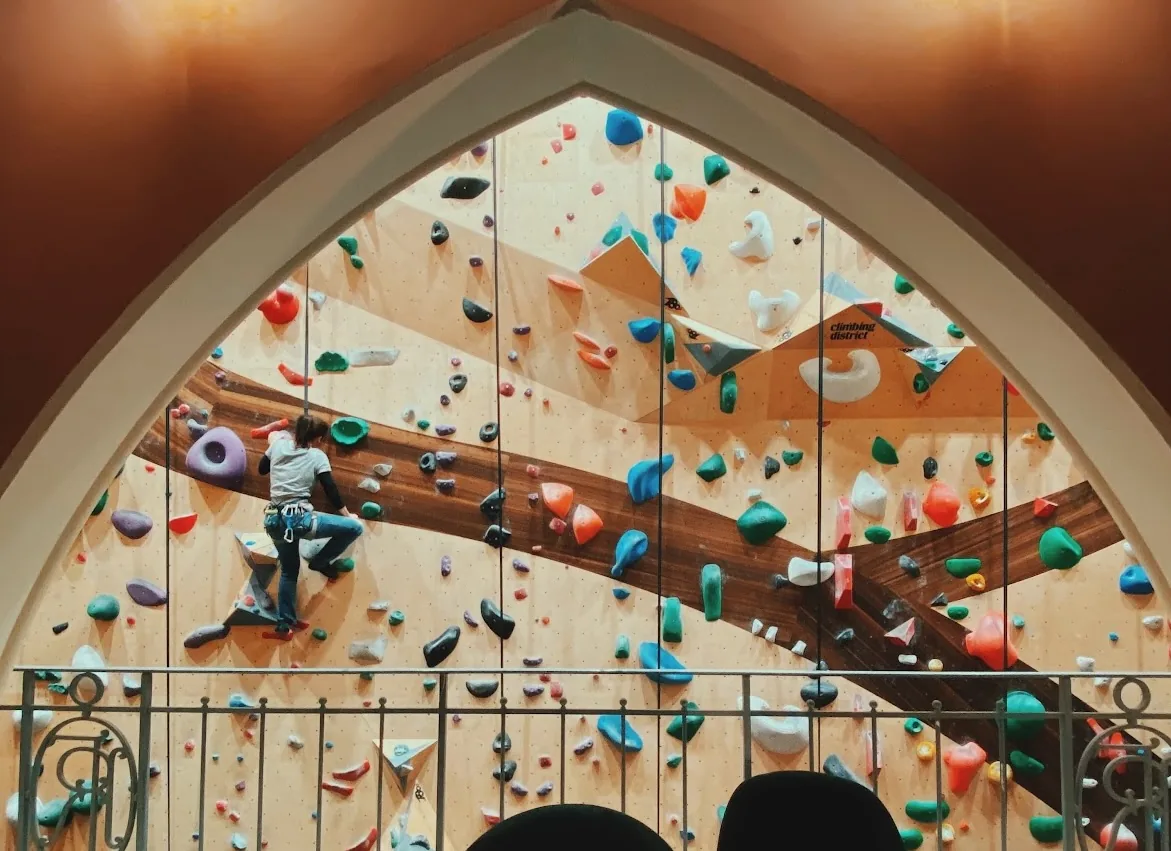


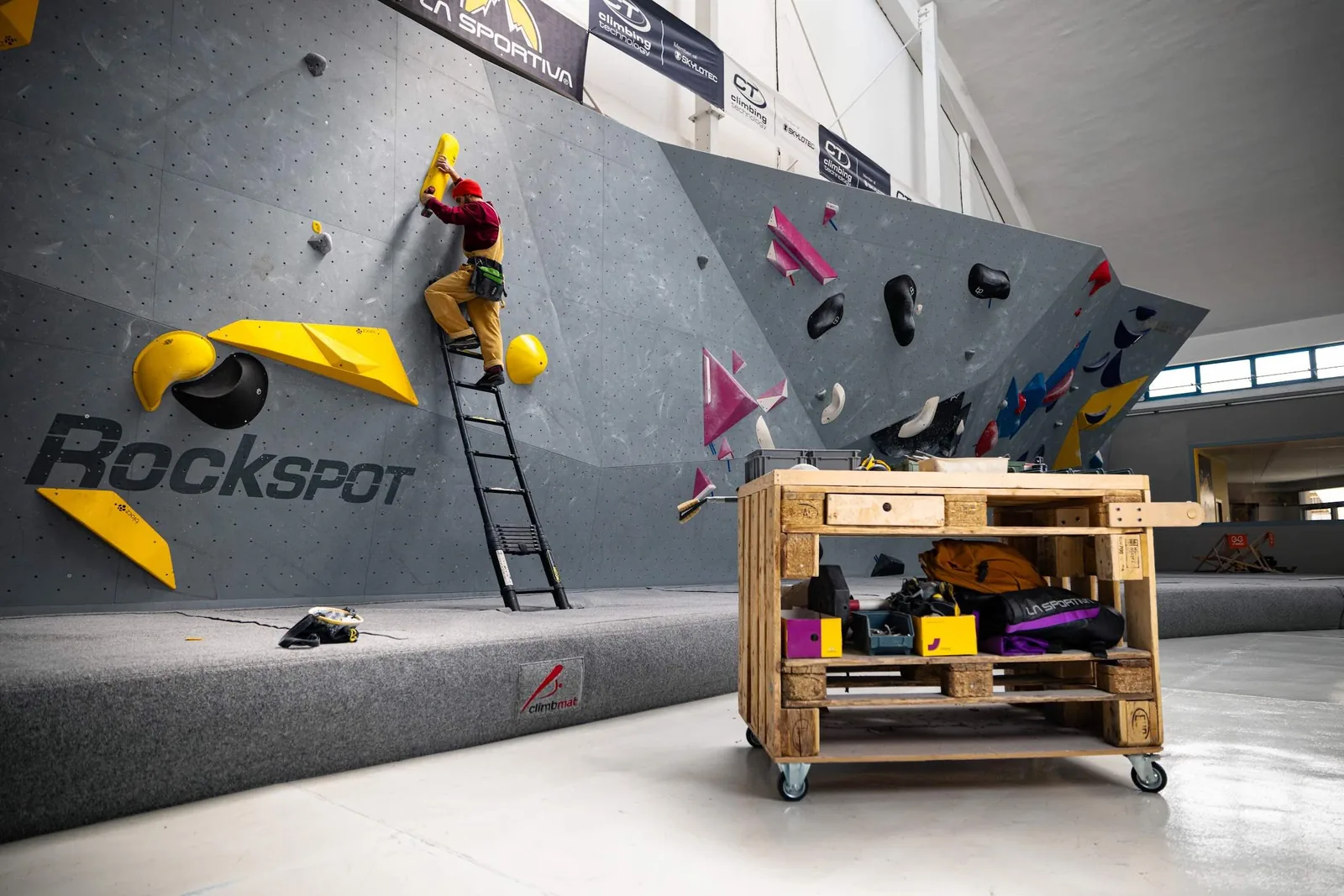
We usually talk about routesetters in terms of creativity: their style, their approach, and their ability to come up with new movements. We rarely talk about what the job does to their bodies. A typical day involves a lot more than climbing. Setters have to strip old holds, carry boxes, move heavy volumes (the large geometric features attached to climbing walls), climb up and down ladders, drill, unscrew, and test their creations. Often, they have to do it all over again. That combination puts demands on muscles and joints that go well beyond climbing itself. It also creates a very practical footwear problem. Setters need shoes they can wear for hours on their feet, move comfortably across gym mats in, and use on ladders. But those same shoes also need to perform when it's time to test a difficult move on a volume. That's the gap La Sportiva hopes to fill with the TX Setter. The idea is to combine some of the performance features of climbing shoes with the support of approach shoes, the footwear climbers typically wear on the hike to the crag. Given the conditions routesetters work in, the concept makes a lot of sense.
What Routesetting Does to the Body
In 2020, Quebec physical therapist Evelyne Lajoie conducted a survey examining injuries among routesetters. The findings were striking: 78.5% of respondents reported a work-related injury, while 71% reported chronic health problems. Nearly a third had already been forced to take time off work. The survey relied on self-reported data and wasn't intended to represent the entire profession. Still, it highlighted some serious concerns. Beyond falls and impacts, setters reported persistent pain in their backs, shoulders, elbows, and wrists. Repetitive movements, awkward working positions, and constant use of power drills all take a toll. What makes routesetting particularly demanding is that it combines intense manual labor with repeated athletic effort. In the same survey, respondents said they spent nearly 40% of their working hours testing their own climbs. Known as forerunning, this process involves climbing newly set routes or boulder problems to check and fine-tune their difficulty. Setters often repeat the same movement over and over until they get it right. The work doesn't end when the last hold is screwed into place.
"When we started working on TX Setter, we started from a very simple idea: route setters deserve a shoe designed specifically around what they do every day"
Francesco Delladio
Concerns about these working conditions aren't new. Back in 2014, the Association of British Climbing Walls was already recommending that setters warm up, vary their working positions, and limit heavy lifting. More recently, the issue has gained momentum. In May 2025, the German Alpine Club published safety guidelines recommending lifting systems for large volumes and appropriate footwear for working on ladders. In France, the French climbing federation (FFME) has identified falling objects, flying debris, and noise from power drills as workplace hazards. Meanwhile, in 2026, Quebec's climbing and mountaineering federation published an entire guide to routesetting safety, including a section on musculoskeletal disorders. All these guidelines point to the same conclusion: behind the creativity we see on climbing walls is a physically demanding job that requires appropriate equipment and working conditions. Of course, a pair of shoes won't solve heavy-lifting hazards or prevent repetitive strain injuries. But it can address one very specific challenge setters face every day: constantly switching between working on the ground or on ladders and testing moves on the wall.
Concerns about these working conditions aren't new. Back in 2014, the Association of British Climbing Walls was already recommending that setters warm up, vary their working positions, and limit heavy lifting. More recently, the issue has gained momentum. In May 2025, the German Alpine Club published safety guidelines recommending lifting systems for large volumes and appropriate footwear for working on ladders. In France, the French climbing federation (FFME) has identified falling objects, flying debris, and noise from power drills as workplace hazards. Meanwhile, in 2026, Quebec's climbing and mountaineering federation published an entire guide to routesetting safety, including a section on musculoskeletal disorders. All these guidelines point to the same conclusion: behind the creativity we see on climbing walls is a physically demanding job that requires appropriate equipment and working conditions. Of course, a pair of shoes won't solve heavy-lifting hazards or prevent repetitive strain injuries. But it can address one very specific challenge setters face every day: constantly switching between working on the ground or on ladders and testing moves on the wall.
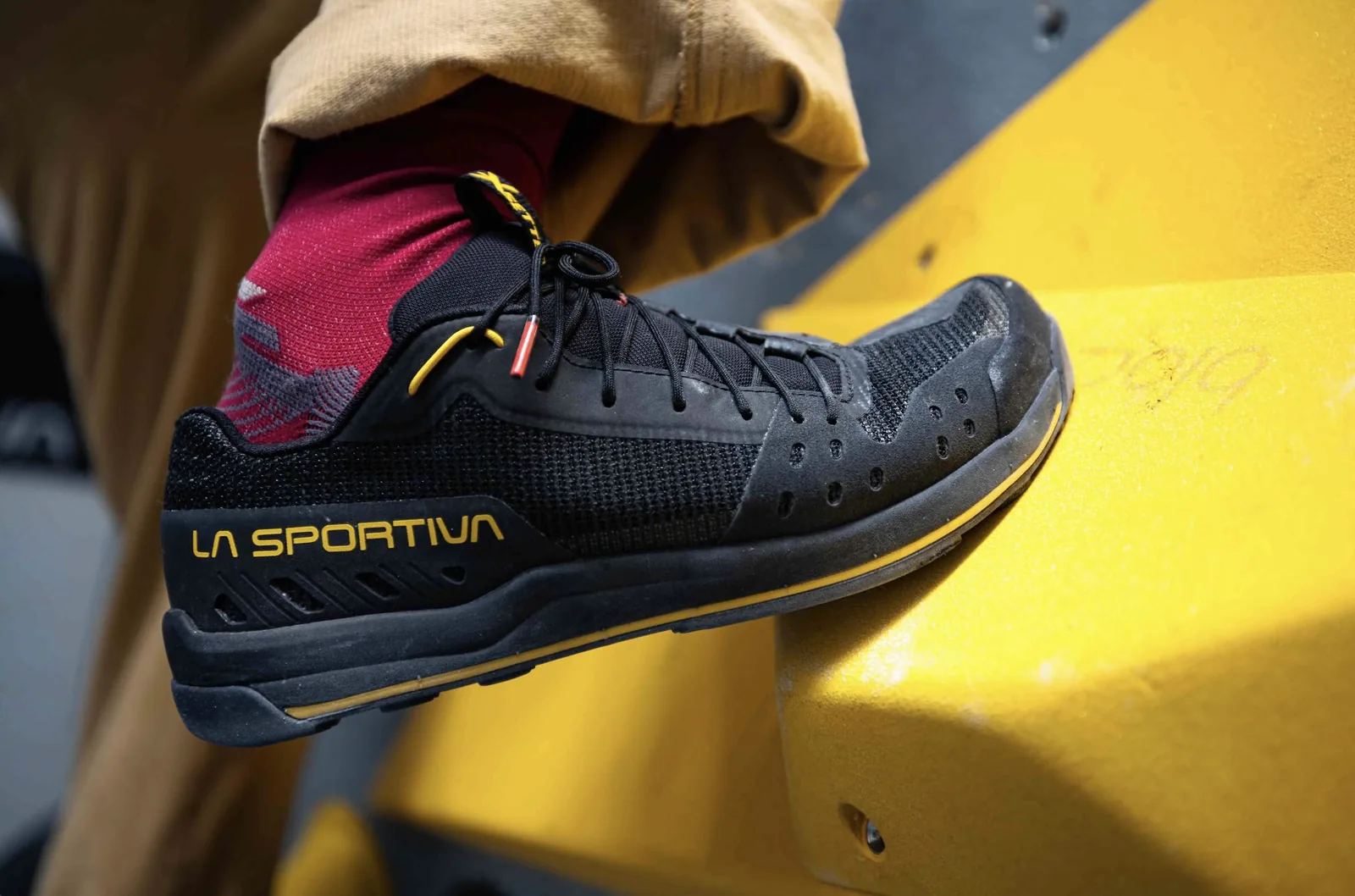
That's where La Sportiva saw an opportunity. "When we started working on TX Setter, we started from a very simple idea: route setters deserve a shoe designed specifically around what they do every day," Francesco Delladio, the brand's product manager, told Vertige Media. As climbing gyms have evolved, with taller walls, enormous volumes, and increasingly dynamic movement, so have the demands placed on setters. La Sportiva worked with professional routesetters and its own athletes to develop the shoe. "We wanted to develop something with route setters, not just for route setters," Delladio emphasized. The goal was to move beyond the usual makeshift footwear solutions and create a shoe that could handle the full range of tasks involved in the job.
One Sole for Setting, Climbing, and Starting Over
The challenge was bringing together two requirements that don't naturally go hand in hand. Routesetters need shoes comfortable enough for hours of walking, standing, and working on ladders, but precise enough to test climbing moves without constantly switching footwear. To strike that balance, La Sportiva developed a dedicated shape for the TX Setter. It gives the foot more room than a traditional climbing shoe while maintaining a relatively precise forefoot for standing on holds. The rest of the construction borrows from approach shoes: a breathable, abrasion-resistant mesh upper paired with a compressed EVA midsole for cushioning.
"For us, they are not simply creating routes and boulders. They are shaping the way we climb indoors,"
Francesco Delladio
But the most interesting design decisions are underneath the shoe. The outsole, in particular, became a major focus of development. "We really wanted to design every part of it around the setter's job and around modern indoor climbing," Delladio explained. Up front, a large section of smooth, treadless rubber extends much farther back than it would on a conventional approach shoe. Why? "Today, setters spend a lot of time working on large volumes, where you're not always standing on a defined foothold. Very often you're smearing, pushing against a surface and trying to generate as much friction as possible," he said. On dual-texture volumes, where a tiny patch of usable friction can make or break a move, having a broad, smooth rubber surface makes a real difference compared with hiking-style tread. For the rubber itself, La Sportiva chose Vibram's MegaGrip Elite, a compound borrowed from trail running. The brand is betting on the combination of that rubber and the sole's geometry.
But the most interesting design decisions are underneath the shoe. The outsole, in particular, became a major focus of development. "We really wanted to design every part of it around the setter's job and around modern indoor climbing," Delladio explained. Up front, a large section of smooth, treadless rubber extends much farther back than it would on a conventional approach shoe. Why? "Today, setters spend a lot of time working on large volumes, where you're not always standing on a defined foothold. Very often you're smearing, pushing against a surface and trying to generate as much friction as possible," he said. On dual-texture volumes, where a tiny patch of usable friction can make or break a move, having a broad, smooth rubber surface makes a real difference compared with hiking-style tread. For the rubber itself, La Sportiva chose Vibram's MegaGrip Elite, a compound borrowed from trail running. The brand is betting on the combination of that rubber and the sole's geometry.
Move toward the middle of the sole, and the design shifts from climbing performance to ladder work. The tread features lugs of varying heights intended to help secure the foot on ladder rungs, a feature inspired by safety footwear. A smooth rubber section on the inside of the heel provides additional grip during sideways foot placements and mantles, moves where climbers push themselves up and over a hold or ledge. Other details also reflect the demands of testing climbs in a gym. The laces are positioned off-center to keep them from coming undone during toe hooks, when a climber uses the top of the foot to pull against a hold. A substantial rubber toe cap protects the front of the shoe, while the heel gets similar reinforcement. Durability was another priority. The TX Setter uses La Sportiva's patented resoling platform, which places a high-density layer between the outsole and midsole. This allows the worn rubber to be replaced without compromising the shoe's cushioning.
Still, make no mistake: this isn't a climbing shoe disguised as a sneaker. According to La Sportiva's specifications, the TX Setter scores 4 out of 5 for stiffness and just 1 out of 5 for sensitivity. In practical terms, that means a firm sole that supports the foot on ladder rungs but doesn't provide much feel for the holds beneath your toes. It's also meant to fit like a regular approach shoe, with room for socks and all-day wear. The shoe weighs 280 grams (9.9 ounces) in a European size 42 and is made without animal-derived materials.
None of this means routesetters can leave their climbing shoes at home. For the hardest moves, they'll still need them. But by focusing on all the work that happens before and between those moments of climbing, La Sportiva is acknowledging something important: routesetting is a profession with its own specific demands, even if the people doing it have long relied on equipment designed for other purposes. "For us, they are not simply creating routes and boulders. They are shaping the way we climb indoors," Delladio said. Making sure they have the right equipment to do that work matters, too.