
Vertige Media: When did you first look at a climbing wall as something to study?
Ivan Le Pays: It might sound strange, but this whole line of thinking started indoors. I’d just finished a boulder problem at Climbing District’s Jaurès location in Paris. I took a photo of the problem, then traced the movement from one hold to the next with my finger on the screen. It made this odd line, like a Chinese character. Something clicked: I was seeing a kind of calligraphy created by movement.
Vertige Media: You used to be a tattoo artist, and you’d already explored this kind of movement in nature. How did you make the connection?
Ivan Le Pays: I grew up in the city, and for a long time I was afraid of nature. When I traveled from city to city tattooing, all I drew were cities: grids, straight lines, very rigid. I wanted to get out of that grid. I started bringing the body into direct contact with the landscape. In Alaska, I organized tattoo sessions out in nature, in the cold, the snow, and the wind. I wanted people to feel their bodies, sometimes through pain, and leave with a trace of the place on their skin. Even then, I was looking for ways to simplify a movement, a shape. So before long, the gym’s plastic holds felt too artificial for what I was trying to do. Some friends took me to Fontainebleau, “where the real climbing happens.” I realized that gym holds were just imitations of what was out in the forest. The raw material was all there: free-form shapes, lines, curves. I’ve never seen anything like it anywhere else.
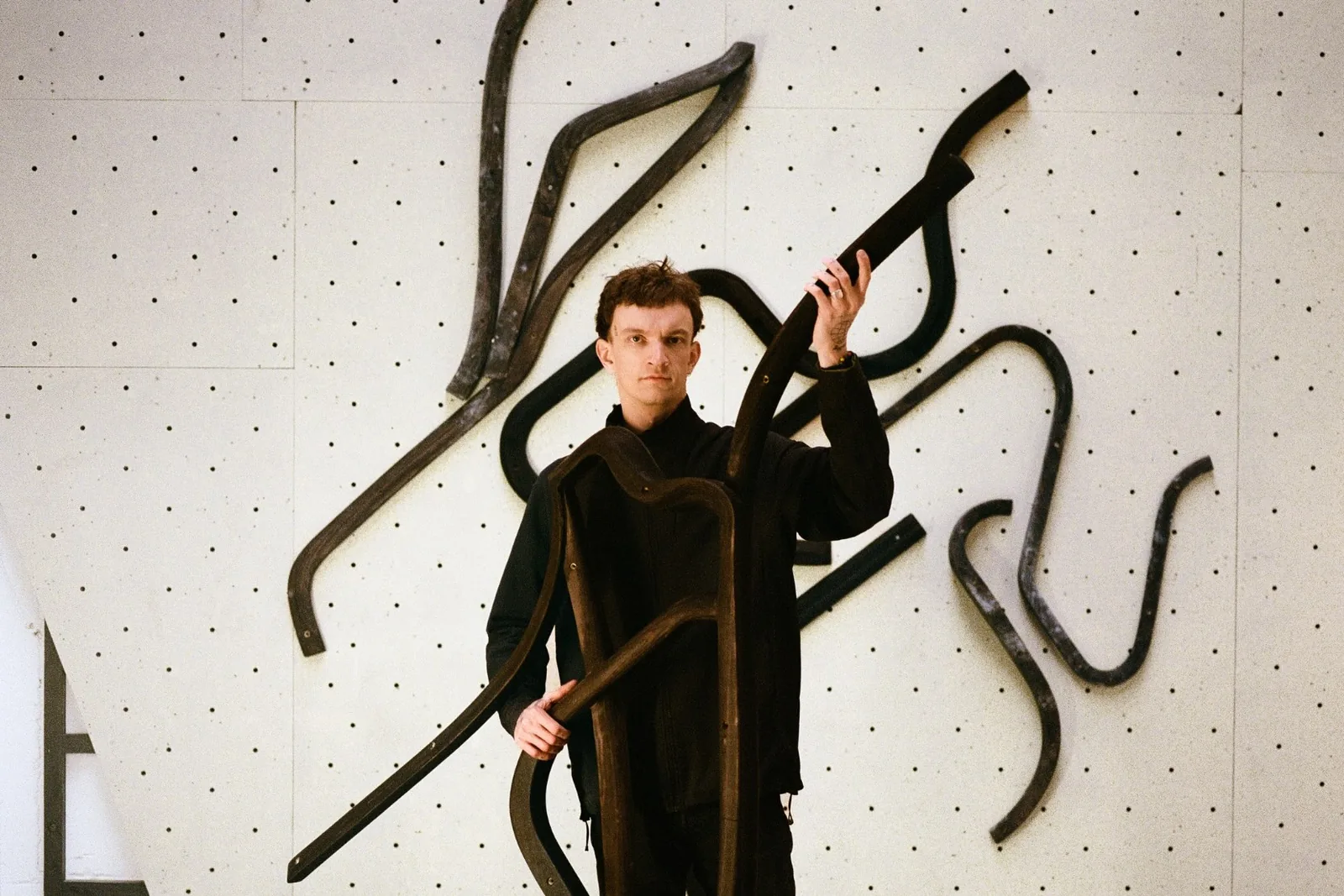
“One day, I started drawing those shapes bigger, eventually scaling them to the human body. I cut one out of a board with a jigsaw and mounted it on the wall. Something happened. I felt that same energy I’d felt in the forest. It was like hearing just the right note.”
Ivan Le Pays, designer and climber
Vertige Media: Climbers read the rock to figure out a route. What does a designer see in those boulders?
Ivan Le Pays: The guidebook, which catalogs the climbs, already traces lines that are both elegant and functional. I’m looking for shapes purely for their aesthetic appeal. At first, I wanted to create an alphabet from the boulders to use in paintings. Is there a language behind those mysterious lines that we don’t understand? I often went to Bleau—short for Fontainebleau—by myself. I felt like I was surrounded by an army of prehistoric animals turned to stone, maybe trying to tell us something. Then I started drawing those shapes bigger, eventually scaling them to the human body. One day, I cut one out of a board with a jigsaw and mounted it on the wall. Something happened. I felt that same energy I’d felt in the forest. It was like hearing just the right note.
Vertige Media: And that became a climbing hold?
Ivan Le Pays: Well, I immediately wanted to climb it. I showed it to some climber friends. At first, it was an edge—a flat, narrow hold—about 8 feet 2 inches long. They told me it was great, but it needed more variety. So I started sculpting my holds in three dimensions, with places to grip all over. With holds on that scale, you get a good grip in one spot and a bad one in another. Just like on a cliff, nothing is marked. You run your hand over the hold to find where to put a finger, or the tiny foothold that will let you climb.
Vertige Media: What does the word “movement” mean to you?
Ivan Le Pays: It all started with a biography of Patrick Berhault (a leading figure in French free climbing, in which gear is used for protection rather than upward progress—Ed.) and his “movement lab,” a place he returned to work on how he moved. I discovered a whole community of climbers drawn to beautiful movement. They were asking the same question I was: How do you do justice to the beauty of a form? Then I made a film, A Line Alone, in 2023, with Ashima Shiraishi (an elite American climber—Ed.). Her father is a butoh dancer (butoh is an avant-garde dance form that originated in Japan—Ed.), and she gets through some cruxes—the hardest sections of a climb—with movements drawn from dance. She was building a vocabulary of movement, just as I was building a vocabulary of shapes. Then I discovered Antoine Le Menestrel (a leading climber of the 1980s—Ed.), a key figure in the fusion of dance and climbing.
“If climbing could become part of dance in the 1980s, then my work as an artist can become part of climbing and offer a different perspective. I thought: I don’t need to prove myself as a climber to have something to offer.”
Ivan Le Pays, designer and climber
Vertige Media: What did those figures teach you about climbing history?
Ivan Le Pays: That different disciplines can inspire one another. Patrick Berhault left his farm in Auvergne to become a “star climber” on the Paris dance stage. So suddenly I, a Parisian, could go to Chamonix and become an artist in the mountains. If climbing could become part of dance in the 1980s, then my work as an artist can become part of climbing and offer a different perspective. I thought: I don’t need to prove myself as a climber to have something to offer.
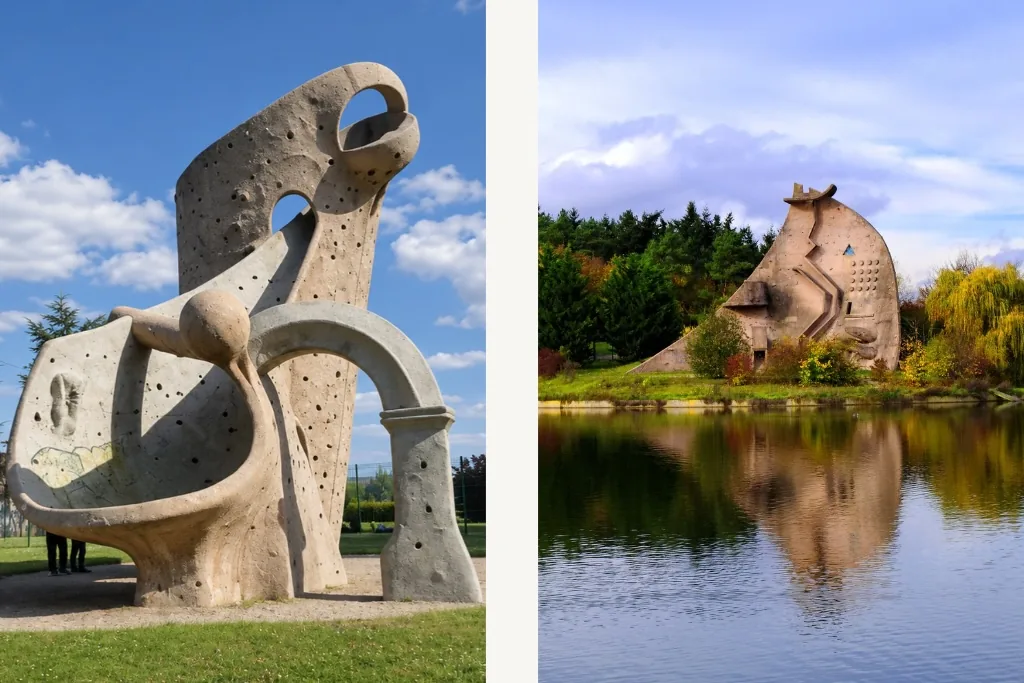
It became a quest, a kind of scavenger hunt. Not to pass on a tradition, but to stoke a fire that had never gone out. What’s left of that era I wish I’d lived through? I went looking around Paris for the monumental climbing structures designed by Jean-Marc Blanche (a pioneer in the design of artificial climbing walls and structures in 1980s France—Ed.) or Guido Magnone (a mountaineer and founder of UCPA who later sculpted climbing structures—Ed.): the Willie Wall (in Fontenay-sous-Bois, in France’s Val-de-Marne department, No. 94—Ed.). There’s also La Dame du Lac, built by Pierre Székely and Bernard Metzlé (in Évry-Courcouronnes, in France’s Essonne department, No. 91—Ed.). They’re monoliths from another era, frozen in time, neglected, fenced off to keep people from climbing them. It feels like a sanctuary; there’s something deeply mystical about it. To me, Jean-Marc Blanche is a legendary figure. His work is a huge reference point, a fundamental inspiration, and yet I’ve never met him. I picture him as a wise old man who’s retreated to his village, La Palud-sur-Verdon. A kind of Gandalf.
Vertige Media: How do you see climbing gyms today?
Ivan Le Pays: I wish they were more fun. It’s all very structured, which is probably reassuring, but I want more options. I love climbing on holds of different colors. But try grabbing a hold that isn’t the color of your route, even while warming up: people look at you like you have no idea what you’re doing. Is it just me, or have we all become too well-behaved? I love the gym, and you have to respect the work of routesetters, the people who design the climbs. But why not a Y-shaped route with two finishes? You get that on real rock.
“A lot of climbers are surprised.”
Ivan Le Pays, designer and climber
Vertige Media: Antoine Le Menestrel, meanwhile, downclimbs—reverses the moves to get back down—and climbs upside down…
Ivan Le Pays: We climbed together at Buoux recently. During the warm-up, he was reading poetry. Then he ties into the rope and tells me, “Today, we only climb what we can downclimb.” We go up, then come back down, like we’re rewinding. It’s fantastic. That doesn’t make grades—climbing’s difficulty ratings—any less important: I love being able to say I’ve climbed a certain grade. But there’s a whole other world out there, too.
Vertige Media: How do climbers react when they climb your sculptures?
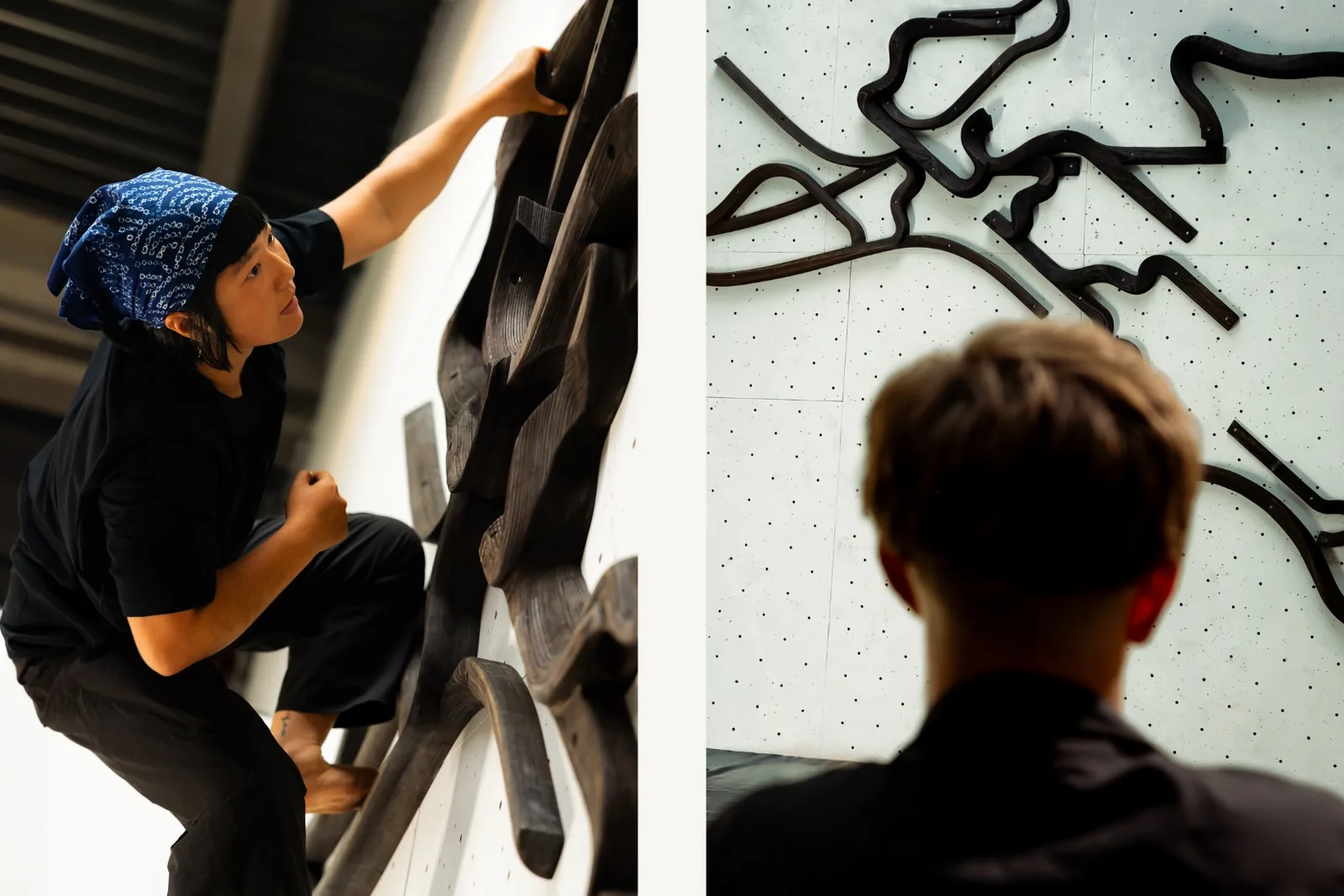
Ivan Le Pays: The first time I showed my Emprises, a climber told me it felt like climbing a tree, the way he had as a kid. He was right: they have the color and smell of a tree, because they’re made of charred wood. No gritty texture, no resin, no color coding, but we still love climbing them. A lot of climbers are surprised by how hard it is: nothing tells you where to go. It’s like a game of chess. And reaching the top isn’t the finish, because the descent is part of the climb. Once people get to the top, they wonder what to do, and most downclimb, often quite elegantly. Clément Lechaptois (an elite French climber who specializes in bouldering—Ed.), who came with Ashima, climbed upside down, in positions he never uses when bouldering. The more endurance he could draw on, the more possibilities he could explore. It was beautiful to watch.
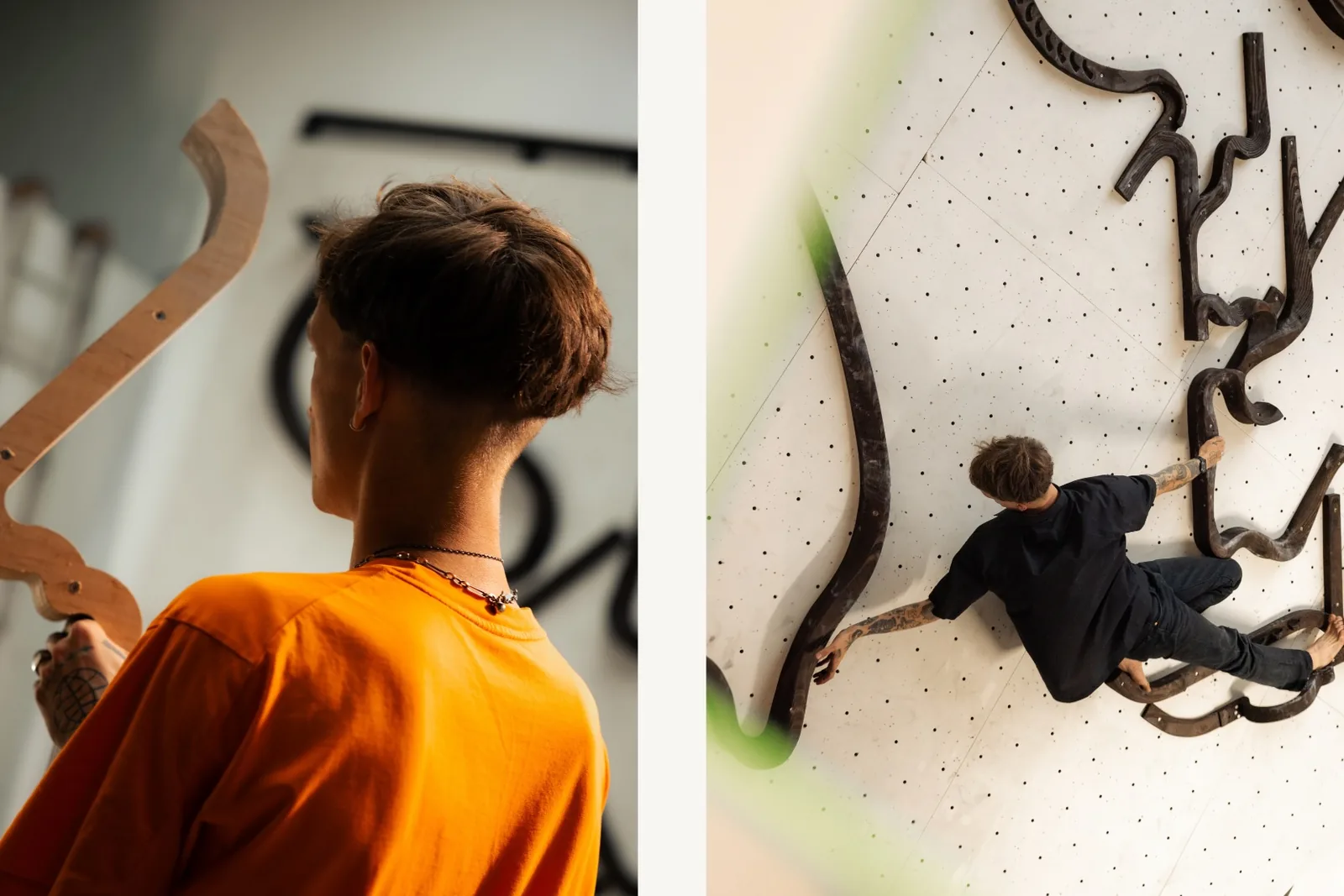
Vertige Media: In Emprises, we see you making holds in a lab before bringing the work back into nature. Was that reversal deliberate?
Ivan Le Pays: You have to give nature back what belongs to it. I copy it as closely as I can, but we can never match it. Next to a Fontainebleau boulder, the sculpture looks almost outclassed; the rock has so much more going on. It’s humbling, almost an offering: “Rock, I made this. What do you think?”
Vertige Media: The film feels dreamlike, almost surreal. Why that title?
Ivan Le Pays: In everyday French, the word has a negative meaning, a toxic kind of control. For me, it’s tied to an obsession I couldn’t shake. In the forest, a shape draws you in physically: Why? Why? Why? You get a little lost in the madness of it. It makes your head spin. The title also condenses the French phrase for “taking an impression”: all I saw in the rocks were impressions, like engravings.
“A project like Emprises is an implicit political statement. It invites us to question our drive for results, to ease up, and to rethink our relationship with nature.”
Ivan Le Pays, designer and climber
Vertige Media: You’re about to set your first route at Climbing District using your wooden sculptures [this interview took place the day before the installation and is being published afterward—Ed.]. Does this feel like the culmination of your work?
Ivan Le Pays: It’s more of a step along the way. Another step in the movement lab. The route will follow a roughly 43-foot-high strip of wall, with about 15 of my Emprises arranged like a musical score running up the wall. I can’t wait to see what choreography people come up with. In early December, I’m installing my wall at La Ménagerie de Verre, a contemporary dance venue, for an audience of dancers. I came looking for dance in climbing, and now climbing is finding its way into dance.
Vertige Media: In all that searching, did you find what you were looking for?
Ivan Le Pays: I don’t know. After three and a half years doing nothing else, I feel like I’ve made my own small contribution to the tradition of free climbing. It won’t revolutionize anything, but it’s the most faithful picture of climbing as I imagine it. It’s my utopia.
Vertige Media: A political utopia?
Ivan Le Pays: I don’t consider myself especially political. But my choices, and a project like Emprises, amount to an implicit political statement. They invite us to question our drive for results, to ease up, and to rethink our relationship with nature. It’s like leaving the city for the country. I’d call it a “quiet strength,” a kind of soft power: questioning our surroundings and our place in them.