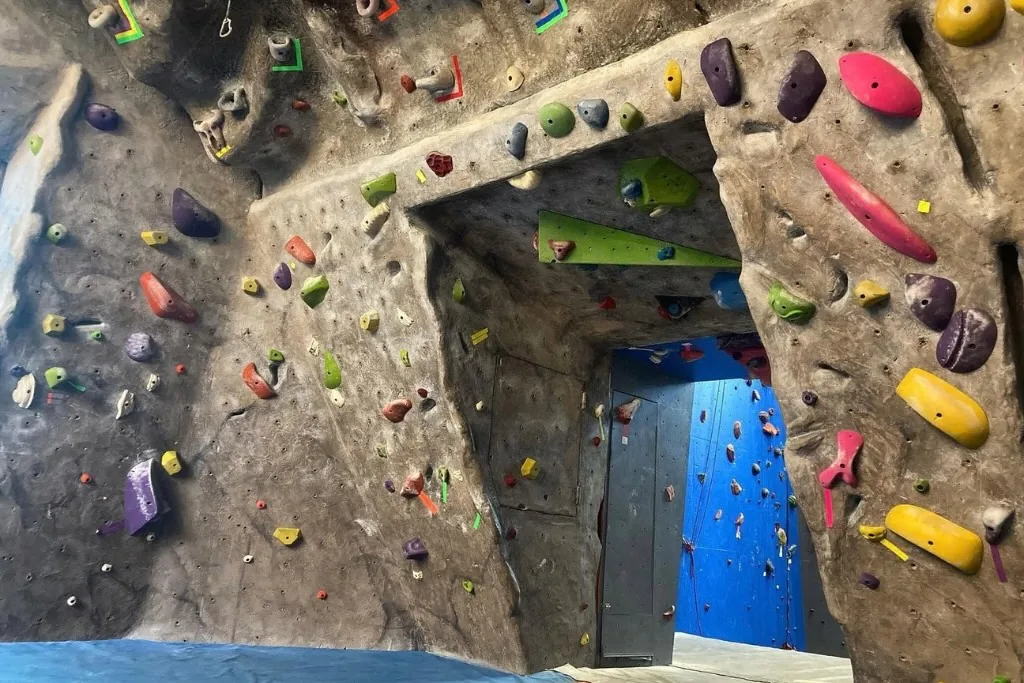

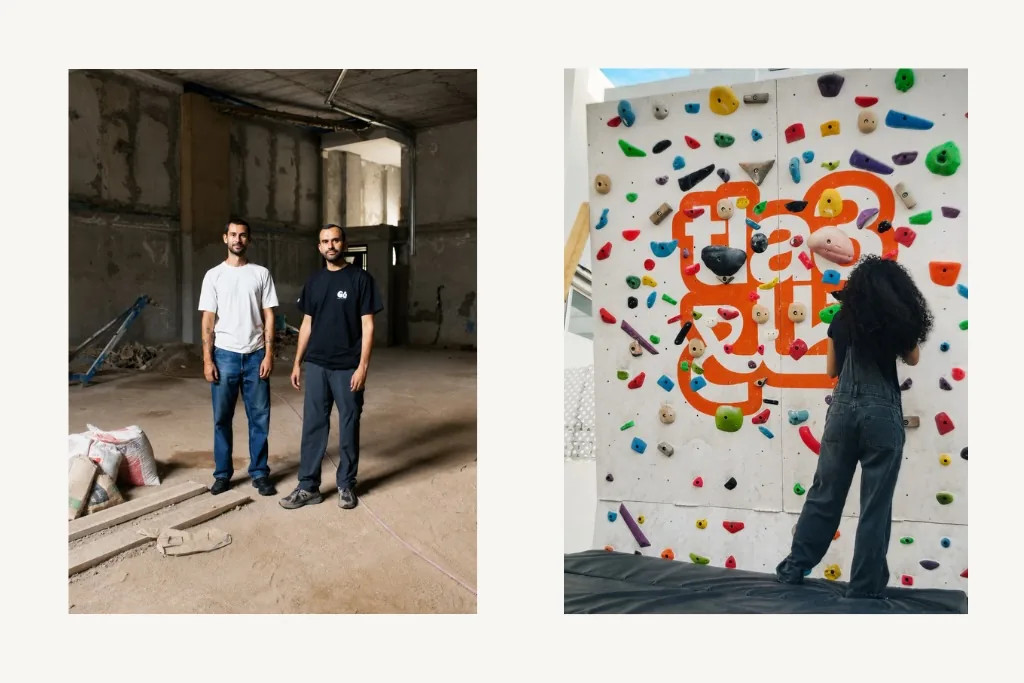
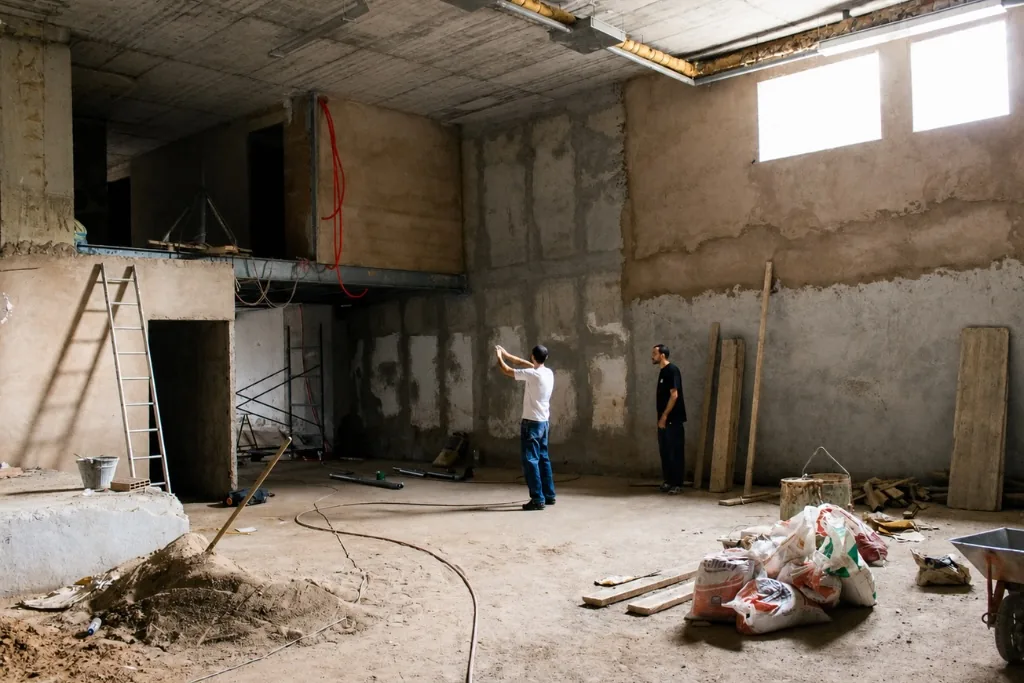
Over six months, they looked at 15, maybe 20 different spaces. Every time, they ran into the same impossible equation: enough ceiling height for bouldering walls, a central location in a sprawling city, parking, and, above all, rent that made sense for a sport still in its infancy in Casablanca. Then Sami and Mamoun found it: 4,300 square feet, 18-foot ceilings, offices nearby, residential neighborhoods just minutes away, and enough room to finally build what they had imagined. About 3,200 square feet will be devoted to climbing, with roughly 215 linear feet of wall, plus a café and a small yoga room. Tla3 is now aiming to open by the end of 2026. “Honestly, we couldn’t have asked for anything better,” Sami tells us. To understand why two guys from Casablanca have spent years pursuing this project, you have to start in Paris.
Back to Casablanca
Sami grew up in Casablanca. His mother is Moroccan, his father French. At 18, after attending Lycée Lyautey, he moved to Paris for college and eventually went into tech as a product manager. Sports weren’t a major part of his life at the time. He had climbed a little in high school, but it hadn’t made much of an impression. That changed almost by accident when a friend took him to Arkose Nation, a bouldering gym in Paris.
“It was like this whole new world opened up in front of me,” he remembers. What hooked him quickly went beyond the climbing itself. He loved bouldering, the puzzle-solving side of figuring out a move, but also everything that happened between attempts and at the base of the walls. “I spent all my time at the gym. I loved meeting people, talking, and just having fun.” The gym became an “escape” for Sami, and almost immediately, it made him think about Casablanca. “When you’re young, there really isn’t a place like that,” he says.
Even then, he wasn’t just imagining climbing walls. He pictured somewhere you could meet friends, get to know new people, grab a drink, hang out after climbing, and host local cultural events.
“We’re still two men, and we don’t necessarily have the perspective or experience a woman would”
The idea could have stayed a daydream. Instead, Sami decided to learn the business. He left tech and took jobs at Climbing District and later Climb Up, both major French climbing-gym operators in the Paris region. He spent two years learning how gyms work and how their economics fit together before returning to Morocco. Paris is also where he met Mamoun, another Casablanca native. Over time, the two climbers realized they wanted the same thing: “to grow climbing where we grew up.”
Getting Casa Climbing
Bouldering was partly a personal choice: it was the discipline Sami had fallen in love with. But it also made practical sense. Roped climbing requires more height, more equipment, and more safety infrastructure. Bouldering has a much lower barrier to entry. “You show up, put on climbing shoes, and climb,” Sami says. For two founders trying to introduce the sport to a new audience, that simplicity matters.
Casablanca already has the historic wall run by the Club Alpin Français, which is mostly focused on roped climbing, along with a small bouldering area. But the city still doesn’t have a modern gym dedicated entirely to bouldering. Marrakech got there first a few years ago with Atlas Elevation, which offers both bouldering and roped climbing. For Sami, though, Casablanca was always the obvious choice. It’s his city, the place he knows best, and Morocco’s main economic hub.
The newsletter that lifts you higher
Every Wednesday: the editorial team’s column, the best articles, and plenty of surprises to help you climb higher — in mind and in spirit.
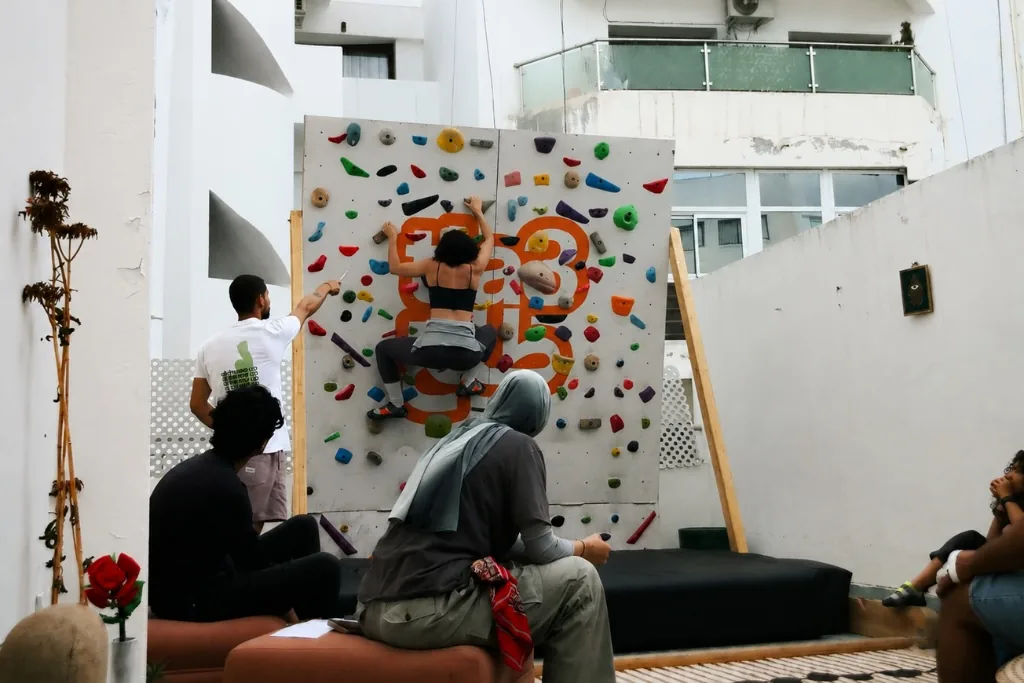
Before they even had a building, the partners wanted to find out whether there was actually an audience. So they built a spray wall—a training wall packed densely with holds—and started organizing sessions. About 230 people have climbed on it so far, according to Sami. The founders found more Moroccan climbers than they expected, but they also saw plenty of people coming in simply to try climbing without really knowing what they were getting into.
Part of the challenge is changing some deeply rooted assumptions about the sport.
“People tend to think, ‘Oh, that’s for kids.’” And that is exactly the audience Tla3 wants to reach: people who are still outside climbing culture. Existing climbers, Sami figures, will find their way to the gym on their own, especially with so few alternatives. “Our core audience is really young adults looking for that kind of third place, somewhere to hang out and have a good time,” he says. The grading and setting will reflect that goal: fewer extremely difficult problems, more beginner and intermediate climbing. Broadening the audience will also mean thinking carefully about what kind of space Tla3 becomes. At one of their sessions, the founders counted 18 women and four men, something they want to take seriously as they build the gym. They hope to reach gender parity on staff, post a code of conduct, and are considering women-only sessions. “We’re still two men, and we don’t necessarily have the perspective or experience a woman would,” Sami says.
“I’d like Moroccans to reclaim some connection to that nature for themselves”
Then there is the question of price, which inevitably complicates any goal of making climbing widely accessible. For now, the gym is considering a full-price day pass of around 140 Moroccan dirhams, or about $14, with discounts for students and others. For comparison, the median monthly wage for jobs registered with Morocco’s social-security system was 3,173 dirhams, about $320, in 2024. A single session would already represent more than 4 percent of that monthly income. For regular climbers, Sami says he wants monthly access to stay somewhere around $45 to $55, or roughly 430 to 540 dirhams. That amounts to about 14 to 17 percent of the same median wage. Despite Tla3’s stated goal of making climbing accessible, that kind of expense will still be out of reach for a significant share of the population.
“The idea isn’t to set a price that makes this an elitist sport,” Sami says. Tla3 also plans to hold free climbing days and wants to keep taking its portable wall to schools, nonprofits, and other organizations where people who might never otherwise encounter climbing can give it a try.
Moving Mountains
The gym’s walls will be manufactured abroad, and much of the founders’ professional experience comes from French climbing gyms. Tla3 is also borrowing from a model that has become common in many Western cities: the bouldering gym as a social hub, not just a place to work out. Sami and Mamoun aren’t trying to hide those influences. Their challenge is making sure Tla3 doesn’t feel like a piece of Paris dropped into Casablanca.
The name is one sign of that effort. Tla3 is written in phonetic Darija, with the “3” standing in for the Arabic letter ع. Depending on the context, it can mean “go up” or “climb.” It is the kind of word you might hear in a taxi or tossed into an everyday conversation. “It’s a really common expression. We use it all the time,” Sami says. The logo combines the phonetic spelling with Arabic script, while the café, events, and collaborations are intended to involve local businesses and organizations whenever possible. Casablanca itself is part of the idea. Sami describes it as a “melting pot,” a city where a single sentence might move between Darija, French, and English. “We wanted to make the model we discovered in France our own, locally,” he says.
That idea of taking ownership goes beyond the gym. Morocco is one of the major climbing destinations in the Mediterranean region. Taghia, Todgha, Tafraoute, and the High Atlas have drawn climbers from Europe and North America for years. Local guides have worked in these mountains for decades. Yet a significant part of the modern climbing history of these cliffs has been written by outsiders: the people who explored new areas, established routes and boulder problems, bolted climbs, and produced guidebooks.
Sami began thinking about that more seriously once he started climbing outdoors himself. Flipping through guidebooks, one thing eventually jumped out at him. “There isn’t a single boulder problem with a name a Moroccan could identify with. The names are in English or French.” His observation closely echoes the work of anthropologist Thomas Fouquet, whose research Vertige Media recently covered on Morocco’s “sporting mountain”: a national landscape whose recreational uses, codes, and stories have long been shaped from abroad.
Sami is not dismissive of the climbers who came to Morocco to establish routes, bolt cliffs, or introduce these areas to the broader climbing world. On the contrary, he points to efforts aimed at passing on climbing skills and knowledge to people who live in villages near the crags. But he would like to see the balance shift. “I’d like Moroccans to reclaim some connection to that nature for themselves,” he says. Not to close the cliffs to anyone else—“everyone is welcome”—but so that people who live just a few miles from the rock are not left watching from the sidelines while visitors come looking for sun, stone, and adventure.
Tla3 hopes to play a small part in that shift. Sami and Mamoun have already met with several guides and organized a few outdoor experiences. For them, climbing on plastic is not the end goal. “I know climbing can be a gateway to the outdoors,” Sami says. But before they can think too far ahead to the rock, they still have to finish construction, work through administrative delays, and pull off an opening that has already been pushed back several times. For now, their first bet is much simpler: get people in Casablanca who have never climbed before to walk through the door. What comes next might eventually lead all the way to the cliffs—and, maybe, to the next generation of boulder problems with names written in Darija.