
Skwama Lite: A Climbing Shoe for Getting Technically Serious

With the Skwama Lite, La Sportiva takes one of its cult models and turns it into something more approachable: more precise than a beginner shoe, less punishing than a pure performance weapon. It is a technical compromise for climbers who want to level up, start using their feet better, and still finish the session breathing normally.

Everyone knows the slightly masochistic ritual of breaking in new climbing shoes. Your foot goes in, but not willingly. Your toes make whatever space they can. The heel pulls. The downturn delivers its little sermon on suffering. And you tell yourself, once again, “They’ll stretch.” With the Skwama Lite, the pitch is different. Yes, it hugs the foot and clearly loads the front of the shoe. But above all, it lets you imagine an actual session: climbing, falling, trying again, working foot placements, without ripping your shoes off every two minutes with the fading dignity of a medieval monk.
A Skwama, really?
The name sets a trap. Skwama Lite. It is hard not to think about the original Skwama, the shoe that has become a staple in a lot of climbing bags, known for its springy softness, S-Heel, and almost cocky ease on modern climbs. By putting that badge on the Lite, La Sportiva immediately throws it into a slightly unfair comparison.
Because the Lite is not a watered-down Skwama. It is not a Skwama that skipped leg day. It is a different tool for a different job. Less aggressive, less asymmetric, more human, it lands right in that very real gray zone of progression: the point where you have worn out your beginner shoes, but you are not ready to sacrifice your toes at the altar of pure performance.
On paper, the brief is pretty clear: a vegan synthetic upper, moderate downturn, 4 mm FriXion Black rubber, a 1.1 mm full-length LaSpoFlex midsole, and the P3 system, which helps the shoe hold its shape and tension over time. Taken one by one, none of that is going to make anyone shout “genius” in the locker room. But together, it says exactly what this shoe is trying to do: give you precision without pretending you have mutant feet.
The first fit backs that up. The forefoot feels wrapped, not crushed. The toe box is much more forgiving than the classic Skwama’s, though it is not wide by any means. Climbers with very high-volume feet should still try before they celebrate. And because the synthetic upper will not stretch like leather, sizing matters from the start: snug, precise, but livable. Going too small “for performance” would be the fastest way to ruin what this shoe is offering: progress without turning every session into a dispute with your toe joints.
When your foot starts asking questions
The Skwama Lite comes alive when your foot has to start thinking. Volumes, insecure smears, modern slabs: the feedback is clear, even a little instructional. You do not get the electric snap of an ultra-soft comp shoe, and you do not get the strict support of a shoe built only for edging, meaning standing on very small footholds. It sits in a readable middle ground: soft enough to smear on a volume, structured enough to stand on a small edge without folding in half.
That is its main strength. It does not turn bad footwork into a miracle. There is no lie here, no cozy illusion where magic rubber covers up every sloppy move. When your foot slips, you can often tell why: you did not commit enough pressure, your hips lagged behind, the angle was wrong, the weight transfer was off. In those moments, the shoe works like a good technique coach. It does not forgive everything, but it explains a lot. That can sting. It is also useful.
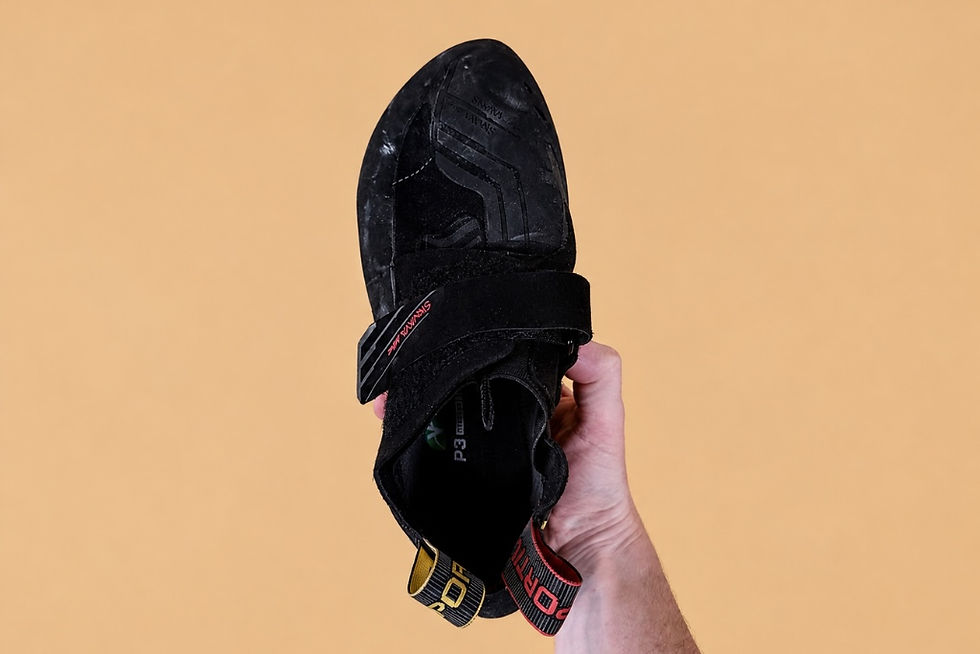
On small edges, it holds up better than the “Lite” label might suggest. The 4 mm sole, combined with the full-length midsole, gives enough support to stand cleanly on vertical terrain or in a slight overhang. You do not get the talon-like bite of a Miura VS or the aggressive pull of a tightly sized Solution, but the shoe is serious. It lets you push, shift weight, and work. For a progression shoe, that matters far more than shining for three moves before turning into a torture device.
Its natural habitat is the modern climbing gym. The Skwama Lite likes volumes, uncertain feet, open boulders, and problems where the foot is not just holding a foothold but helping balance the whole body. The FriXion Black rubber offers steady grip and makes sense for climbers stacking indoor sessions. It does not quite have the mental security of Vibram XS Grip2 on the slickest surfaces, that extra bit of trust that lets you commit without second-guessing. But this is not bargain-bin rubber. It simply makes you place your feet well. Bad news for the ego, excellent news for technique.
The toe patch handles basic toe hooks well enough. Toe hooks, where you pull with the top of the shoe, feel solid on simple compressions, standard gym moves, and everyday scumming. But once the movement gets very physical and competition-style, with a lot of pulling through the front of the foot, you start to find the shoe’s limit. The Skwama Lite can do the move, but it does not pretend to be a mutant sock built to live on a 45-degree spray wall.
The heel tells a similar story. By dropping the original Skwama’s S-Heel, La Sportiva gains comfort, simplicity, and probably a better fit for more feet. But it also gives up some absolute lockdown. On a heel hook, where you use the heel to pull or hold tension, it works fine for balance, positioning, or moderate compression. On a hard heel hook locked on a tiny feature in steep terrain, with your body pulling the other way, the Lite lacks authority. It does not necessarily pop off, but it does not give you that locked-in feeling that lets you forget the heel and think about the next move. And in that situation, being able to think about the next move instead of your heel already feels like a small luxury.
The technical age
Outside, the Skwama Lite still has real credibility on single-pitch sport routes, especially on technical vertical terrain or slight overhangs with smears, small feet, and placements you need to read carefully. Rock does not scare it. Its sensitivity even helps you understand footholds, adjust pressure, and avoid climbing only with finger strength, that old temptation whenever a foot looks even slightly questionable.

That said, it would not be our first choice for long multi-pitch days, cracks, or routes that demand a lot of sustained support. For that kind of terrain, a Katana, Miura, or TC Pro will offer more structure, more useful stiffness, and more overall coherence. The Skwama Lite can absolutely go to the crag. It just was not designed to spend its life at a belay while your partner sorts out the rope.
That is where it finds its real place: in the very specific moment when you realize climbing better does not just mean pulling harder. When you start looking at your feet differently. When you learn that a tiny edge is not always too small; sometimes you just have not weighted it properly. That a volume is not a missing foothold, but an invitation to manage pressure. That a foot slip often says more about your position than about the shoe.
For that phase, the Skwama Lite checks a lot of boxes without feeling like it was designed by committee. It is precise enough to help you improve, comfortable enough to keep on for a while, and sensitive enough to help you understand what is happening under your foot. It does not sell pain as proof of commitment. It also does not turn climbing into an easy walk. It offers something more useful: learn to place your feet before punishing them.
Its limits are clear, and that clarity is part of what makes it easy to understand. Very advanced climbers may find it too tame. The heel lacks lockdown for demanding use. The rubber will not silence XS Grip2 purists. The more forgiving fit will not magically work for every foot. But criticizing it for those things would almost be criticizing it for being honest. The Skwama Lite is not a classic Skwama dressed up as an accessible shoe. It is a serious progression model, built for climbing often, training cleanly, and feeling a little more of what you are doing.
It is not the shoe that will hand you two number grades just by touching your foot. No honest shoe does that. And any shoe that suggests otherwise should probably answer for its promises in front of a court of battered toes. But it can help you place your feet more accurately, load them more confidently, and keep your shoes on long enough to repeat, understand, and adjust. In a time when climbers still confuse technical performance with suffering, that is not so “lite” after all.
The Skwama Lite is available through La Sportiva and specialty retailers in sizes 34 to 48, with half sizes across the full range. Suggested retail price: €130.
Sponsored by La Sportiva.


