
Desire Lines: A New Platform for Marginalized Voices in Climbing and Mountaineering

Desire Lines grew out of a simple conviction: mountain literature has been built around one narrow voice—white, male, and heroic—while pushing many other stories to the margins. Katie Ives, the former editor-in-chief of Alpinist, and Holly Chen, the collective’s art director, explain how a 2024 writing workshop sparked an editorial project that feels both ambitious and urgently needed: making room for marginalized voices in climbing and mountaineering at a time when their rights in the United States are under growing attack.

Vertige Media: Mountaineering and climbing are still very male and very white spaces. How do you explain that, structurally and culturally?
Katie Ives : It really depends on how you define mountaineering. If you look at the earlier meaning of the word—in both French and English, montagnard and mountaineer—it meant someone who dwelled in the mountains. Then the Victorians came along and redefined it in a much narrower way: specialized gear, alpine clubs, and hiring local guides who had been climbing those mountains for generations, while relegating them to a lower status as guides and porters.
We are still trapped inside that very narrow definition. When you look at mountaineering in a broader, more global sense, you realize that countries in Africa, Asia, and South America have their own mountain-climbing traditions that long predate the first ascent of Mont Blanc.
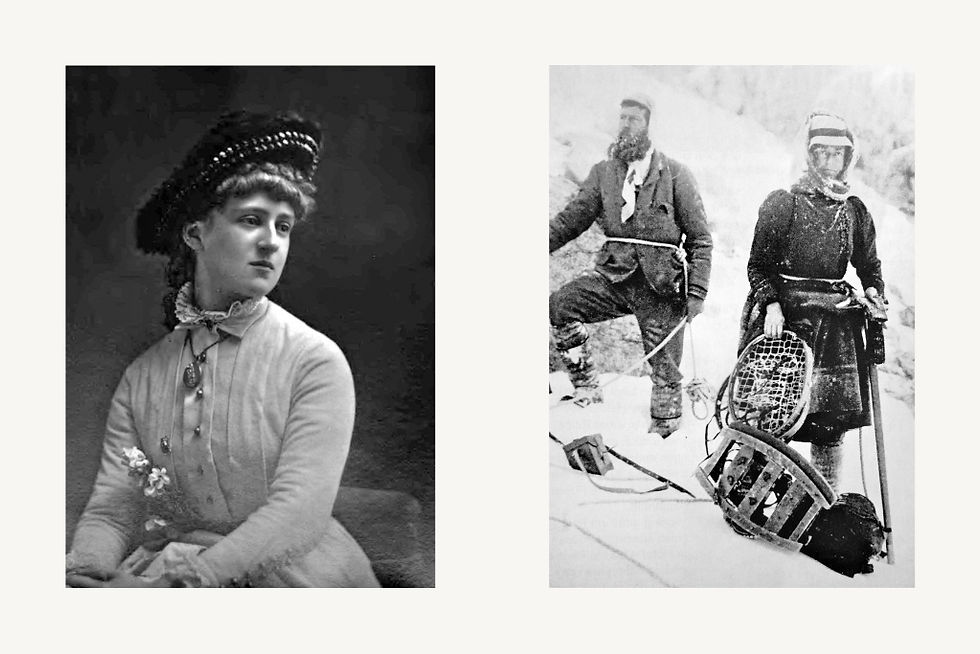
Even within European alpine climbing, women were far more involved from the beginning than the history books suggest. Clara Roche has done important scholarship in Britain, looking at guides’ journals and private letters and compiling first ascents—not first female ascents—and first winter ascents that women did. When winter mountaineering was developing in the Alps in the 1870s and 1880s, many of the people doing groundbreaking work were women. In Lizzie Le Blond’s case, she was writing the first English-language guidebooks to winter mountaineering.
You have to read between the lines of history books to see that people pushed to the margins were always there.
“Creating that broader, more diverse spread of voices and stories is going to take much longer. Probably as long as it took for the problem to be created in the first place”
Holly Chen, Creative Director at Desire Lines
Holly Chen : My perspective is more lived and first-person. I grew up in Taiwan and Hong Kong. There wasn’t a big mountaineering culture around me, not a big outdoor culture. So as a kid, I would go to the library, pull every adventure book off the shelves, and start reading. Walter Bonatti’s Mountain of My Life, Jon Krakauer—all the big hero narratives. I devoured every single book.
And in my mid-teens, I suddenly thought: I can’t do this. I can’t mountaineer. I can’t rock climb. Everyone in these books is a man.
I held on to that belief for most of my life. I moved to the U.S. when I was 18, started climbing in a gym, and still thought, “Oh, I’m just doing this for fun. I’m not a real climber.” It wasn’t until I started getting into mountain journalism, and reading some of the texts Katie talks about, that I understood this field was actually much deeper than it looked to me as a kid.
Why aren’t these people more prominent? Because I spent ten years of my life believing I couldn’t do this.
Vertige Media : Why has it taken so long to change?
Holly Chen : A problem that took almost a century to create is not going to disappear in a couple of years. This is something we may be working toward for our entire lives.
But the next person who lives in Hong Kong or Taiwan, or anywhere in the world, and picks up a book because they’re interested in mountaineering and climbing culture—they shouldn’t see only one dominant voice. Creating that broader, more diverse spread of voices and stories is going to take much longer. Probably as long as it took for the problem to be created in the first place.
Katie Ives : When I was editor-in-chief of Alpinist, even as late as 2015, I still had trouble finding women to write for the magazine. I realized I had to break that cycle: women saw magazines, didn’t see themselves in them, and assumed they couldn’t write for them.
So I started doing a lot of outreach directly to the community—seeking out women writers, nonbinary writers, writers of color, Indigenous writers—and inviting them in. After a while, you get momentum. People see themselves in the pages and think, “Oh, I can do this.”
By the time I left Alpinist, about 50 to 60 percent of the writers we were publishing were women and nonbinary writers. I wasn’t trying to find them anymore. They were finding us.
You have to create spaces where people feel welcome. Then people can take creative risks because they know they’re supported.
Vertige Media : Other cultures have a very different relationship with mountains—neither conquest nor performance. What does that teach us?
Holly Chen : Taiwan is a very outdoor country. I would have to double-check the exact number, but it has around 52 mountains over 10,000 feet running down the center of the island. People there are immersed in nature all the time. It becomes part of us, rather than some faraway peak you have to go conquer.
It’s a parallel existence with nature, not dominance over it.
Hong Kong, where I spent most of my teenage life, is different: concrete, glass, high-rises. But for Taiwanese people, nature is so integrated into the culture. There’s this recreational mindset of existing with nature, in nature.
“How we approach mountains is a microcosm of how we approach nature in general: do we consider ourselves separate from it, or part of it?”
Katie Ives, Editorial Director of Desire Lines
Katie Ives : In many cultures around the world, mountains are seen as bridges between earth and the heavens—sacred spaces. Approaching them becomes more like a pilgrimage than a conquest. Sometimes reaching the summit is part of that. Sometimes it isn’t.
There is also the sense of living with and living in the mountains, as Holly described, rather than coming from the outside to dominate.
Ashima Shiraishi wrote something in a recent anthology on women mountaineers that I found really powerful. She asked: “How can climbing circle back to being an activity rooted in ritual and meaning? What other traditions and cultures that have gone unwritten and unnoticed may emerge into the climbing culture?”
That is exactly the question we are asking. How we approach mountains is a microcosm of how we approach nature in general: do we consider ourselves separate from it, or part of it?
Vertige Media : What was the founding moment of Desire Lines?
Holly Chen : It was in 2024, at the Women Up Climbing Festival in Los Angeles. I had known Katie for a while, and that’s where I met Rosie Bates.
After the festival ended, the three of us—Katie, Rosie, and I—sat down to teach a writing clinic. It was just a small yoga room, a couple of tables pushed together, a little projector. And the energy in the room was so different. The energy of that entire weekend was: everyone feels safe being who they are. No one is performing for anyone else.
The questions, the excitement that came out of it—when it was over, we looked at one another and said, “How do we keep this going?”
That conviction kept growing, until we invited Natalie Berry and Juliet Kennedy to join the team.
Vertige Media : Which literary and cultural references inspired the editorial direction of Desire Lines?
Katie Ives : Around 2016, I started noticing real growth in writers coming into mountain literature from the margins—women, nonbinary and gender-nonconforming writers, writers of color, Indigenous writers. They were bringing radically different, cutting-edge, experimental ways of looking at mountains, and they were shattering old paradigms.
There have been a number of powerful books. Faye Latham’s erasure poetry took Frank Smythe’s British Mountaineers and used whiteout and stitches to remake it into something new: this idea of bursting through the seams of Western colonial mountain literature and finding buried voices by reinterpreting the past.
And then there is Headstrap, by Nandini Purandare and Deepa Balsavar, about the Sherpas of Darjeeling. It’s told in a nonlinear style, almost as a series of interwoven conversations. That inspired me a lot in terms of narrative form.
We don’t have to follow a traditional arc that looks like a mountain: an inciting incident, rising conflict, summit, resolution. Life—and history—is much more full of gaps and missing spaces.
Holly Chen : Something struck me when I first started writing about climbing. I had just led my first climb outside—lead climbing means clipping the rope as you go—and I was very excited. I started writing about the experience, but I would flip open those classic mountaineering books and try to imitate the language because I wanted to be part of that world.
The tropes were all there: the storm closing in, pushing through, conquering the objective. So I wrote about this little 5.7 crag I had just led for the first time as if I were conquering some big mountain.
I wrote like that for a long time. Until one day I looked at it and thought: that is not how I feel about rock climbing. I don’t feel like I’m conquering anything. Why am I writing this way?
“We have to keep producing these stories faster than they are being silenced”
Katie Ives, Editorial Director of Desire Lines
Vertige Media : In the U.S., federal policies are directly attacking the rights of trans people and minorities, including in national parks. Has this changed the sense of urgency around Desire Lines?
Katie Ives : Absolutely. Doing this work was always important, but now it feels like we’re racing against time.
You look at the ways the U.S. government has been rapidly deleting and removing stories about the contributions of women, LGBTQIA+ people, people of color, and Indigenous people. We have to keep producing these stories faster than they are being silenced. We have to keep helping people continue to have a voice faster than they are silenced.
And by “we,” I don’t mean specifically us. There is only so much our small group can do. But everyone in America should be doing what they can to push back.
Vertige Media : You say Desire Lines isn’t a media outlet—it’s a movement. Where do you draw the line between journalism and advocacy?
Katie Ives : When I first got into writing, the idea was that you weren’t supposed to write about ideas or politics. I came across a piece by a British editor, Dave Cook, who talked about how climbing writing had the same problem: it was keeping out discussions of race, gender, and politics. By doing that, he argued, it was becoming an incredibly narrow, escapist genre that was, as he put it, running on empty.
Mountain literature needs to open its doors to these wider conversations if it wants to be relevant to our changing world.
And there can be a false idea of neutrality—this notion that we have to give equal weight to both sides. When one side is saying that trans people shouldn’t exist, are you going to give equal weight to that?
Women are people. Climbers of color are people. Trans people are people. Those should be basic human ideas, and nonpartisan. And yet, strangely, in our current world, they have been branded as somehow partisan. That is incomprehensible to me.

Vertige Media : What are the most urgent stories to tell right now? And the most difficult ones?
Katie Ives : My preference, generally, is that if we include a story about a marginalized culture, the writer should be from that culture. That removes a lot of the difficulty of outsiders misinterpreting things.
What feels both urgent and difficult to publish is work on sexism and sexual harassment in the climbing community. Those topics make people very uncomfortable, and it can be hard for writers to get published because some editors see them as too political or too divisive.
But that is exactly where you need to be bold.
“These stories need a place to be told. I really hope we can be that place—where people feel safe”
Holly Chen, Creative Director at Desire Lines
Holly Chen : I feel very similarly. I host a routesetting podcast—routesetting is the craft of designing climbs in a gym—and sometimes, weeks after an episode comes out, someone reaches out to me anonymously to say that the person I just hosted has some dark backstory, or has left a trail of hurt people behind.
And I feel absolutely frozen. I don’t know what to do. I don’t know if it is even my place to help these people. And I have potentially platformed someone’s abuser online.
These stories need a place to be told. I really hope we can be that place—where people feel safe.
Vertige Media : In five years, what do you hope Desire Lines will have changed?
Holly Chen : On a small scale, if I can provide a safe space for just one person to be themselves, that would sustain me.
On a larger scale, I hope people in the climbing and mountaineering community will feel a little more confident being themselves, and more willing to speak up about these issues rather than staying silent out of fear of repercussions or losing work, like what happened to Shannon Joslin.
Katie Ives : Every story that gets told is something saved from the void. I believe very strongly that every human being has infinite realms of wonder, possibility, and worth within them. Every fragment of that preserved in a publication is something saved from the abyss. That has always been a huge motivation for me.
And beyond representation, I think about what Julie Rak wrote about cholita climbers in South America. For them, it wasn’t just about being able to climb. It was about being able to climb as themselves, wearing their traditional dress, and redefining what climbing means.
That is the transformation: not just more representation, but revolutionizing the genre itself.


