
This article was originally published in french by Reporterre.
It looks like one of the dozens of videos posted every day. A young man films himself walking along a river beneath towering mountains. His name is Omar, and he has a message for the people watching: “Get out of your neighborhoods and go hiking. It opened my eyes.”
What he gets in return is a flood of vile racist comments, all boiling down to the same idea: “They better not start coming to our mountains.” Mountain trails are often portrayed as universal places to recharge. But as Omar’s story shows, the reality is harsher. For some people in France, heading into the mountains means crossing an invisible line—and sometimes being brutally reminded that they have crossed it.
Warning shots
Thousands of young people of color have decided to tear down that invisible barrier—and make sure people know it. In mid-August 2026, a TikTok video showing a mountain landscape appeared with a caption along the lines of: “One of the few places left in France without ‘wallah, wesh, mashallah,’ where you can still feel safe.” The post spread quickly and crystallized a familiar idea: the mountains as a last “sanctuary,” protected from certain groups of people. In response, dozens of young people of color launched the “We’re Coming” trend. They flipped the original message on its head, filming themselves hiking, camping, and summiting peaks with a single refrain: “We’re coming.” Driven by accounts including @sors2cheztoi and @iwas.here38, the trend racked up millions of views, turning a racist attack into a collective assertion that they belong in the outdoors too.
“We didn’t even know the name of the mountain range that was 500 yards from our homes.”
Foued, a 48-year-old Franco-Algerian
Foued has spent most of his life brushing up against that invisible line. He grew up in Voreppe, near Grenoble, surrounded by the cliffs of the Vercors and Chartreuse ranges. Now 48 and French Algerian, he spent years knowing almost nothing about the mountains, just like his friends in the neighborhood. “We didn’t even know the name of the mountain range that was 500 yards from our homes.” When he was a child, his mother became ill and he was placed in a residential care home in the Vercors. For two years, he skied, hiked, and camped outdoors. “The mountains helped me get through that really hard time.” On weekends, he went back to his father’s home in the neighborhood. None of his friends there knew how to ski. Years passed before Foued found his way back to the mountains. A coworker pointed out that people from Paris were taking the train to hike practically in his backyard. He started going again, eventually working his way up to the Ultra-Trail du Mont-Blanc, or UTMB, and the GR20 long-distance trail in Corsica. He was hooked. But his presence never felt entirely unremarkable. “When there were two North Africans among 500 racers at a mountain-bike race, you thought, statistically, we stand out.”
The newsletter that lifts you higher
Every Wednesday: the editorial team’s column, the best articles, and plenty of surprises to help you climb higher — in mind and in spirit.
That absence has a history. “High-mountain sports were long dominated by men, shaped by a culture of performance, and largely reserved for more affluent social classes,” says geographer Léa Sallenave. Her research with young people from working-class neighborhoods in Grenoble found that the adults seen as authorities in these spaces—elected officials, mountain guides, recreational mountaineers—still largely come from more privileged backgrounds. “If you’re from a neighborhood in Paris and you have the chance to get away, you’re more likely to go rest by the ocean,” says Kovana, 28, who grew up in Essonne, outside Paris, and works delivering fruits and vegetables. “All year long, we’re stressed and physically exhausted from work. In the summer, we need a break. The mountains feel like more work.”
“The Alps or the Fontainebleau forest aren’t inherently white spaces, but they become white because they’re occupied by people who experience themselves as dominant”
Nacira Guénif-Souilamas, professor at Paris-VIII University
Class is only part of the picture. Race matters too. “The Alps or the Fontainebleau forest aren’t inherently white spaces, but they become white because they’re occupied by people who experience themselves as dominant,” says sociologist and anthropologist Nacira Guénif-Souilamas, a professor at Paris 8 University. The landscape itself is not doing the excluding, she argues. The exclusion comes from people who see themselves as its rightful gatekeepers.
Sallenave has documented that dynamic. In the journal Géographie et cultures, she analyzed more than 1,240 images published by 14 Alpine resorts between 2018 and 2020. The bodies pictured were overwhelmingly white, young, thin, and heterosexual. She calls this mechanism an “order of places”: the idea that the mountains have been claimed by certain groups, while others are treated as if they are crossing a line simply by showing up. The framework draws on sociologist Razmig Keucheyan, whose 2014 book summed up the argument in its title: Nature Is a Battlefield.
Stares, mockery, and the racial burden
Once they get onto the trails, the people Reporterre interviewed describe experiences with unsettling similarities: the feeling of being watched, the sense that they have to prove themselves, and sometimes outright ridicule and insults. Foued experienced it directly on the GR20. He and his friends asked for a cheese plate with bread, but the bread was only being served with charcuterie plates. The refuge manager became angry, and the group ended up leaving in the middle of the night. “It was just plain, stupid racism,” Foued says. Nadir Dendoune knows the feeling too.
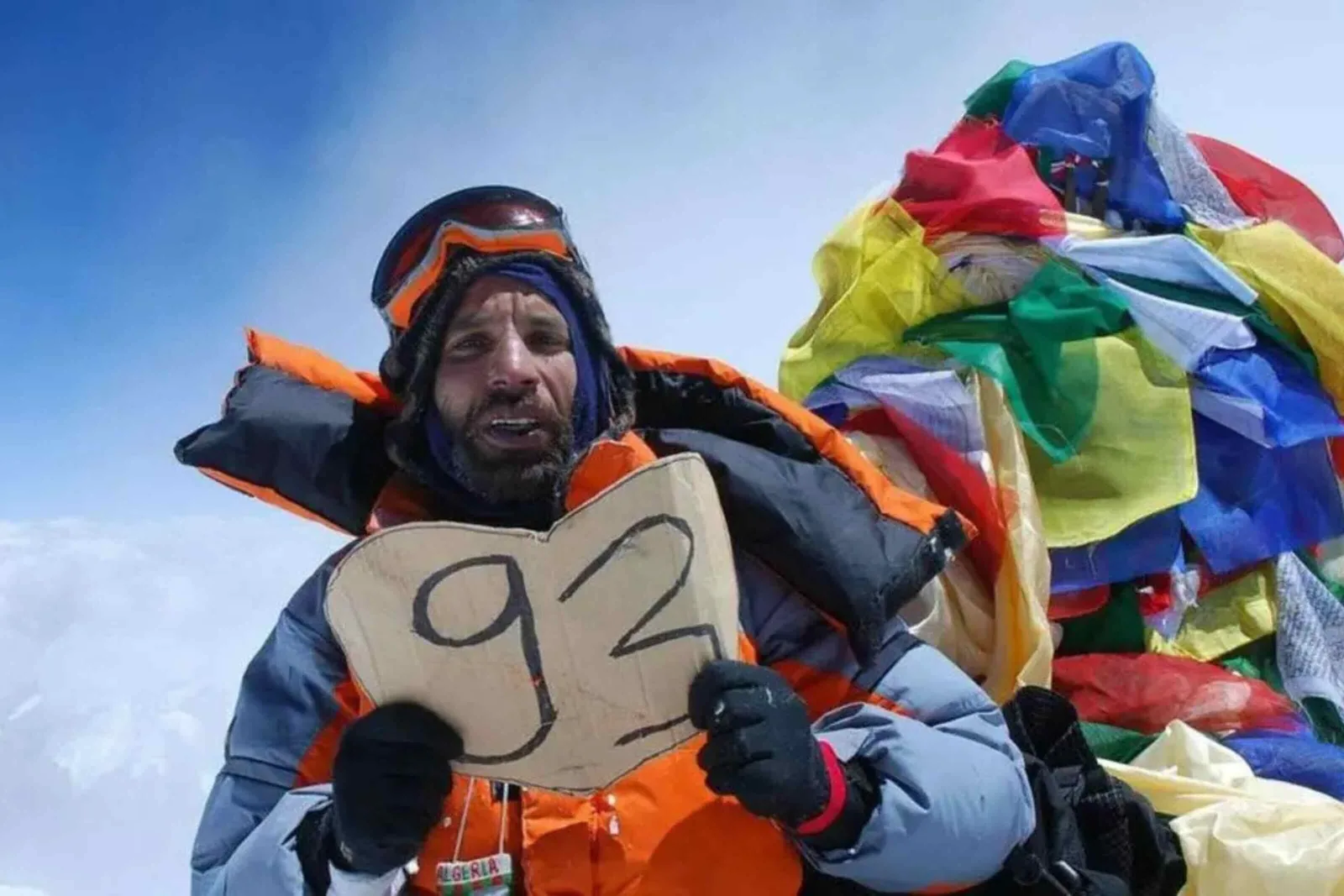
In 2008, he became the first North African to reach the summit of Mount Everest, where he held up a flag marked “93,” the number for Seine-Saint-Denis, the working-class department northeast of Paris where he grew up. “It was a political gesture. It meant: we belong everywhere.” He told the story in Un tocard sur le toit du monde (A Loser on Top of the World, Pocket, 2010), which was adapted into the 2017 French movie The Climb. Since 2019, Dendoune has spent every summer taking young people involved with France’s juvenile justice system into the Alps. He is also a patron of Apart, an organization that has used outdoor sports as a path toward employment and social inclusion for the past 20 years, including through trips to the mountains.
On one of those outings, a group of well-equipped hikers began quietly making fun of one of the teenagers because of the way he was dressed. “If people laugh at me, I don’t care. I’m old enough to take it. But these are kids, and getting them into the mountains takes months of work.” A nearly identical kind of contempt surfaced again this summer at Lac de la Muzelle in the Écrins, where Le Monde described experienced hikers making fun of newcomers’ “two-second” pop-up tents. Foued has experienced the same thing.
“I could feel that some people were surprised to see us taking part in mountain-bike races or ski mountaineering. And sometimes that surprise came with little digs,” he recalls. People would comment on clothing they considered inappropriate for the sport—a soccer or basketball pair of shorts at a mountain-bike race, for example. “To me, part of it is about the codes of the sport. But sometimes it’s also a way of keeping certain people at a distance.”
“I grew up in the Paris region, always surrounded by concrete. Everyone needs to touch some grass once in a while and breathe fresh air. Being able to enjoy nature and recharge shouldn’t be a privilege.”
Imen, a member of the Hijabeuses.
Imen, an outdoor-sports enthusiast and member of Les Hijabeuses—a collective founded in 2020 that campaigns for women who wear the hijab to be allowed to compete in official soccer and other sports competitions—describes a state of constant alertness. “On the trails, you know people are going to look at you, sometimes for a long time. Just leaving the house requires real mental preparation, and it can get to the point where it stops you from doing certain things.” For her, white privilege in the outdoors can be summed up simply: not having to worry about how other people are looking at you.
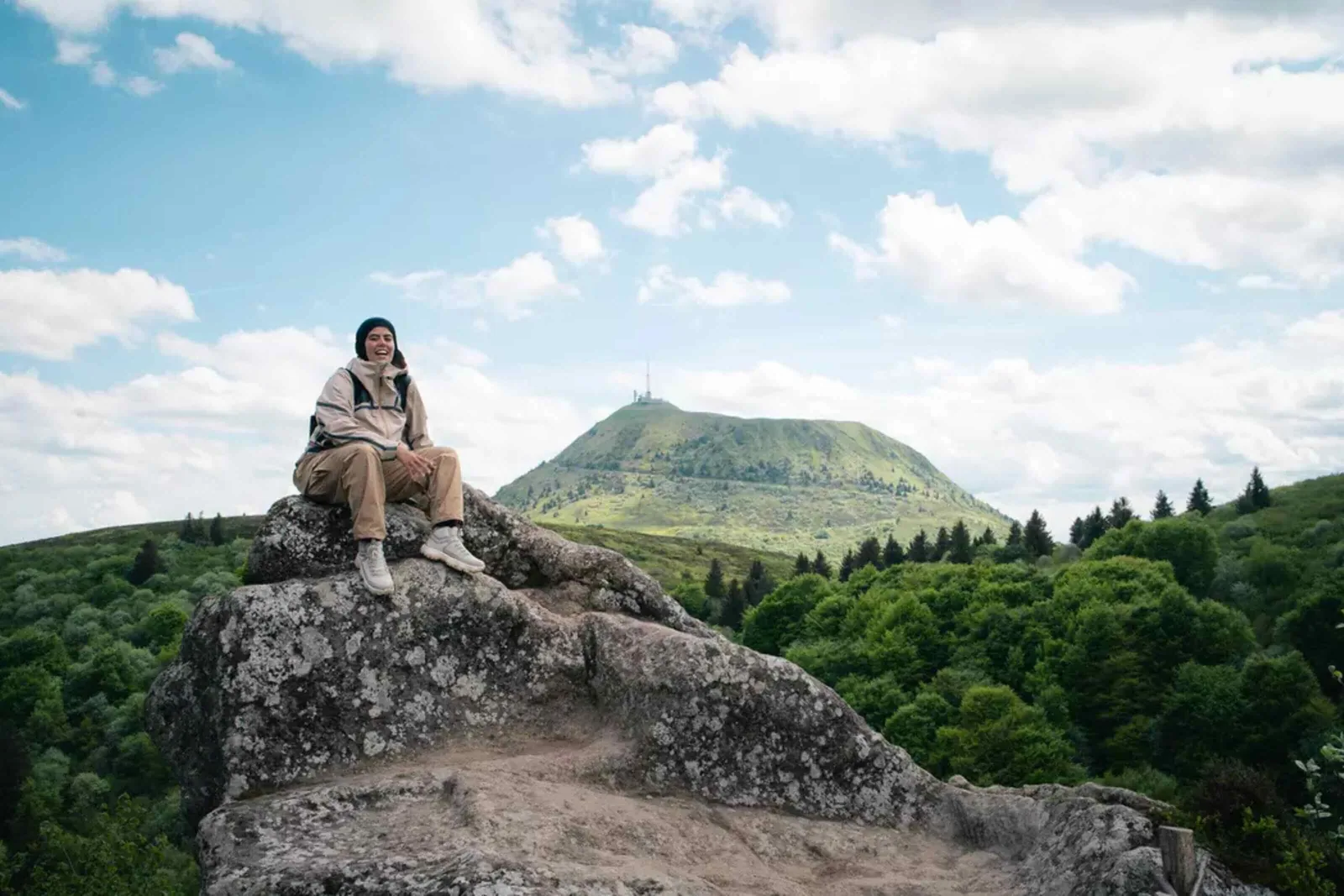
Sociologist Nacira Guénif-Souilamas connects that vigilance to a broader mechanism.
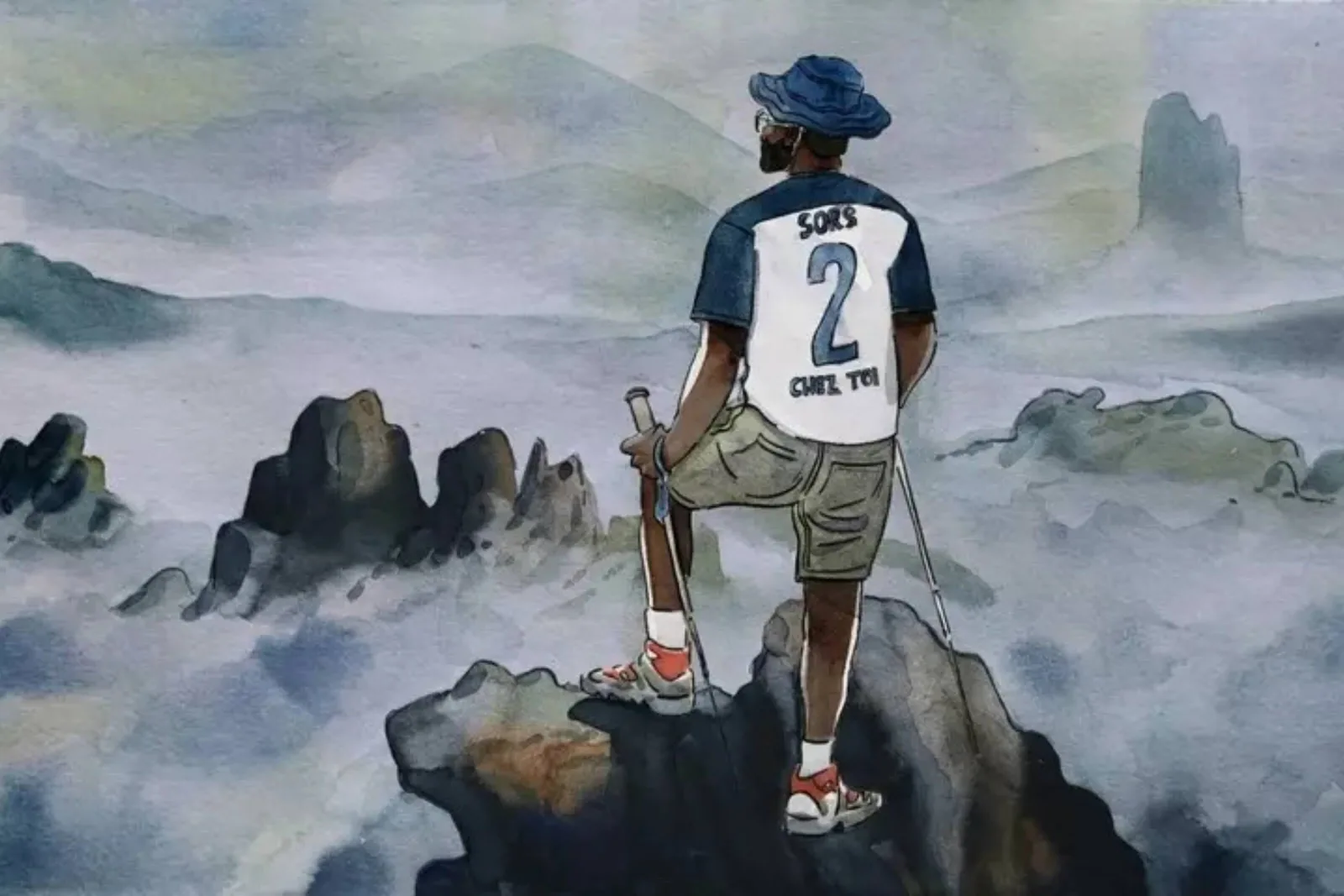
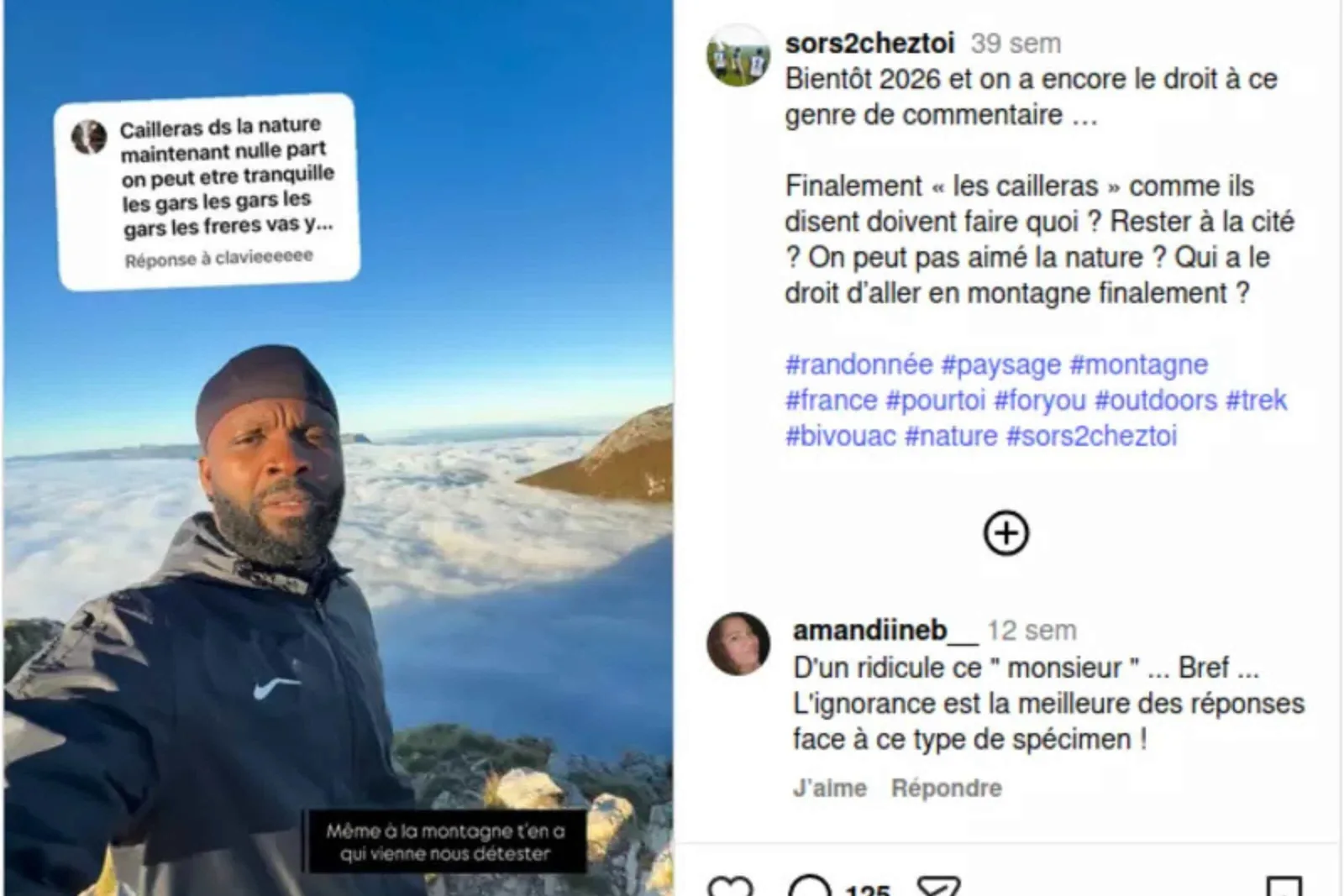
“That’s the whole problem with what people sometimes call ‘everyday racism.’ It happens in ordinary situations, but racism itself is never ordinary. People who experience racism know that these interactions are never harmless. They can have a lasting effect on the people subjected to them. And at altitude, when you’re especially vulnerable, the behavior of a refuge manager, for instance, can have serious immediate consequences.” Kovana found his own unlikely way into the mountains: playing video games with friends he had met online, until the group eventually decided to meet in person at Lac du Léat, near Grenoble. He loved it enough to start the Instagram account Sors2chez toi, where he shares his outings with infectious enthusiasm and tries to convince people from working-class neighborhoods like the one he grew up in that hiking is for them too.
The racist responses online came quickly. “Stay home, we don’t want to see you here.” More recently: “Thugs in nature now. There’s nowhere left where you can have some peace.” But the comments that affect him most come from other hikers in person. When he camps, they often focus on cleanliness. “People ask me all the time whether I have something to put my trash in, as if respecting the place wouldn’t come naturally to me,” Kovana says. Most of the people he meets in the mountains are open and curious, he says. They ask questions. But every so often, something feels off. “You can tell the guy watches too much BFMTV. He’s nice, but he already has an idea in his head. And there you are, having to prove you’re not dangerous, not what he expects a Black man to be.” To help his community avoid bad experiences, Kovana regularly shares practical advice about gear, trail behavior, and respecting lakes and wildlife.
Nadir Dendoune gives the young people he takes into the mountains an even harsher warning. “You don’t get to make a mistake. If you screw up, every French banlieue gets blamed for it. We know people are watching us.” It is the burden of having to represent an entire group—to reassure people, to be exemplary—in a way white people generally do not have to. Sociologist Maboula Soumahoro has described this as the “racial burden.”
“It always falls on the person experiencing the racism,” Guénif-Souilamas says. “That’s exactly how something recreational can turn into a nightmare.”
The future is theirs
Over the past few years, things have started to change, in part because of social media.
In June, Kovana announced a group outing to Étretat on his account. A teenage girl and her brother, who had been following him for weeks but had never dared to message him, showed up on the trail with their mother. “I loved that,” he says. Dendoune sees how different things are now. “My Everest climb in 2008 had a limited impact. If social media had existed back then, it would have been crazy. A kid sees someone who looks like him in the mountains—like the YouTuber Inoxtag—and thinks, ‘I can do that too.’” In Grenoble, Foued also follows local hikers of color, including @iwas.here38, who post videos of alpine lakes and summits accessible by bus. “Since they started posting those videos, I feel like it’s easier for people to take that first step.”
“I think things are going to change, even if the political rhetoric targeting Black and Arab people doesn’t help. They need to get used to seeing us in the mountains. Not against them. With them.”
Nadir Dendoune, journalist
Many of those creators are women. Dounia, known online as @the_routarde_voilée, documents her hitchhiking trips. Aché founded the organization Our Summit, which runs free outdoor outings for young people from the banlieues. “Visibility is a political act because, for us as women who wear the hijab, visibility can also put us at risk,” says Imen. In 2023, she helped organize an ascent of Kilimanjaro, Africa’s highest peak, with eight French women of color from the banlieues, guided entirely by women. “You get Islamophobic
comments that are even worse than what men get.”
Other groups want to take things further. Rando fragile organizes fully planned hikes from Paris that are meant to be accessible “to everyone.” In southern France, PSartrek Club operates in the same spirit and emphasizes what it calls “real connections.” “With these groups, we’re no longer trying to fit ourselves into a space that wasn’t designed with us in mind,” says anthropologist Jasmijn Rana, who has led a European research project on ethnoracial inequality in outdoor recreation since 2025. “We’re creating a space that was.”
One question remains. Reporterre asked Nacira Guénif-Souilamas: Why so much hatred, and why now? Her answer flips the question around. If racist comments are multiplying under videos like Omar’s, she says, that does not necessarily mean things are moving backward. It may be a sign that more and more people of color are going into the mountains, filming themselves there, and feeling that they belong. “They’re saying to themselves, ‘If I want to do this, why should I deny myself?’”
For Guénif-Souilamas, the hostility says a great deal about the people who see the mountains becoming more shared—and feel their sense of exclusivity slipping away. “I grew up in the Paris region, always surrounded by concrete,” Imen says. “Everyone needs to touch some grass once in a while and breathe fresh air. Being able to enjoy nature and recharge shouldn’t be a privilege.” “I think things are going to change, even if the political rhetoric targeting Black and Arab people doesn’t help,” Dendoune says. “They need to get used to seeing us in the mountains. Not against them. With them.”