
Mélissa Le Nevé: “I’m a Bit of a Wild Animal”

A defining figure in world climbing and the first woman to send Action Directe, the legendary 5.14d in Germany, Mélissa Le Nevé has always carried both mystery and intensity. Behind the résumé is an athlete fiercely attached to freedom, someone who turned climbing into a way of understanding life and nature into her safest refuge. An unusually quiet encounter.
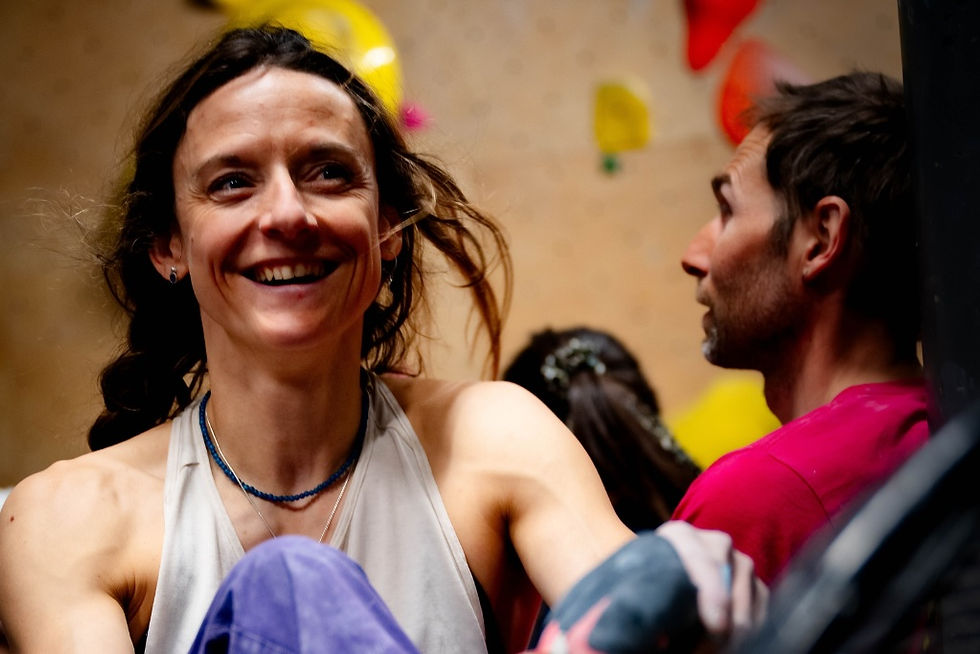
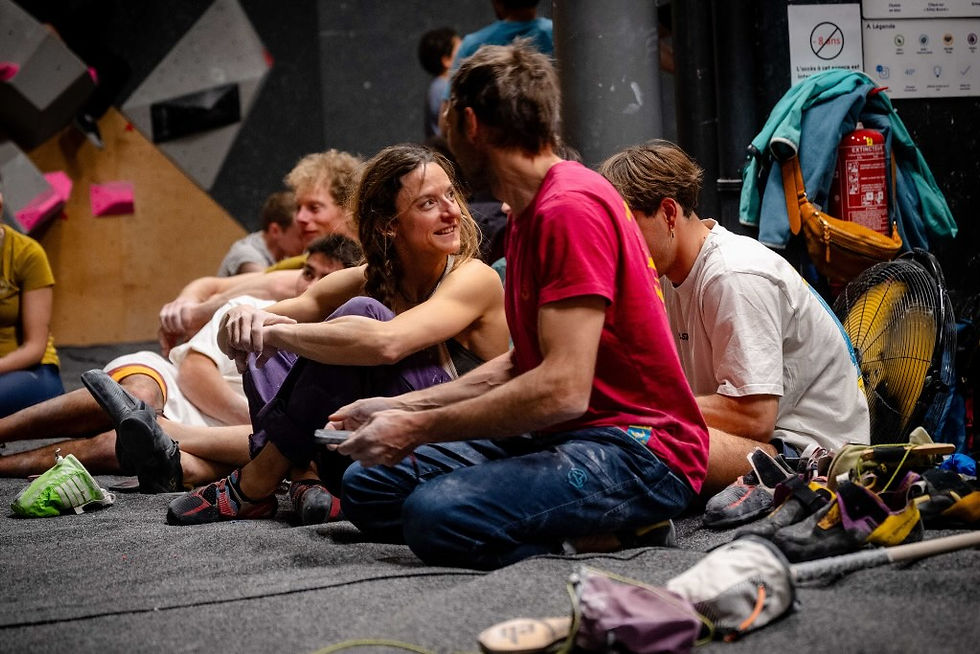
The Paris climbing gym is still mostly empty early in the day. Before the launch of the La Sportiva Climb World Tour, the front desk at Climb Up Porte d’Italie is filled with little more than a conversation between Caroline Ciavaldini, Mélissa Le Nevé, and a pair of bloggers dressed head to toe by the Italian gear brand.
The handshake is polite, but Le Nevé is clearly guarded. It takes a little proof of good faith, and the promise that her words will be handled carefully, before she lets the wall down. A few moments later, she smiles at herself for it. As the interview begins, she admits: “I showed up very suspicious. I’m a bit of a wild animal. I need to be tamed.”
From the Vosges to Bordeaux Asphalt
To understand the Le Nevé puzzle, you have to go back to the beginning, near Gérardmer, in the Vosges. She describes it as a “little piece of paradise,” the place where she lived a dream childhood shaped by total freedom and a deep, physical connection to the outdoors.
Then, just before she turned 10, that original balance broke. Her father, an engineer specializing in wood resistance, was transferred to Gironde. For the young girl, the landing was rough. “When I arrived in Bordeaux, I had a lot of trouble fitting in,” she says. “A big city, so different from Gérardmer... I had trouble integrating, understanding the codes.”
“I was someone who had trouble breathing. I shook. I was afraid of a lot of things”
Uprooted and introverted, she looked for a place to belong. The ocean called to her, but without the money to buy a surfboard or cover the back-and-forth trips, she put her name, almost by chance, on the waitlist for a climbing club in Cestas. A year later, when she got in, it felt like a revelation. “It really was love at first sight when I started climbing. I immediately felt like I was in the right place,” she remembers.
More than a sport, climbing gave her mentors: young retirees who helped run the club, took her outside for the first time in Ariège, and passed on a deep love of nature.

Most of all, climbing became an unexpected antidote to the anxiety that was starting to take hold. “I was someone who had trouble breathing. I shook. I was afraid of a lot of things,” she says. Climbing gave her a safe ecosystem and a place to land. A lifeline for a young girl hungry for experience, who kept collecting passions: pole vault on Wednesdays with the woman who would become “her sister,” climber and vaulter Alizée Dufraisse, and a serious musical education that eventually led her to play Carmen as a solo clarinetist.
Competition as a Mirror
Against the cliché of the competitive machine, Mélissa Le Nevé entered competitions with an almost clinical interest in her own weak spots. Deeply prone to stress, she treated the circuit as a place to learn herself. “I put myself in those stress-management situations to try to understand who I was,” she says now.
She draws an interesting parallel between being uprooted in Bordeaux and entering the competition world, seeing in both the same search for belonging. “Isn’t competition, in the end, a situation of integration?” she asks. “It’s being socially part of something moving in the same direction.”
“And what if it’s the men who are scared?”
The holds and the wall became tools for self-examination. “For me, climbing is a mirror,” she says. “It allowed me to get a little distance, to breathe better, to face certain fears, to manage certain emotions.” Every route became an inner dialogue, a way to break down her own blocks. The benefits reached far beyond results: competition simply taught her how to open up to the world, how to face other people’s eyes “without turning red as a tomato and stuttering.”
Still, that private, healing search sometimes collided with the demands of high performance. After one competition where she had just won two silver medals, France’s national technical director asked her bluntly: “When are you going to win gold?” She learned to build a sealed-off bubble around herself. Performance would never be the point. It would be a tool.
“There are rituals where young warriors go into the forest to meet all the power of nature,” she says. “That’s how I see it.”
Climbing as a “Feminine Force”
That careful reading of herself inevitably shapes the way Le Nevé sees the evolution of her sport. As the first woman to climb Action Directe, the mythic 5.14d that helped define modern sport climbing, she watches with fascination as a new generation narrows the gap with men in a way that feels almost unprecedented.
But when the conversation turns to the sometimes awkward media treatment around women’s achievements, she steps out of the argument with a mischievous edge. “And what if it’s the men who are scared?” she says, amused.
More than comparison for comparison’s sake, what excites her is the larger movement underneath. “I really see climbing as a feminine force moving forward and setting an example of parity. With several real role models, with strong personalities, it’s incredibly interesting,” she says.
It is a whole generation breaking free and rewriting the codes of performance on rock, drawing strength from one another, proving there does not need to be one queen at the top, but many possible lines.
“I like relationships that are deep, really connected”
Training has played a major role, of course. But Le Nevé also believes the nature of climbing itself helps push the sport toward parity. Modern climbing has lowered the altar of pure muscle and put better movement in its place. “Because of gravity, I think we can be more or less equal,” she says. “There is movement, flexibility, decision-making, the mind, emotional management.”
The Pull of Open Air
Le Nevé left the competition circuit at the end of 2016 to focus on rock, and she has built a particularly rich private world far from the usual concerns of the climbing scene. She reads the psychoanalyst Carl Jung. For a while, she became fascinated by Eastern European literature, from Bulgakov to writers from the former Yugoslavia, because she was “fascinated by how so much suffering could create so many masterpieces.”
“What makes me happy is seeing a bird fly”
Ethnology studies and deeply formative trips to Malawi and Madagascar even led her, when she was younger, to consider becoming a foreign correspondent. But faced with the noise of the world and the scale of its social problems, the athlete eventually chose a kind of deliberate simplicity, with no trace of cynicism. “I feel like, as an ant, I’m not going to move the whole path forward,” she says.
That realization allowed her to accept that her place in the world was, above all, to be happy in it, and to inspire others through her passion rather than through grand speeches.
That choice pushes her to focus her energy on real human connection, and to avoid the empty comfort of social performance. Small talk is not her thing. “I like relationships that are deep, really connected. Superficiality is something I can handle now. I’m a frank and direct person. I try to be calm and choose my words.”
It is a radical search for meaning, and it shapes her encounters in climbing as much as in everyday life. Now based near L’Argentière-la-Bessée, at the edge of the Écrins, she lives days that feel like her, without chaining herself to one fixed point on the map. In her own words, it becomes almost an aphorism: “I really am a free bird.”
Most of all, air has replaced rock in more ways than one. Since the pandemic, she has developed an all-consuming passion for paragliding. Asked what truly feeds her day to day, her answer bypasses both plastic holds and cliffs. “What makes me happy is seeing a bird fly. What I love is sitting down before I unfold my paraglider and watching the birds,” she says.
Her eyes light up as she describes a flight over the Vercors. “I found myself face to face with a bearded vulture. It’s huge. I honestly think it was one of the most beautiful moments of my life. To fly, to have that chance.”
The climber who was on alert in the first minutes has given way to a contemplative woman, relieved to have walked paths other than pure athletic performance. Still, even rare birds have to deal with the ordinary laws of time. The hour is getting late, and Mélissa Le Nevé has a train to catch. However much you want to keep the flight suspended, eventually, it is time to come back down to earth.


