He takes a deep breath, then steps forward. As if bracing himself for what he is about to see, he grips the camera hanging from his shoulder. He steps over cracks in the earth and charred roots. The ground beneath his feet is still warm. The devastation is everywhere: blackened trunks, scorched boulders, and bare branches stretching into the distance. But what strikes Simon most is the silence. The trees that remain are still standing, yet there is not a sound. No birds. No glint of sunlight. Not even the feeling of wind. It is as though everything has stopped.
Bleau on Fire
Standing between two boulders, Simon listens closely to the French National Forests Office official accompanying him. Sophie David explains that when a tree trunk is burned more than two meters, or about six and a half feet, above the ground, the tree can be considered dead. Each one will have to be assessed individually. But David needs only to turn in a circle to estimate that two-thirds of the trees here will eventually come down. This is Trois Pignons, on the southwestern edge of the Fontainebleau forest, one of the areas hit hardest by the most destructive fires in the massif’s modern history. More than 2,000 hectares—12 percent of the largest state-owned forest in the Paris region—have burned. Nothing like this has happened here before. And it is not over. David places the back of her hand against a layer of peat that is still warm. The fire has been contained, she explains, but it is not yet out. Just a few yards away lies the famous 25 Bosses loop, along with a collection of boulders that have played an iconic role in climbing history. Simon stops in front of one of them.
“This is Le Diplodocus, the boulder that gave the area its name,” he says. Then he points out its features. “When you tilt your head and look closely, it really does look like a dinosaur.”
“The forest isn’t the backdrop to our sport. It’s the other way around: The forest is the reason our sport exists here”
Simon Senet, climber and creator of the Instagram page Fontainebleau Boulder
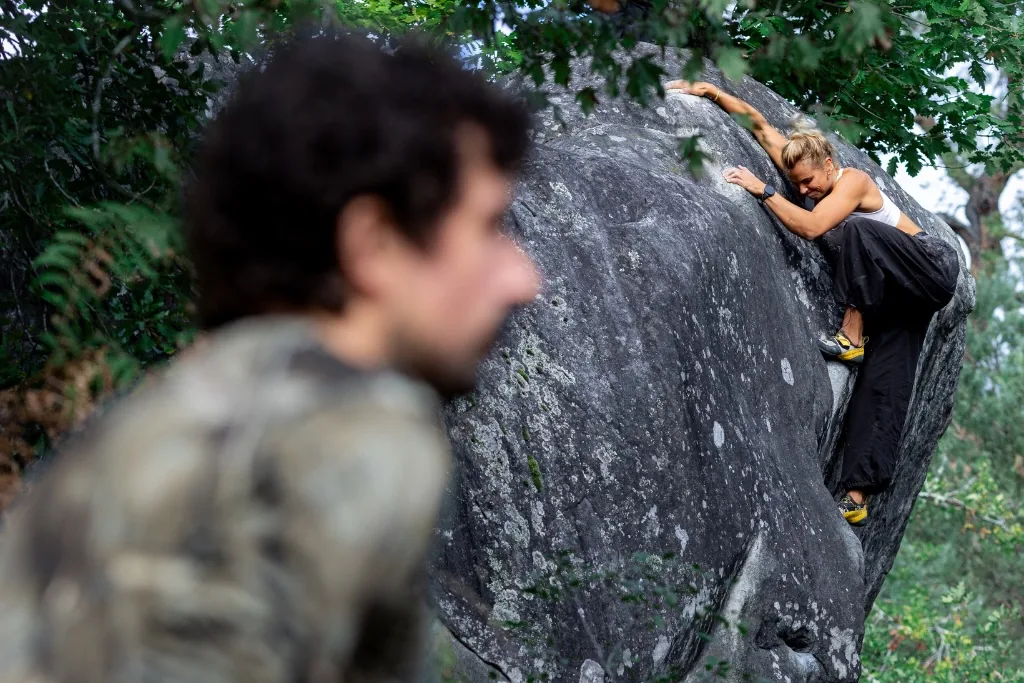
At 31, Simon Senet already knows the forest by heart. He describes his first visit, 10 years ago, as “love at first sight.” Coming from a commercial climbing gym in the Paris area, he immediately saw Fontainebleau as a completely different way to climb. While many of his friends treated the forest as an extension of their “playground,” Simon became interested in its natural heritage. As “a reaction against the obsession with performance,” he created an Instagram account called Fontainebleau Boulder, where he documents the countless stories behind the forest’s boulders. After standing silently in front of Le Diplodocus for several minutes, he finally speaks. “I’ve never come to Fontainebleau just to climb,” he says. “The forest isn’t the backdrop to our sport. It’s the other way around: The forest is the reason our sport exists here.”
Bleau in Their Blood
Every climber who spoke with Vertige Media made the same point. About 10 days after what they all describe as “a tragedy,” talking about climbing almost feels indecent. For them, the forest has always come first. Christophe Laumône started climbing in Fontainebleau long before climbing gyms existed. When the fire began on Sunday, July 11, firefighters stopped it about a hundred yards from his home. “I thought my life was going up in smoke,” he says over the phone. He means it both literally and figuratively. Climbing among the maritime and Corsican pines has defined his entire life on the rock. Now an instructor, he describes climbing less as performing on a boulder than as “sitting between attempts and looking at nature.” After the fear came what he now calls “a profound sadness.” In the areas where he put up hundreds of problems, the boulders are now charred. For someone who has climbed in the forest for more than 40 years, entire landscapes have burned away—and the memories tied to them. “The idea of climbing at Trois Pignons again is just unthinkable,” he says quietly. “It doesn’t make sense anymore.”
“To me, it’s like when a family member suddenly becomes disabled. Everything is different”
Gaëtane Potard, climber and secretary of the Respect Bleau association
With thousands of boulder problems, Trois Pignons is one of the busiest areas in the massif. It may account for more than a quarter of all climbing traffic in the forest. Will these scorched boulders, formed from Fontainebleau’s ancient sands, ever be safe to climb again?
“No one knows,” says Gaëtane Potard, secretary of Respect Bleau, one of the climbing organizations most active in protecting the forest. Some holds may have broken. The fire burned through the massif within about four inches of the ground’s surface, destroying roots that helped hold certain boulders in place and potentially making them unstable. “Either way, trees are going to fall onto the boulders,” Potard says. “There will be too much disruption for Trois Pignons to reopen anytime soon.” Sophie David of the National Forests Office stops short of confirming that assessment, but the agency may formally impose a one-year closure in the coming days.
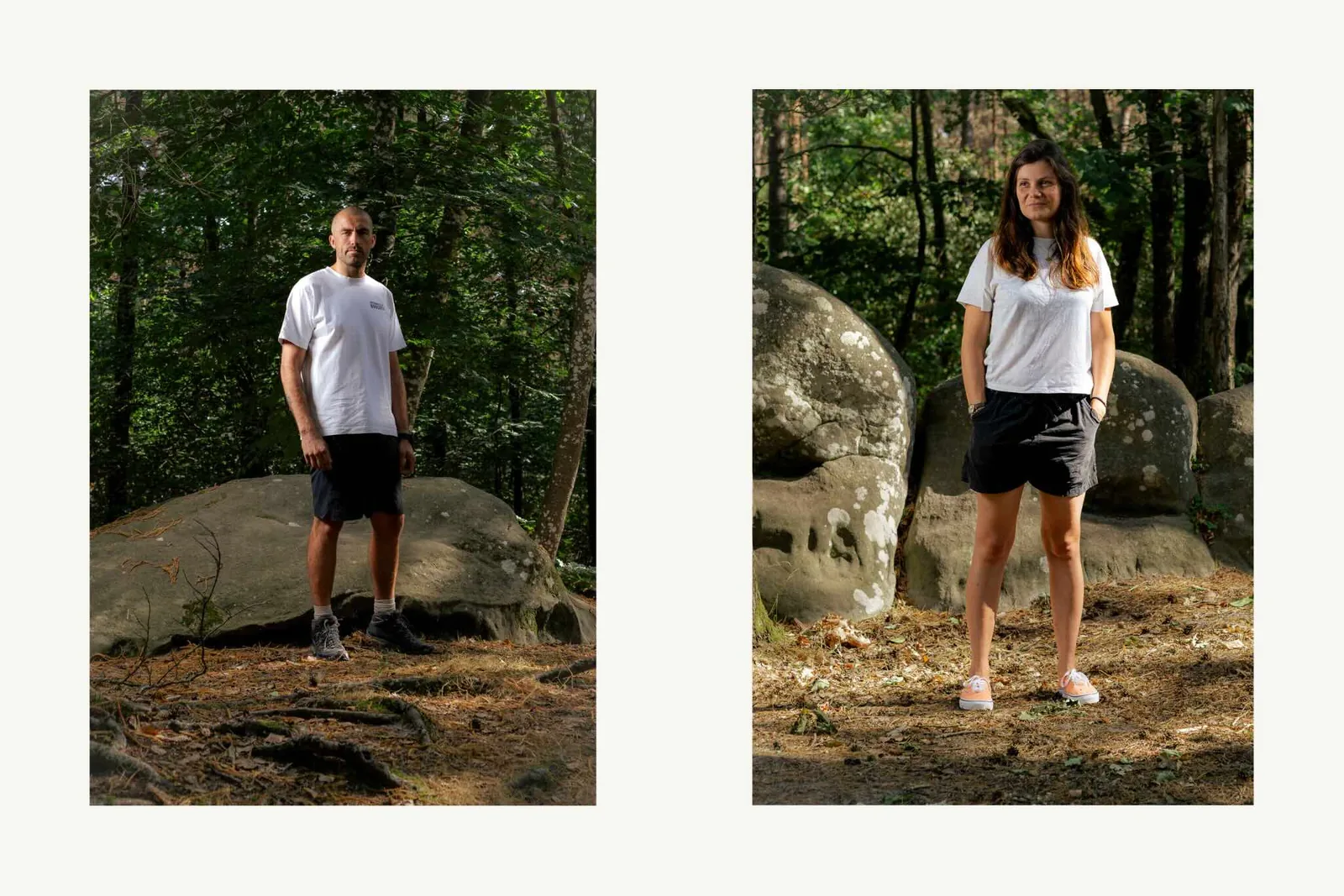
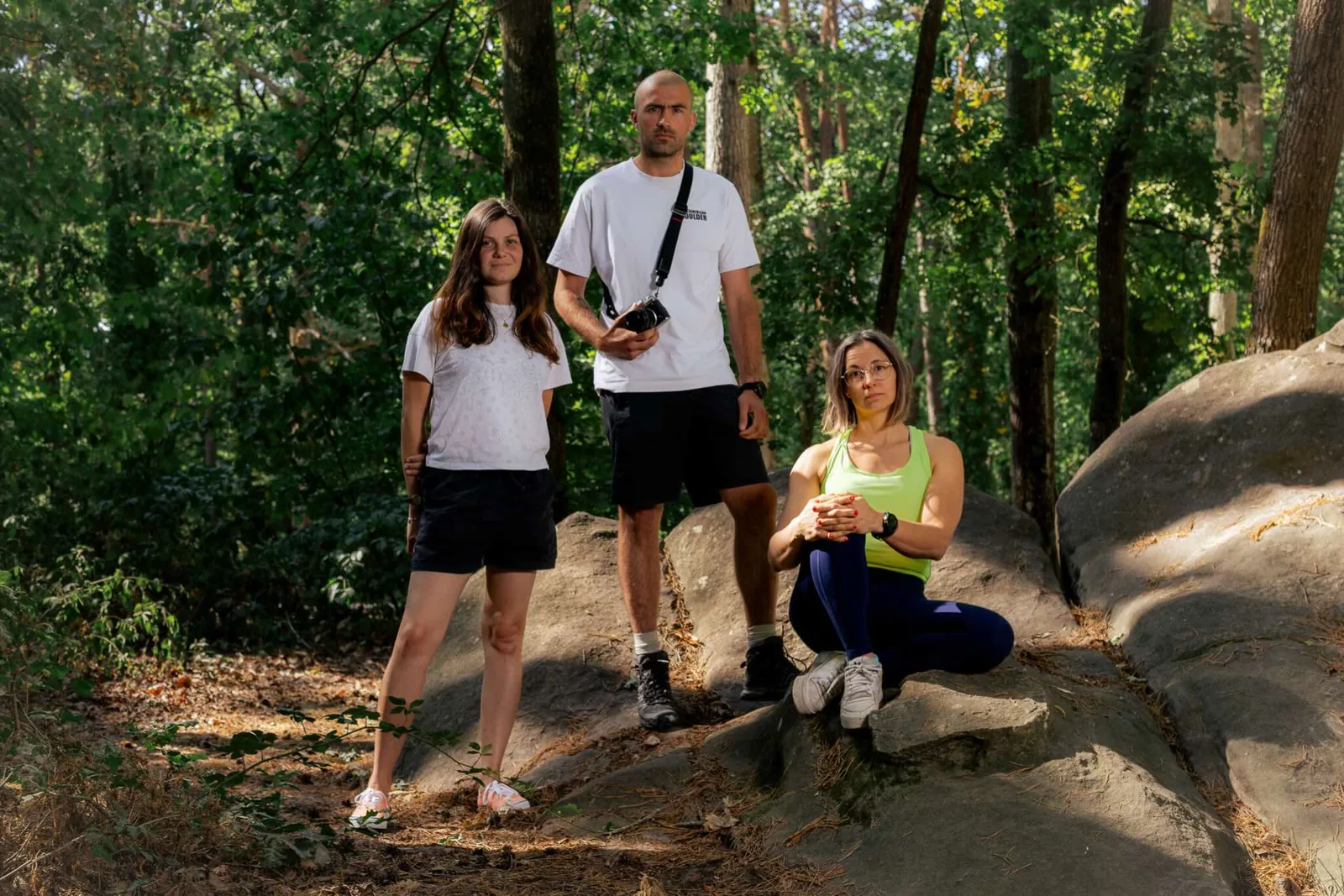
“We’re entering a waiting period that will change how we live,” Potard says. “To me, it’s like when a family member suddenly becomes disabled. Everything is different.” For the Bleausards—the local climbers who see the forest as essential as breathing—it means finding a new way to live. Many residents have already shifted into the role of caretakers. Climbers are helping public agencies educate visitors. Raphaël and Tiphaine are even patrolling with the National Forests Office, making rounds to ensure that no one ignores the ban on entering the forest. At times, they are also watching for anyone who might try to set it ablaze again.
“That was my first instinct,” Raphaël says. Twenty-four hours after the fire began, the man in his 40s says he raced around the parking areas, checking for “other malicious acts.” Tiphaine, who was born here, says her greatest fear is that one person could start the fire again. She knows that 90 percent of forest fires are caused by human activity, with a significant number believed to involve deliberate or criminal acts.
Between Fires
Access points around the forest’s 25,000 hectares have been blocked with barriers and caution tape installed by police, forestry workers, and climbers. For Tiphaine, that collective effort shows “how deeply people care about the forest.” Raphaël also sees a practical benefit.
“The National Forests Office knows the trails inside and out,” he says, “but I think they need climbers to keep an eye on the bouldering areas.” That is exactly what has happened. Fontainebleau averages around 30 fire starts each year, and climbers have often stepped in—sometimes putting out fires themselves with sand, sometimes reporting early warning signs, and often educating other visitors.
“To me, something has changed. I’m seeing more and more new climbers who are obsessed with performance and don’t care about the environment around them”
Aurélie Blaise, climber and president of the Bloc'age association
Aurélie Blaise knows the problem well. She is the president of the climbing organization Bloc’age and runs a guesthouse in Noisy-sur-École. Along with cancellations, she has had to manage visitors’ frustration over being unable to climb. “I understand,” she says. “When you’ve planned your vacation around climbing, that can be hard to hear.” But beyond the fires, Blaise has also noticed what she calls “a troubling consumer mentality.” “People act as though they’re entitled to everything,” she says. “As if they assume someone else will clean up after them.” Wearing a fluorescent yellow tank top, Aurélie folds her arms before making her next point. “To me, something has changed,” she says. “I’m seeing more and more new climbers who are obsessed with performance and don’t care about the environment around them.”
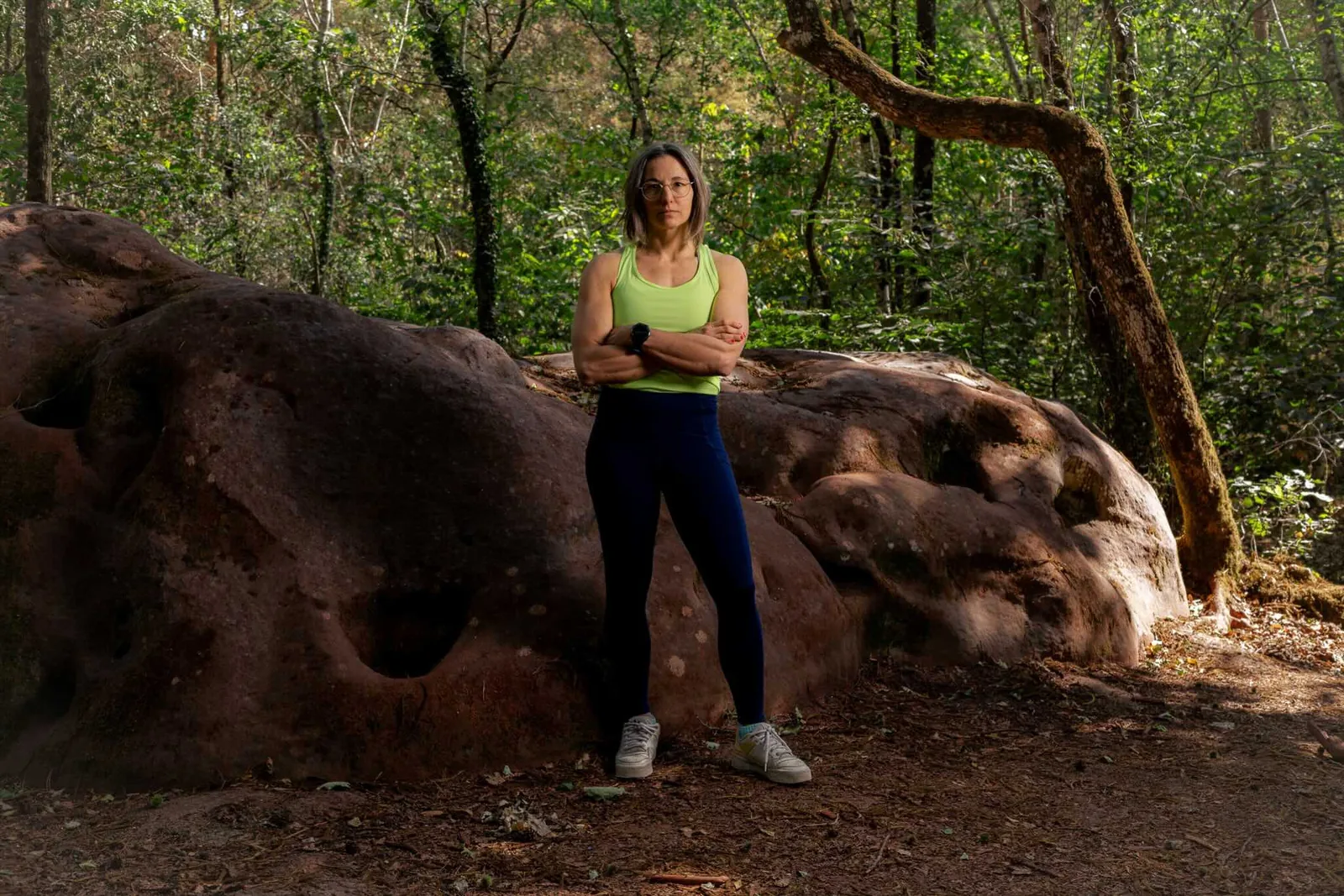
For Fontainebleau’s climbing community, the fire has forced a deeper reckoning. Millions of people now visit the forest, and some of their behavior is becoming a serious problem. “Climbers still smoke at the base of the boulders,” Tiphaine says. “Plenty of people bring a camp stove to make coffee,” Simon adds. “There’s a huge wave of solidarity right now,” Raphaël says. “But I know the difficult conversations may start tomorrow.” In fact, those questions are already being debated in WhatsApp groups and on social media. Should climbers have to pay for access? Should the forest be closed entirely whenever the fire risk becomes too high? Simon Senet is convinced that no matter how often climbing organizations repeat their warnings, the message is not getting through. “Only 1 percent of the people who visit this forest ever hear these messages,” he says. “We need to change how we communicate them.”
Simon insisted on visiting Roche aux Sabots, where millions of climbers, including him, first learned to climb outdoors. The moment he arrives, he feels a deep sense of relief. Located close to nearby homes, the area was spared by the flames thanks to firefighters’ relentless efforts. Suddenly, the forest feels like itself again. The colors return. So do the smells and the feeling of wind. Simon seems restored by it. This, he says, is when his project feels most important. “To share the richness of the forest,” he says, “and with it, the entire heritage of climbing in Bleau.” That evening, he will head back to his keyboard and write the story of another boulder. For now, Sophie David jokes that the chalk marks are still here. And, miraculously, Simon smiles.