
Diary of a Foothold Nobody Respects

In climbing’s grand story of upward struggle, the glory always goes to the biceps and the big, flashy moves. But the real line between a smooth send—a clean climb from bottom to top—and a sudden fall is usually under your shoe, on the tiny footholds climbers ignore right up until panic sets in.
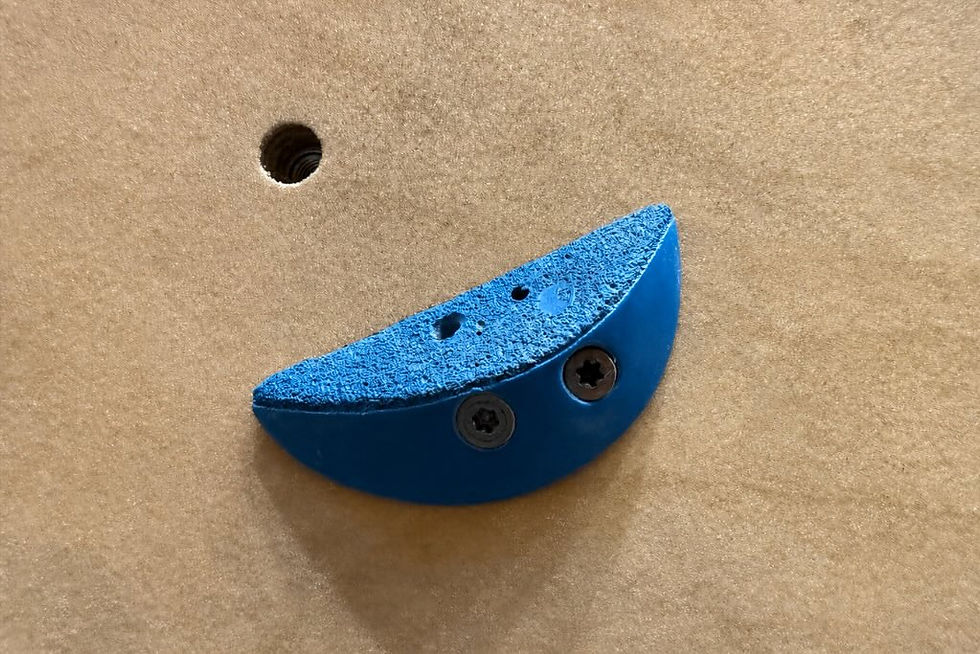
I live in the shadow of Instagram-friendly jugs, those big, easy-to-grab holds; dramatic volumes; and moves designed to feed your social media accounts. From my permanent blind spot, I watch the great misunderstanding of climbing play out over and over again: most of you think you’re not strong enough. Really, you just lack basic technical decency.
I am not spectacular.
Nobody gasps when they see me. Nobody walks across the gym to study me with the solemn devotion you reserve for purple slopers or shiny new pinches. Nobody debates my texture, my line, or my aesthetic value. I am not a handhold. I am not the final jug. I am not that giant orange lip around which three adults in tank tops suddenly form a research committee.
I am a foothold. In other words, I am the thing you refuse to consider until the exact moment your self-respect depends entirely on my existence.
No matter where I sit on the wall—down low, barely above the mat, or three yards up on a slab, a less-steep wall where balance matters more than muscle—I live below your useful field of vision, below your pride, down where rubber and swearing meet. You step into a boulder problem like you’re entering a private negotiation with reality. Your eyes go up. Your fingers are already picturing the victory. Your forearms are rehearsing their own tragedy. You see everything that lets you tell climbing as a story of courage and upper-body strength: that intense little face you make to hide the fact that you still refuse to bend your knees.
You notice me later. Usually too late.
When your foot starts searching empty air with the panic of a kitten on a sunroof. When your hips decide to join a different gravitational system. That is the split second when you realize this problem was not designed to be solved with pull-ups and a gym membership alone.
That is also when desperation takes over. Panicked, some of you try to grab me with your hands. You should see a climber in distress trying to pinch my two centimeters of plastic with their fingertips, clawing at resin and hoping for a miracle. I was not made for your hands.
Then, inevitably, you fall. You look down. And you blame me.
Not directly, of course. You say, “That foot sucks.” Or, “It’s slippery.” Or the timeless classic: “It’s morpho”—climber shorthand for “this only works for certain body types,” and also the elegant refuge of people discovering that their bodies are not quite the biomechanical fantasy they had imagined. You call it slipping. I call it putting the full weight of your denial on two centimeters of plastic.
You should see the way you step on me. My daily life can be divided into a few major schools of bad faith.
In the symbolic economy of the climbing gym, I am the working class of your success
First, there are the movers. They bring their foot down like they’re trying to get a double-door refrigerator onto an escalator. No angle. No softness. The shoe lands, physics does its best, and when it slips, they blame gravity, the route setting, or the temperature in the gym.
Then come the tappers. They test the surface. Tap. Tap. Tap. Like they’re trying to wake up an old coffee machine. They feel me, but they refuse to weight me, because trusting a foothold requires an act of technical faith they simply cannot manage. They would rather hang from their arms, stiff as coat hangers, and conclude that “the problem is kind of weird.” No, the problem is not weird. You tried to negotiate with gravity without bringing a valid argument.
And finally, there are the theorists, who have a very verbal approach to failure. Stainless steel water bottle, loose pants, hours spent analyzing from the mats. They say things like, “Honestly, if you take the undercling in a shoulder position, it opens up the hips.” They say a lot of things, basically, except the only one that matters: “Maybe I should place my foot properly.”
In the symbolic economy of the climbing gym, I am the working class of your success. Wherever I am on the wall, I support, I absorb, and then I disappear from the story. When you send, you talk about the deadpoint, the dyno, the crimp you held. You never say, “And then I entrusted my entire future to a tiny screw-on bump in the middle of the wall.” Your tragedy is that you dream of having steel fingers when what you really need is faith in your toes.
Remove me, and your smooth little world becomes a full-body torture session
The upper body gets good press. It flexes. It makes veins. It photographs well. Feet, meanwhile, live trapped in shoes that are too small and remind the human species that before it became obsessed with climbing upward, it was made of mammals that had to learn how to shift their weight. That is a harder sell. Nobody launches an influencer career on the quality of an outside edge.
But the good climbers know. They walk up, read the feet, and understand that the hand move is often just the result of everything below it. They do not step on me like they are crushing an inconvenient thought. They weight me.
Weighting a foothold is not just pressing down. It means arranging the body so weight turns into friction. It is a technical conversation between rubber, hip position, and the decision to stop pulling like a wild boar. A good foot placement has a kind of politeness toward the wall.
That is why I know how good you really are. Not the level in your social media bio, or the one you announce with carefully measured modesty somewhere in the “5.11” range—that wonderfully vague administrative region where so many bruised ambitions live. Your real level comes down to the split second when your climbing shoe meets me. Precision. Silence. Or noise.
I am not jealous of handholds. They get the spotlight. They get brushed. You assign them personalities: “That sloper is nasty,” “that pinch is powerful.” I am just “the foothold.” A piece of furniture. But remove me from a section and everyone starts crying. Remove me, and your smooth little world becomes a full-body torture session.
I am small, narrow, rarely comfortable. But I am a promise. All I am saying is this: look down, lower the pride in your ankle, and place your foot. Not like some administrative formality before the “real” move.
Place it like your whole world depends on it.
Because, statistically, it does.


