
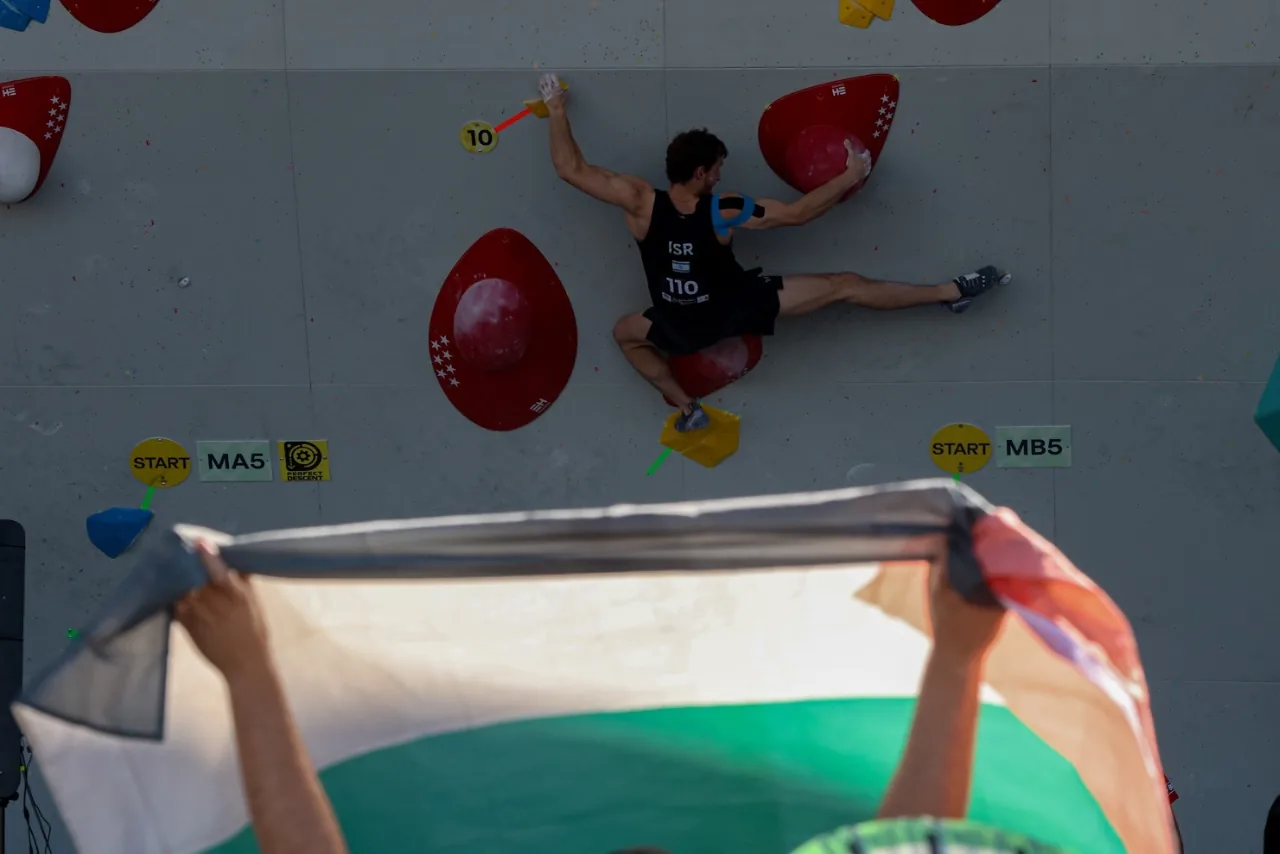
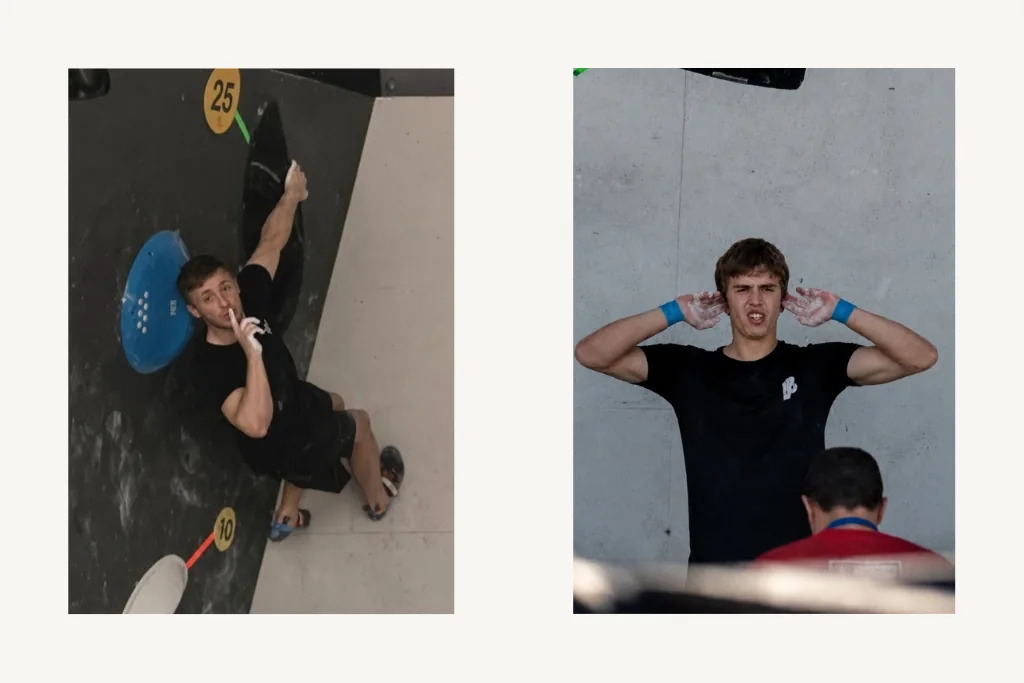
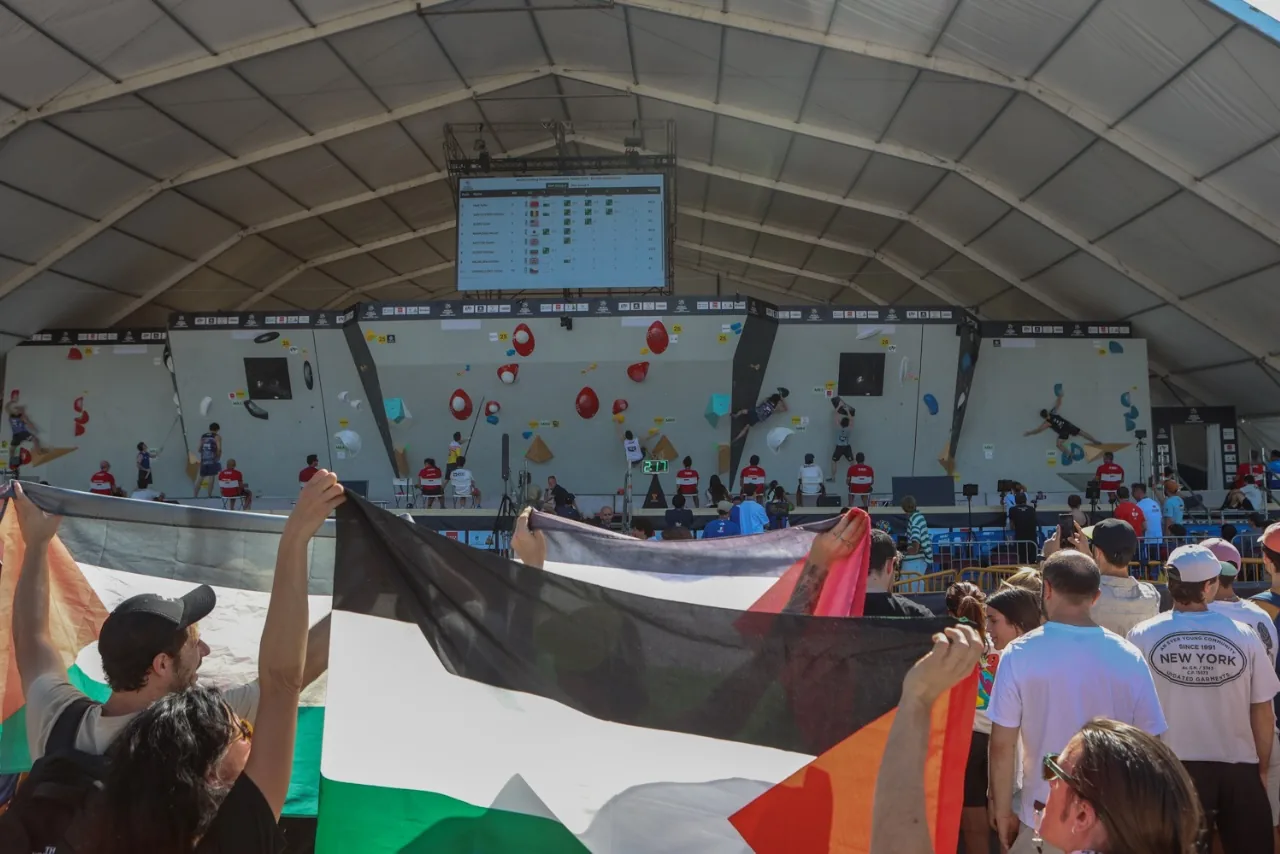
In climbing, athletes almost never do this. When Adi Bark tops one of the boulders in the qualification round of the Madrid World Cup, the Israeli climber turns toward the crowd and raises his index finger to his lips. “Shhh.” In sports, that gesture usually belongs to soccer players answering hostile fans or critical journalists after scoring a goal. Here, Bark is addressing a crowd of protesters chanting pro-Palestinian slogans each time athletes wearing the Israeli flag climb onto the wall. On Thursday, May 28, the temperature in Alcobendas, outside Madrid, is above 86 degrees. Still, roughly a hundred protesters have shown up, chanting “Free Palestine” at full volume and waving large Palestinian flags.
The Conflict Moves Onto the Wall
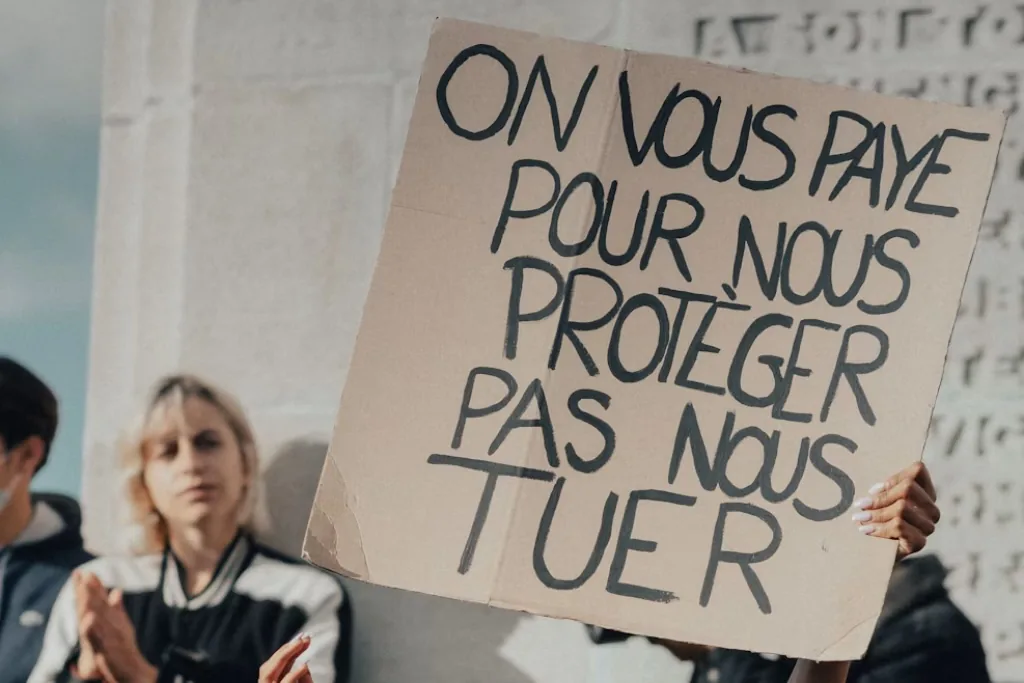
Climbers for Palestine Spain had made its intentions clear. For several weeks, the Spanish branch of the international movement had been announcing protests around the official competition circuit run by World Climbing, the international climbing federation. Whether through chants, boos, or whistles, the Spanish group’s action is part of a growing series of visible efforts by collectives denouncing the presence of Israeli athletes in official international climbing competitions.
In mid-May, a private Belgian climbing gym known for its strong values decided to close its doors to an event it was supposed to host — the World Climbing Europe Youth Series Brussels 2026 — because athletes representing Israel were scheduled to compete. In a rare move in the history of the sport, World Climbing was forced to cancel the event.
The groups calling for a boycott of Israel on World Climbing’s official circuit do not intend to stop there. Pascal Etienne, a member of the French collective Grimpe Solidaire Internationale, or GSI, recently told Vertige Media: “From now on, World Climbing should expect mobilization at all of its competitions.”
Organized internationally under the banner of Climbers for Palestine, several national groups have sent letters to their federations, demanding that they take a position on the presence of Israeli athletes in competitions. So far, no federation has answered the letters or responded to requests for meetings made by the collectives.
“It took only four days after the invasion of Ukraine to exclude Russian athletes from all sports competitions. Nothing has been done by the IFSC to ban Israeli climbers from its competitions”
Grimpe Solidaire Internationale, in a letter addressed to the FFME
Vertige Media was able to review the letter sent by GSI directly to Sandra Berger, president of the French climbing federation, the FFME, on May 28, 2026. GSI, which is affiliated with the FSGT and has been involved for years in climbing development projects in Palestine, describes the conditions faced by Palestinian climbers: crags they bolted themselves later confiscated, access to climbing areas blocked by military checkpoints, and the import of climbing gear restricted. Members of the Palestinian Climbing Association have even been arrested and held under Israel’s policy of “administrative detention,” without charges, without trial, and without a defined release date.
GSI also argues that the Israeli climbing federation, the ILCA, “is directly involved in various processes denying the rights of Palestinian climbers, thereby violating the rules of the international federation.”
In November 2025, the Palestinian Climbing Association filed a formal request with World Climbing’s Executive Board calling for the immediate suspension of the ILCA. World Climbing responded by citing a lack of sufficient statutory grounds: according to the federation, the alleged violations were the responsibility of the Israeli state, not the climbing federation itself.
GSI’s letter also leans on the Russian and Belarusian precedent, which has become the central reference point for the international movement: “It took only four days after the invasion of Ukraine to exclude Russian athletes from all sports competitions. Nothing has been done by the IFSC to ban Israeli climbers from its competitions.”
The group asks the FFME representative to World Climbing to support the request for exclusion at the next general assembly and seeks a meeting beforehand to discuss the issue.
The FFME Waits
Sandra Berger did not respond directly to GSI. Contacted by Vertige Media, the FFME declined to comment, saying it “did not wish to speak before consulting with World Climbing, the CNOSF,” France’s national Olympic and sports committee, “and other sports bodies.”
The FFME also denied a claim that had been circulating: that Israeli athletes had trained with members of the French national team. The federation confirmed to Vertige Media that “Israeli athletes trained in Paris in private gyms and at Karma Fontainebleau,” a federation-run gym, “where they may have crossed paths with French athletes, but nothing was organized and no official training camp was planned.”
“The fact that Israeli athletes should stop competing is not on World Climbing’s agenda, nor, to our knowledge, on the agenda of any other international federation in the Olympic environment”
World Climbing in a statement to Vertige Media
France’s position is not unique. Internationally, the pattern is repeating itself: national federations are waiting for World Climbing to move first. In a statement sent to Vertige Media on June 5, the international federation defended its role as a neutral referee. It said it recognized the legitimacy of demonstrations, while pointing to their impact on “a majority of people who had no choice in these matters”: young athletes forced to cancel travel to Brussels, and spectators whose experience in Madrid was “tarnished.”
On the Brussels cancellation, World Climbing said that “the private gym did not guarantee the opening of its facilities in the presence of Israeli athletes,” and that there is “no ad hoc rule for a competition.” On the substance, World Climbing’s position is one of status quo: “The fact that Israeli athletes should stop competing is not on World Climbing’s agenda, nor, to our knowledge, on the agenda of any other international federation in the Olympic environment.”
The federation also rejects the accusation that it has refused dialogue, saying it has “exchanged several emails” with members of Climbers for Palestine Spain. “The fact that they did not like our answers does not mean we did not have dialogue.”
Still, the statement leaves out one detail: the question of Israeli athletes’ participation was supposed to be put to a vote at a general assembly scheduled for April in Riyadh, Saudi Arabia. That assembly was moved online on April 23, 2026, with no vote possible.
Israeli officials responded quickly.
In a statement to the pro-Israel outlet Israj, ILCA president Liad Agmon praised the Brussels cancellation as a decision that, in his view, prevented “anti-sport discrimination.” Yael Arad, president of the Israeli Olympic Committee, denounced what she described as an attempt to impose “blind hatred of Israel” on sport, saying Israeli athletes would continue carrying their flag “with pride” around the world.
On Instagram, World Cup climber Ayala Kerem reacted to the Madrid events: “I believe competitive sport is a beautiful place where people from all over the world finally come together, equally, in fairness and respect. Trying to destroy that helps no one.”
A Chain Reaction
Contacted by Vertige Media, Climbers for Palestine Spain responded sharply to World Climbing’s statement the same day. “It’s not that we didn’t accept their answers. It’s that they didn’t give any.”
Between September 2025 and May 2026, the group says it sent World Climbing a 14-page report documenting the ILCA’s own activities in occupied territory. According to the collective, that report received no substantive response.
“There is simply no rule requiring international federations to wait for IOC recommendations”
Climbers for Palestine Spain
The grievances focus on verifiable elements. The ILCA promotes at least six climbing areas in the occupied West Bank and one in the annexed Syrian Golan, listing them on its website as “natural climbing sites in Israel.” The most documented case is Ein Yabrud: a crag first developed by international climbers, included in the 2019 guidebook Climbing Palestine, and closed to Palestinians before October 2023. The ILCA later published its own version of the area, carrying the logos of the IFSC — the former name of World Climbing — and the UIAA, the International Climbing and Mountaineering Federation, while removing any mention of the original route developers.
Climber Ayala Kerem is also sponsored by Shikun & Binui, a group added in 2025 to the United Nations database of companies involved in settlement-related activity. The ILCA also works with a pre-military academy on the Gaza border whose stated goal is to prepare young Israelis to join elite combat units.
In response to these points, the collective has listed several questions it wants to send to World Climbing so the federation can take a position. Above all, the group wants to challenge the argument that the violations are the responsibility of the state, not the federation.
It again cites the Russian and Belarusian precedent, and its aftermath. In March 2022, the Russian and Belarusian federations were suspended in four days. In February 2026, just weeks before the events in Brussels and Madrid, World Climbing lifted that suspension.
“There is simply no rule requiring international federations to wait for IOC recommendations,” the collective writes, noting that World Athletics acted independently in the Russian case. “National sports federations are not above international law,” the group concludes.
“Suspend the Israeli federation from competitions as long as it continues to promote sports activities in the occupied territories”
Marzio Nardi, a leading figure in Italian climbing
The issue is now spreading to Italy.
The World Climbing Youth Championships are scheduled in Arco from July 18 to 25, 2026. Climbers for Palestine Italy has announced a mobilization, supported in part by Italian climbing figure Marzio Nardi, who has publicly asked the federation to “suspend the Israeli federation from competitions as long as it continues to promote sports activities in the occupied territories.”
The Italian climbing federation, FASI, is watching the situation closely. Its vice president, Ernesto Scarperi, told the Italian daily Il T that he wants “to know whether there will be demonstrations and whether they risk creating public-order problems.”
Before Arco, another stop is approaching. From July 10 to 12, all of World Climbing’s elected officials will be in Chamonix for one of the most prestigious competitions on the circuit. Protests may well take place there, too.
One thing is clear: this sensitive case has left the federation stuck in a deep hesitation.
The collectives have made it known that every stop on the circuit will now be watched. World Climbing is finding itself in an increasingly uncomfortable position. The procedural answers it gives in response to the demands are not ending the debate. They are trapping the institution inside it.
National federations, starting with the FFME, are waiting for the international federation to decide before taking a position of their own. For now, World Climbing can only tell Vertige Media that an extraordinary general assembly is scheduled for July 23 to address the issue.
By then, the file may have grown even thicker. Members of Climbers for Palestine say they intend to keep increasing pressure on the international climbing federation.
And it will probably take a lot more than one finger to the lips to quiet this debate.