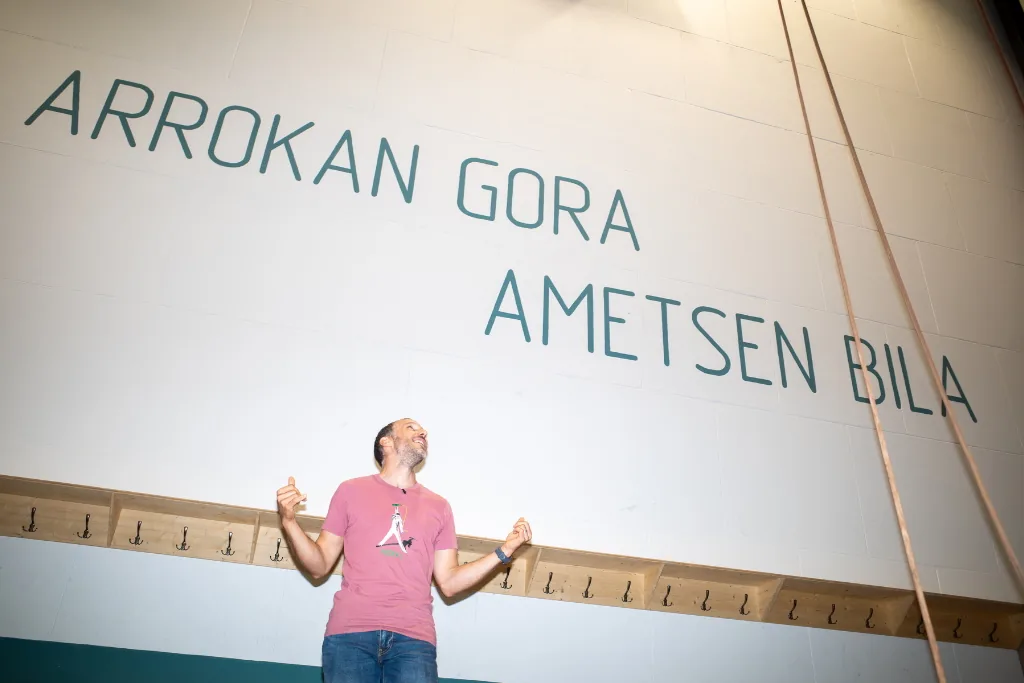


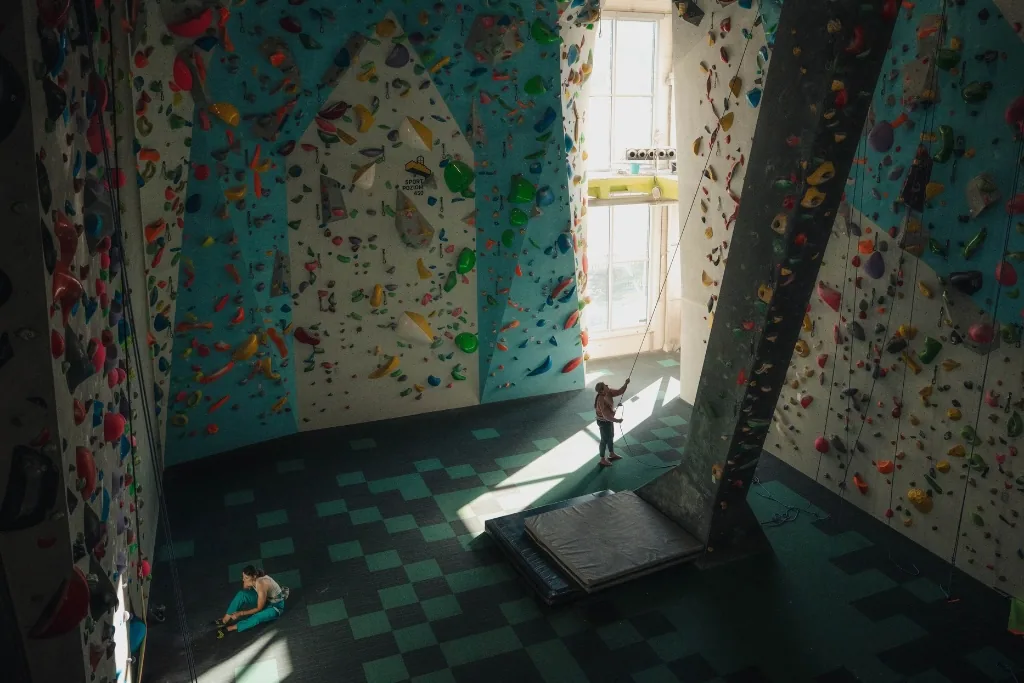
“Szczęść Boże” (“God bless you”). Polish miners traditionally exchanged the greeting before heading underground. Today, it’s inscribed at the entrance to the Skarpa Bytom climbing gym, welcoming climbers. On this warm fall morning, Maxim, a 48-year-old Ukrainian, has come to enjoy the quiet before the late-afternoon rush. “I moved to Silesia in 2022, after Russia invaded Ukraine,” he says. “Before the war, I climbed in Crimea. When I wanted to start climbing again here, everyone told me about the gym that had opened in the town’s old mine. That’s how I ended up here.”
Climbing in Coal Country
Bordering the Czech Republic, Silesia is Poland’s second-most-populous region and its industrial and mining heartland. Beginning in the late 18th century, the region built its economy around its abundant coal deposits. When the Soviet Union collapsed, mining still employed some 400,000 people there. Since the 1990s, however, mine closures have hit the region hard, driven by an accelerating energy transition, falling demand, competition from imports, and rising extraction costs as mines reach deeper coal seams. Silesia had roughly 65 mines in the 1980s; today, only about 15 remain.
Mine closures have also meant the loss of dozens of places where community life once thrived. They’ve left behind abandoned industrial sites and neighborhoods deeply affected by the region’s industrial decline. Dobromir Bujak, a Silesia native and manager of the Skarpa Bytom climbing gym, explains: “For people in Silesia, the mine was much more than a workplace. People celebrated here, and their lives revolved around the mine. Almost every part of their lives was connected to this place.”
“For us, it was essential to create a place that reflected this history, not just another climbing gym.”
Dobromir Bujak, manager of the Skarpa climbing club
Over the past 15 years or so, a growing number of climbing gyms have opened across Silesia. “Ten years ago, there may have been four or five climbing gyms in all of Silesia. Today, there are four or five in Katowice alone, the regional capital,” Dobromir Bujak estimates. Several of these new gyms, in Bytom, Rybnik, and Sosnowiec, have moved into former mines, taking advantage of the spacious interiors and high ceilings while helping revitalize a region undergoing major changes.
From Coal to Climbing Shoes
In the heart of Silesia, a few miles from Katowice, Bytom has been hit hard by the wave of mine closures. As the coal industry collapsed, nearly 100,000 residents left the city between 1985 and 2025, seeking opportunities elsewhere in Poland or abroad. With many homes on the outskirts abandoned and falling into disrepair, the city even earned the nickname “Poland’s Detroit.” Against that backdrop, Bytom’s climbing club, Skarpa, decided to move into the old mine and bring new life to what had once been a center of community life. Since its founding, the club and its roughly 40 members had been squeezed into a cramped municipal gym. When the Rozbark mine closed in the 2000s, they saw a chance to make more room for climbing and introduce the sport to the rest of the city.
From the start, Skarpa’s members wanted the climbing gym to reflect the mine’s history. “For us, it was essential to create a place that reflected this history, not just another climbing gym,” Dobromir Bujak says. He has incorporated reminders of Bytom’s mining culture throughout the gym, re-creating the miners’ old locker rooms and their redbrick cafeteria. His son Milosz Bujak, Skarpa’s sports director, is proud that the center celebrates “Barbórka, the miners’ holiday, every year. Former miners come back to their old workplace, put on their uniforms, and celebrate with local residents.” In 2023, Skarpa unveiled a stone memorial outside the gym honoring the 145 miners killed in the disaster of 1923. Former miners and city representatives attended the ceremony.
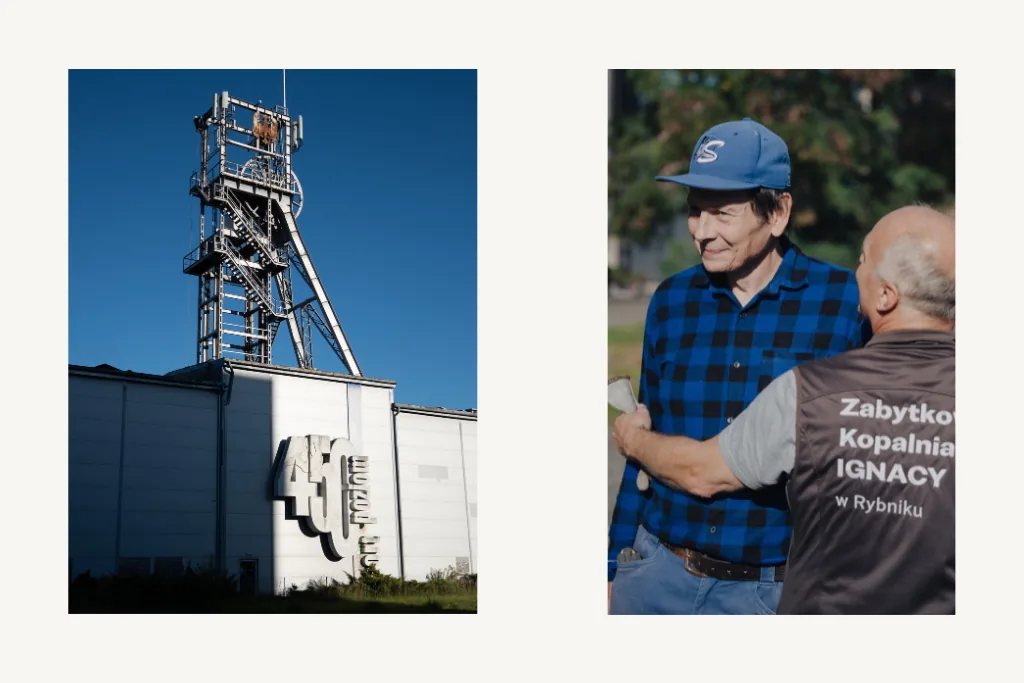
At an old mine in Sosnowiec, a few miles from Bytom, the only visible reminder of its past is the headframe, the tower that stood over the shaft. The mine’s former engine house now holds Poziom 450, a climbing gym Piotr Banasik opened in 2013. The name means “Level 450,” a reference to the Anna shaft’s depth—450 meters, or about 1,480 feet—when it closed in 1998. Determined to preserve the town’s mining heritage, Piotr kept reminders of the shaft that once occupied the site. Along with the tower above the gym, he preserved a sealed cylinder at the base of the routes—the paths climbers follow up the wall. It once ventilated the tunnels at that depth. Natalia, a student from Lubita, about 60 miles from Sosnowiec, has come to spend the afternoon on the auto-belays, devices that catch and lower climbers without a partner. Looking up toward the top of the walls, she says it’s “great that they’ve given the mine a new life. Better than an empty building!”
Community, Compressors, and Folk Costumes
In Bytom, Skarpa quickly grew beyond a climbing facility into a gathering place for people from across Silesia. “When we created the sports center, I also wanted it to be a place for local residents,” Dobromir Bujak explains. Every year, Skarpa holds a celebration in Rozbark highlighting local history, period clothing, regional culture, and traditional music. “Last year, we even broke the national record for the most people wearing folk costumes. Nearly 700 of us wore traditional Silesian clothing,” Milosz Bujak says proudly.
For Henryk, it’s essential that “young people and children get to see what their grandparents and parents did here.”
With European grants and money of its own, Skarpa also runs social programs to support the local community. The club serves about 30 children from disadvantaged families in Bytom, welcoming them to the center every day after school for help with schoolwork and cultural and sports activities.
Climbing gyms can be seen as symbols of gentrification, but Skarpa’s managers want their project to be as inclusive as possible. Milosz sees “the profits from our sports activities as a way to fund the club’s social and educational programs.” More broadly, these projects have strong support among residents and public officials. Bytom’s city government has backed Skarpa from the beginning, including by helping it secure European grants.
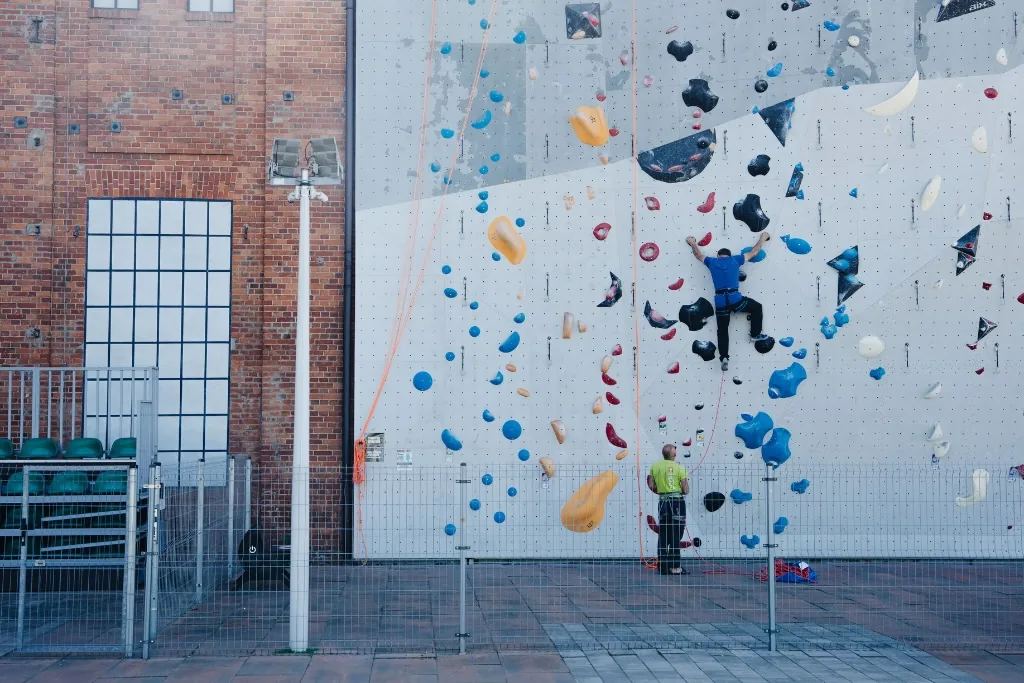
Climbing gyms are also opening in the southern part of the voivodeship (a Polish administrative region—author’s note), in the Rybnik coal basin near the Czech border. Rybnik still has two active coal mines, but since 2015 it has also been home to a cultural center on the site of the former Ignacy mine. Speaking in flawless French, city representative Iwona Nawrocka says enthusiastically, “The city was quick to support repurposing the mine as a gathering place for all residents.”
In 2021, the Zabytkowa Kopalnia Ignacy center opened a small climbing gym in the mine’s former compressor room. Adam Grzegorzek, the center’s deputy director, says, “Since the last gym closed during COVID, this has helped fill a real gap in this part of Silesia.” Every week, children and volunteer firefighters from Rybnik can train on the center’s climbing wall for free.
The climbing gym in Rybnik isn’t just for climbers. Former local miners also meet at the base of the walls. Some now work for the center, including Henryk, 62, and Zbigniew, 58, former mine rescuers who met underground during rescue operations. Between jokes, the two coworkers help restore the site and share their experiences with younger generations. For Henryk, it’s essential that “young people and children get to see what their grandparents and parents did here.”
A Gold Mine for the Pros
With modern facilities and a thriving gym scene, Silesia is emerging as a major new climbing hub in Poland. In the years before COVID, Poziom 450 in Sosnowiec hosted several national competitions, including the Polish university championships and national junior championships. In Bytom, Skarpa now draws many Polish and Ukrainian professional athletes, some of whom competed at the 2024 Paris Olympics. The gym offers 120 indoor and outdoor routes, with an entire wall dedicated to professional climbers. The Polish Mountaineering Association’s routesetters, who design the climbs, set that wall specifically for those athletes.
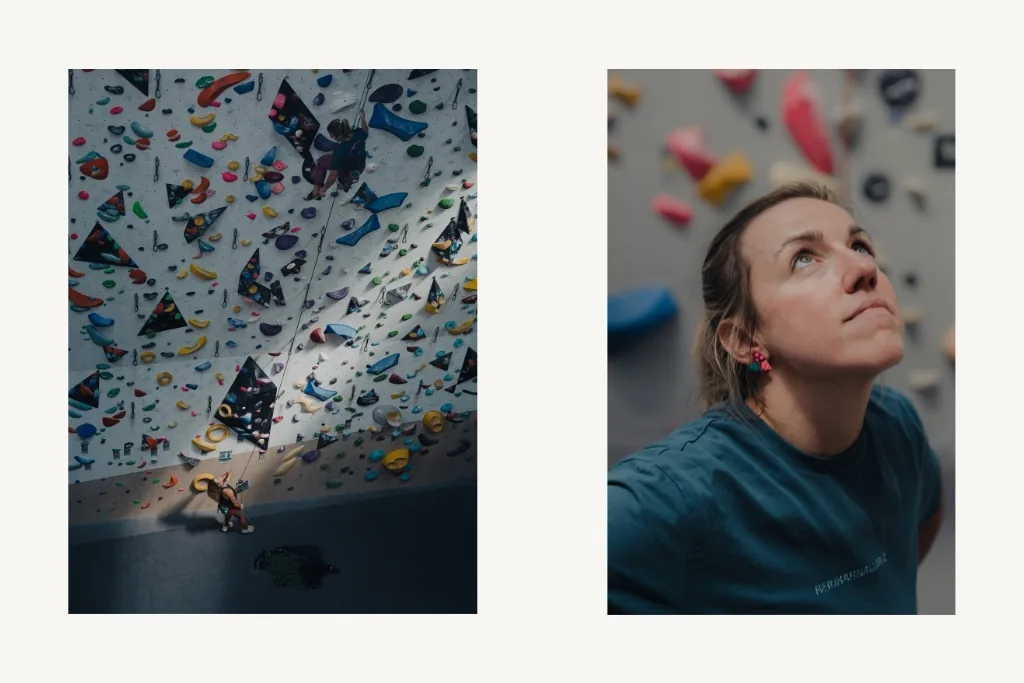
Thanks to its facilities, Skarpa Bytom has become known throughout the region as a center for training and climbing instruction. Some climbers, including Anna and Helena from Zakopane on the Slovak border, drive as long as four hours to get here. “This is where we’ll take our climbing instructor certification exam. We came to Bytom for the day to train before the test.” Like many Poles, the two women got into outdoor climbing thanks to the abundance of routes in the Tatra Mountains and Lower Silesia’s Rudawy Janowickie range.
Encouraged by the success of these conversions, climbing gyms are looking to expand and restore more of the region’s many abandoned industrial sites. In Czeladź, a few miles from Bytom, Skarpa has taken over the former boiler house at the Saturn mine, which closed in 1998. Milosz Bujak says, “Once again, the goal isn’t just to build another climbing gym. It will be a new place for people from Czeladź and across Silesia to meet, work, talk, and climb.”