
“I Need That Verticality to Feel Alive”: Christophe Dumarest, a Mountain Guide Reckoning With Life

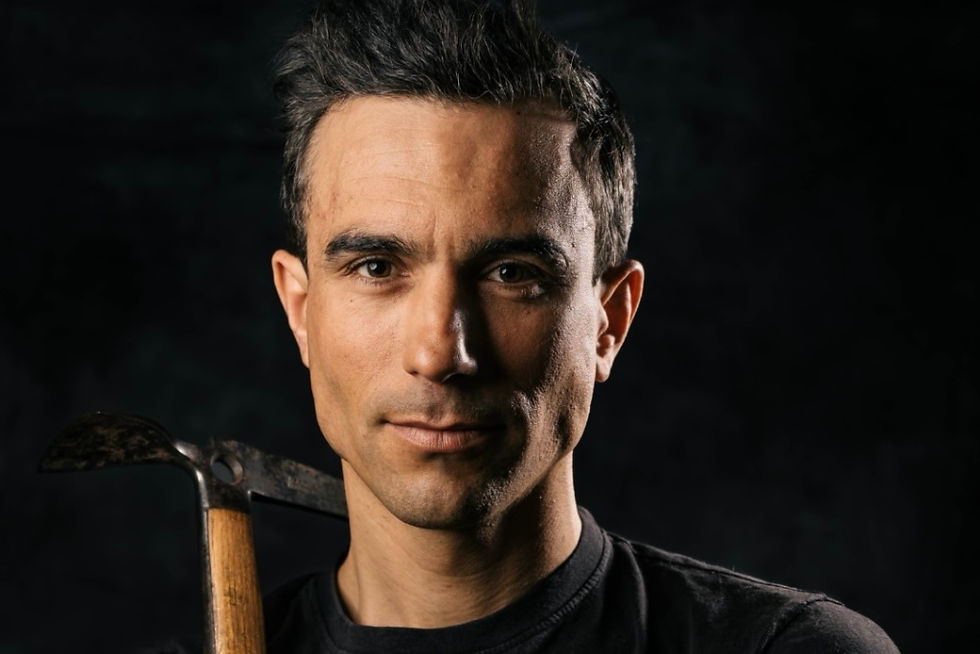
At 46, Christophe Dumarest is still putting up new routes and guiding clients on some of the hardest faces in the Alps. But after more than 20 years of chasing intensity in the mountains, he now looks clear-eyed at what that pursuit has given him—and what it has cost. A portrait of a mountaineer who is still learning how to come back down.

Christophe Dumarest has barely started telling us about his life when he starts asking about ours. How does Vertige Media finance investigations that may upset brands in the outdoor industry? How far can a publication push before alienating the companies that might help keep it alive? Dumarest knows the publication well. As he encourages us to keep doing work he considers necessary, he almost immediately starts probing the fault lines in our business model. It is the kind of balancing act he has known since he was young, up on ridgelines with empty space on either side—places that have given him as much to think about as they have adrenaline. Talking with Dumarest is a kind of intellectual ping-pong. A question about Patrick Gabarrou, the renowned French mountain guide, can lead to Walter Bonatti, the Italian mountaineering legend; guiding can lead to capitalism; the Grandes Jorasses to Spinoza. Dumarest talks fast, ideas spilling into one another, and sometimes you have to wait for him to take a breath before jumping back in. At 46, more than anything, he seems to have spent a great deal of time thinking about what the mountains have made of him—and about the contradictions they still force him to confront.
One wedding and a few funerals
At first, though, nobody really asks for his opinion. Dumarest grows up in Annecy with a father who loves the mountains and who, his son says, “really dreamed of becoming a guide and a mountaineer.” Weekends and vacations are therefore spent at altitude. “There was a pretty strong expectation,” Dumarest says today. “You don’t have to be some great Freudian psychoanalyst to see that there was a dream being lived out there, an ambition—especially my father’s.” He remembers cold fingers, bonking from hunger, breakfast at 6 a.m. before hours of skiing, and Swiss mountain huts filled with “bearded guys in overalls” watching two little kids walk through the door. Sometimes his parents would even leave Dumarest and his brother with the hut keeper while they went off to climb a peak. They are memories he now describes, smiling, as “colorful and a little borderline.” “We were in the post-’68 generation,” he says. “Those are things I wouldn’t have done with my own kids.”
For the mountains to become his, Dumarest first has to get away from the version he inherited. As a teenager, he turns toward snowboarding, partying, and “a few detours,” before joining a regional mountaineering team that reawakens something that had been “lying fallow.” He later tries out for the FFME’s elite mountaineering development program, run by the French Mountaineering and Climbing Federation. Out of roughly 20 candidates, Dumarest finishes second. “I remember thinking, What the hell? I’m getting into something. I was so proud.” He had never found much recognition at school. Now he had found a place where he was good—and where other people could see it. “This was where I was recognized,” he says, looking back on how he felt at the time.

Dumarest insists he does not have “a competitive soul.” He says he goes into the mountains to escape “the constraints of meters and seconds.” And yet, among these handpicked groups of young mountaineers, he also wants to stand out. The mountains become both the place where he believes he is escaping competition and the place where he begins defining himself in relation to other people.
“There’s probably a little pride in being able to guide routes that amateur mountaineers dream about.”
On July 14, 2003, he learns just how high the price can be. Dumarest is then part of the ENJA, an elite French mountaineering group, alongside Arnaud Drouet, François Dupety, and Marshal Mussemessi. The three men, ages 22 and 23, die in the same accident in the Mont Blanc massif. Dumarest is almost exactly their age. He is at ENSA, France’s national school for skiing and mountaineering, when the news arrives. It hits him like “a physical blow to the body.” Then come the funerals. “Burying a 20-year-old, honestly, I wouldn’t wish that on anyone. Burying three of them in a row is really hard.”
Dumarest begins asking himself whether “the game is really worth the candle”—whether any of it is worth the cost. But he cannot stay away for long from what has already become both his passion and the main place where he feels recognized. Around the same time, French mountain guide Patrick Gabarrou becomes one of his main climbing partners. Nearly 30 years separate them. Gabarrou brings “the project, the strategy, the determination.” Dumarest brings more technical ability and physical strength. Dumarest also becomes a mountain guide himself and, as he puts it, “gets a toe into the professionalization and media side of mountaineering.”
More than 20 years later, he still pushes that logic surprisingly far in his guiding. Some of his clients become skilled enough to follow him onto objectives that professional alpinists themselves dream about. “There’s probably a little pride in being able to guide routes that amateur mountaineers dream about,” he admits. In spring 2026, Dumarest climbed the Gousseault-Desmaison with Didier Laurent and Charly Richer, potentially the first guide-client team to complete the route. Soon after, he opened Kairos on Mont Blanc du Tacul with Symon Welfringer. And yet, on his website, Dumarest invites clients to pursue their dreams “safely.” “That’s the contradiction at the heart of being a mountain guide,” he says with a smile.
Staying in tune
That intensity comes at a cost when it is time to go home. Asked what a life like his does to the people closest to him, Dumarest makes no attempt to protect the image of the heroic alpinist. “I don’t think it’s easy.” He compares his profession to being the concertmaster of the Orchestre de Paris: you have to maintain your instrument every day. The difference is that in his line of work, failing to prepare can have consequences far more serious than playing a wrong note. “Before a climb, you’re not completely there. Then there’s the climb itself, when you’re not there. Then afterward, you’re processing it, and you’re still inside the climb.”
Dumarest has two children. And children, he says, require “attention, care, time, and presence,” including in the harder sense of the word: “When you’re there, are you really there?” Again, he does not try to defend his record. “I don’t think I necessarily got everything right.” He even describes becoming accustomed to experiences so intense that ordinary life can feel dull afterward. “It can make you somewhat antisocial,” he says.
In 2009, after the death of someone close to him, another practice enters his life. His then-wife leaves for an intensive yoga training course in Bali, and Dumarest drops plans for an expedition to go with her. There, his résumé in the mountains counts for nothing. “You’re no longer a mountain guide, or a speaker, or a mountaineer. You’re nobody.” Since then, yoga has given him another way to look for the quality of attention that comes so easily when a wall forces him to be fully present. “In the end, I need that intensity, that verticality, to feel alive,” he says. It is his way of saying that when he climbs, the mental chatter stops.
“We all still have to make a living. I get invited into companies. I’m not going there because I love the look of their eyes. I’m going there to earn money.”
As he gets older, though, Dumarest is trying not to reserve that intensity for major alpine objectives. In 2020, during the Covid pandemic, he and Arnaud Petit founded ACTS, short for Action collective de transition pour nos sommets, a collective focused on reducing the environmental footprint of mountain sports. The goal was to travel less, use less energy, favor adventures closer to home, and push the outdoor industry to change. Six years later, Dumarest does not tell the story as a success. The organization lost momentum, and criticism quickly turned toward the people delivering the message: “What about you?” Dumarest says that since ACTS was founded, he has never again flown somewhere for an expedition.
A week spent walking, climbing, and bivouacking between Mont Aiguille and the Granier felt almost like a pilgrimage. “I came back completely blown away.” These days, he talks about “doing more with less.” Fewer miles and less logistics, yes, but also less dependence on performance to determine which experiences are worth having—or worth telling people about. Two days in the rain with wildlife photographer Jérémy Villet, just a few hundred yards from a car, were enough to reveal a mountain world Dumarest thought he already knew: waiting in a blind, watching migrations, reading tracks, spending time observing instead of climbing.
That is also how he describes a recent encounter with Andy Parkin. At 72, the British climber and artist can no longer climb the way he once did after a serious accident. But Dumarest finds a man who still paints, sculpts, dreams up projects, and keeps creating even as physical performance has become less central to his life. Dumarest leaves with a conviction. “I thought: Andy Parkin at 72—that’s really the future of the mountains.”
Letting go of grand claims
Still, Dumarest has not left the world he sometimes criticizes. He bristles at the obsession with speed records and the pressure to perform, yet part of his income comes from corporate speaking engagements, where the rope team becomes a way to talk about management or collective performance. “We all still have to make a living,” he says. “I get invited into companies. I’m not going there because I love the look of their eyes. I’m going there to earn money.” Dumarest says he tries to use that access to steer the conversation toward other subjects: taking care of yourself, rebuilding a sense of collective purpose, or reminding people that a life perhaps should not be nothing more than one summit after another.

He also turns down some offers. “You’re still walking a fine line,” he says. Ocean Peak has also taught him to be wary of stories about life-changing experiences that wrap up a little too neatly. When he co-founded the organization in 2018, using the sea and mountains to work with young people facing serious difficulties, Dumarest briefly imagined taking corporate executives on immersive trips designed to shake them out of their usual environment, “give them a little slap,” then send them back to their companies ready to behave differently. Today, he smiles at the ambition. “I think that was a little pretentious.”
That does not mean some experiences cannot leave much deeper marks. Dumarest tells the story of a former client who recently told him that their ascent of the Matterhorn had helped him get through cancer. For Dumarest, that day had almost disappeared among countless others. For the man tied into the rope behind him, it had become something he could draw on while facing the hardest ordeal of his life. By now, Dumarest understands that this may be why we ask questions in the first place. Because so often, we find answers in other people.


