
Every climbing gym has one sentence that should set off a biomechanical alarm: “I’m just going to do an easy session.” You were supposed to recover. You end up pulling on a crimp, a small, finger-intensive edge. You were supposed to keep it mellow. But your body does not know what a “mellow session” is. It only knows load. It only knows stress. That is the misunderstanding this article is trying to track: the fatigue you cannot always see, the “active recovery” that turns too quickly into a workout in disguise, and the strange guilt that rises the moment an evening passes without climbing shoes.
The Phantom Load
The problem with fatigue in climbing is that we want it to be obvious. We want it to burn, swell the forearms, make the jugs — the big, easy holds — feel humiliating, announce itself loudly enough that we can finally give ourselves permission to stop. When fatigue is clear, it almost feels comforting. You are not quitting. You are cooked.
But the body does not always fade like a battery dropping from 20 percent to zero. It can lose precision before it loses strength. It can compensate before it complains. It can feel normal again while some systems are still absorbing the damage. In climbing, that quiet fatigue settles into the fingers, tendons, shoulders, and coordination. It shows up as a warm-up that takes weirdly long, a familiar move that suddenly feels wrong, a twinge you call “just a little warning sign” so you do not have to listen to it.
Readiness to climb hard did not return until 60 hours
Study published in Frontiers in Sports and Active Living
That is what a 2024 study by Arthur Fernandes Gáspari and colleagues, published in Frontiers in Sports and Active Living, helps make clear. The researchers followed nine members of the Brazilian climbing team after a national bouldering championship. They did not just ask the athletes whether they felt tired. They measured several markers before the competition, immediately after, and then 12, 24, 48, and 60 hours later: maximal grip strength, forearm swelling, delayed-onset muscle soreness, perceived fatigue, and readiness to climb hard again. The study separates what the body can still produce, what the athlete feels, and when the whole system is actually ready to go again.
The results show that those signals do not all return to baseline at the same time. Grip strength and forearm pain were back to pre-competition levels after 24 hours. Perceived fatigue took closer to 48 hours. Readiness to climb hard did not return until 60 hours. The authors describe “different recovery profiles” depending on the marker and suggest that athletes may need “up to 60 hours” to fully recover after this kind of competition.
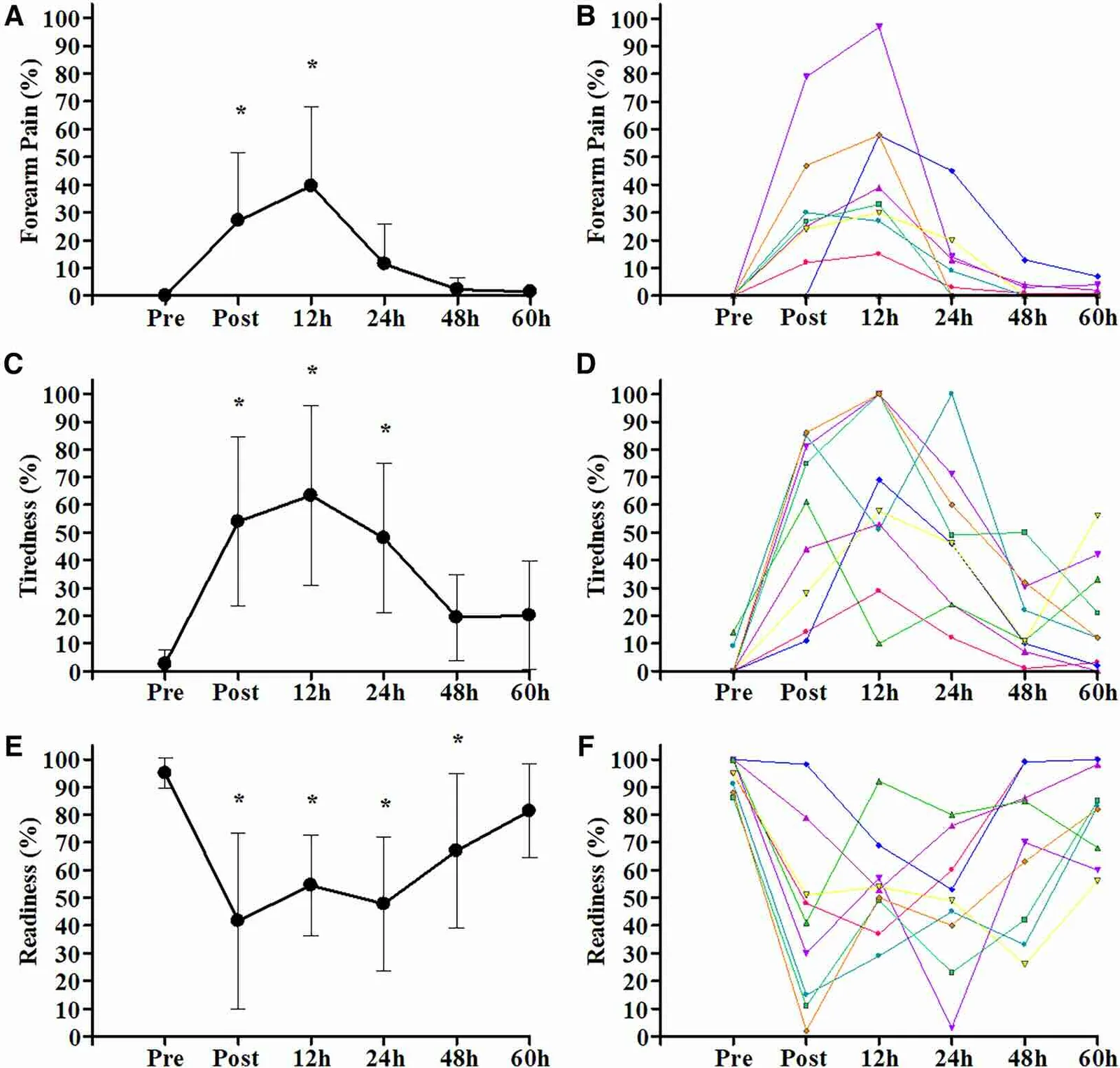
The study does not say you need three days off after every bouldering session. It does not say every bit of fatigue is a biomechanical disaster waiting to happen. It simply reminds us of something important: being able to squeeze a hold does not necessarily mean you are ready to add intensity again.
And climbing is especially good at hiding load. A bouldering session can feel short, playful, even light, while still stacking maximal efforts, falls, violent pulls, poorly managed crimps, and dynamic moves that look nothing like rehab.
A 2023 systematic review by Andrew Quarmby and colleagues, also published in Frontiers in Sports and Active Living, points in the same direction. After analyzing 34 studies on overuse injuries in adult climbers, the authors identified several factors linked to higher injury risk: “higher climbing intensity, bouldering, reduced grip or finger strength, use of the crimp grip, and previous injuries.” The same review notes that the data on training volume are “conflicting.”
That shift matters. The right question is not only, “Am I climbing too much?” It is, “What does this session actually cost my body?” Your body does not care what mental category you put the session in. It does not know you planned to take it easy. It does not read your intention. It absorbs the intensity.
The False Friend of Active Recovery
At this point, it would be tempting to turn rest into the opposite command: do nothing, sit still, wait, feel guilty in a different direction. That would be too simple, and probably wrong. Recovery is not always passive. In some contexts, moving lightly between efforts can help you come back stronger for the next burn.
Two studies published in the Journal of Sports Science and Medicine help explain what active recovery actually means. In 2006, Nick Draper and colleagues compared active and passive recovery in 10 recreational climbers across five two-minute climbing efforts. The researchers found that blood lactate concentration and perceived exertion were lower with active recovery, while also noting that the strategy did not produce complete recovery. Lactate, to put it simply, is not the single villain behind exploding forearms. It is a useful but imperfect marker of how the body responds to hard effort and recovers afterward. Moving can help, but it does not reset the clock to zero.
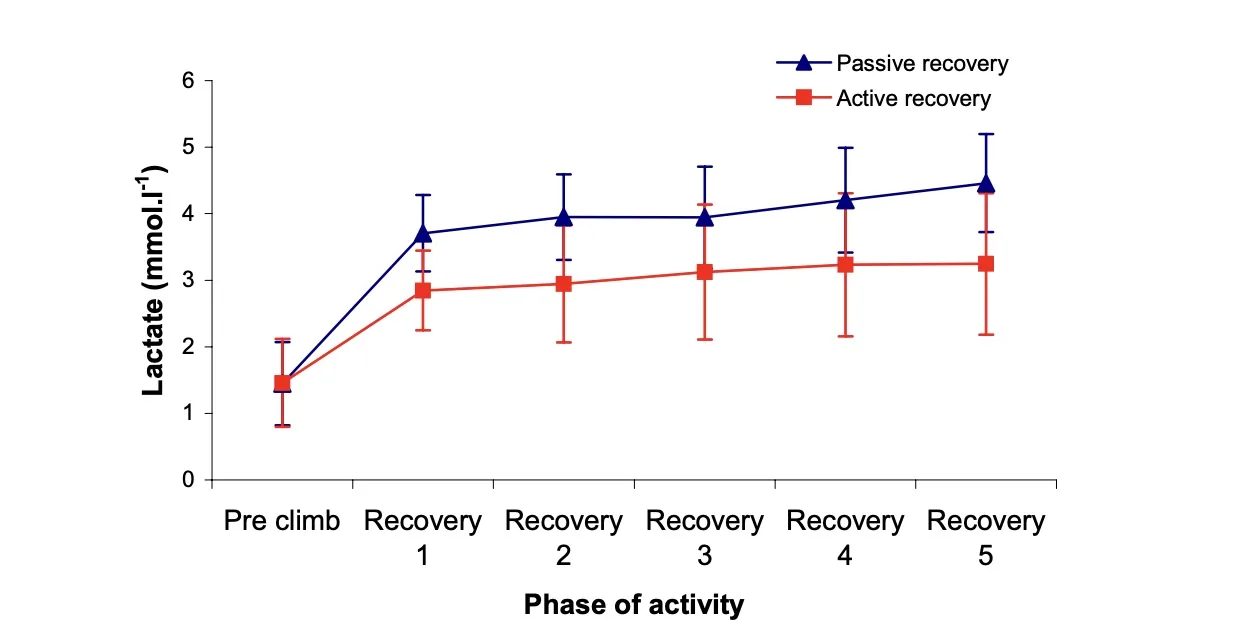
In 2015, Pedro L. Valenzuela and colleagues sharpened the question by comparing two kinds of active recovery: walking and easy climbing. Fourteen climbers performed three maximal two-minute efforts, separated by two minutes of recovery. In that protocol, easy climbing on a 5.6 route — 4c in the French system — cleared lactate better than walking and allowed climbers to cover more distance on the next effort.
But the details matter. In these studies, active recovery is short, controlled, and low-intensity. It is not an improvised session under the banner of “just moving a little.” It is not three hours at the gym. It is not a detour to the board, a steep training wall, “just to see where things are at.”
Climbing culture has a remarkable talent for turning every tool meant to protect us into another excuse to try hard. Strength work becomes one more session. Mobility becomes a performance. Volume becomes a contest over who climbed the most feet. The fingerboard becomes a confessional where everyone goes to check whether they still deserve their grade. Even active recovery can become another place for comparison, control, and productive guilt.
16.2 percent of participants were classified as ‘at risk’ of exercise addiction
Study published in Medical Science Pulse
This is where “load” becomes a more useful word than “session.” A session is just a social format. Load describes what actually happens to the body: intensity, repetition, grip type, fatigue, sleep, injury history, and sometimes the rest of life spilling over.
The 2023 systematic review puts it plainly: prevention strategies should target “strength and conditioning, load management, and climbing technique.” That is not flashy. It is not especially Instagram-friendly. But it is probably where a lot of sustainable progress happens — less in the heroic accumulation of sessions than in the ability to understand what those sessions really cost.
And this is where the subject moves beyond physiology. If climbers so easily turn active recovery into a workout in disguise, it is not only because they misunderstand recovery. It is also because not climbing takes away something more intimate than training.
Withdrawal in Climbing Shoes
Then comes the harder question: Why is stopping so difficult? Not just for athletic reasons. For identity reasons. Climbing is not only training. For many people, it is the rhythm of the week, a social place, a way to feel competent, a way to live in the body, and sometimes a more or less conscious method for keeping everything else at a distance. You do not go to the gym only to improve. You go to see familiar faces, to feel a kind of control, to measure an inner state against an external problem, to turn a shapeless day into something you can check off. In that context, rest takes away more than a session. It takes away a marker.
The newsletter that lifts you higher
Every Wednesday: the editorial team’s column, the best articles, and plenty of surprises to help you climb higher — in mind and in spirit.
A qualitative study by Robert M. Heirene and colleagues, published in 2016 in the Journal of Behavioral Addictions, explored withdrawal states in eight climbers during periods of abstinence. The sample was small and entirely male, so it has to be treated carefully. But the study gives scientific shape to a feeling many climbers know well: not climbing can become more than simple athletic frustration. The authors found that higher-level climbers reported more frequent and more intense cravings to climb, along with more frequent and more intense negative feelings during time away from the sport. They concluded that climbing athletes “appear to experience withdrawal symptoms when abstinent from their sport.”
Another study, published in 2022 in Medical Science Pulse, surveyed 272 climbers and mountaineers using an exercise addiction scale. The results showed that 16.2 percent of participants were classified as “at risk” of exercise addiction according to the tool used, with higher scores especially among competitors and boulderers. Again, this is not a diagnosis to slap on everyone who climbs four times a week. But it is a meaningful signal: for some climbers, the inability to stop is not simply extra motivation.
Then there is another pillar we often underestimate: sleep.
The CLIMB study, published in 2024 by Fredrik Identeg and colleagues in BMC Sports Science, Medicine and Rehabilitation, looked at advanced and elite Swedish climbers. Among the 183 climbers studied, 45.4 percent reported poor sleep quality, and about 48 percent reported at least moderate stress symptoms. The researchers did not find a statistically significant difference from the control group, so we cannot conclude that climbing damages sleep or mental health more than modern life in general.
But the finding still matters. A large share of advanced climbers say they sleep poorly, even though sleep remains one of the major drivers of athletic recovery.
We can spend hours debating a method, a hangboard protocol, a strength cycle, the curve of a shoe, a measurement tool, or a slightly slopey hold. But sleeping more, cutting a session short after a heavy week, accepting that you are not climbing because you have not recovered — somehow that feels almost too simple to take seriously.
The point is not to love climbing less. Climbing asks for consistency, commitment, repetition, and sometimes even obsession. The problem begins when that love keeps you from reading what it is producing: fatigue, pain, recovery debt, damaged sleep, guilt over stopping, fear of losing your place in the story.
Rest is not the opposite of climbing. It is where climbing becomes something the body can absorb.
Training creates stress. Recovery allows adaptation. Without enough recovery, you are not building stronger progress. You are stacking debt.
There is something almost cruel in that conclusion. Climbers spend so much time learning how to hold on: to holds, to tension, to fear, to other people’s eyes, to the project, to the schedule. But getting better sometimes asks for the exact opposite.
Let go.