
Jean-Luc Marion: “Climbing Is Something No One Else Can Do for You”

Updated: Apr 3
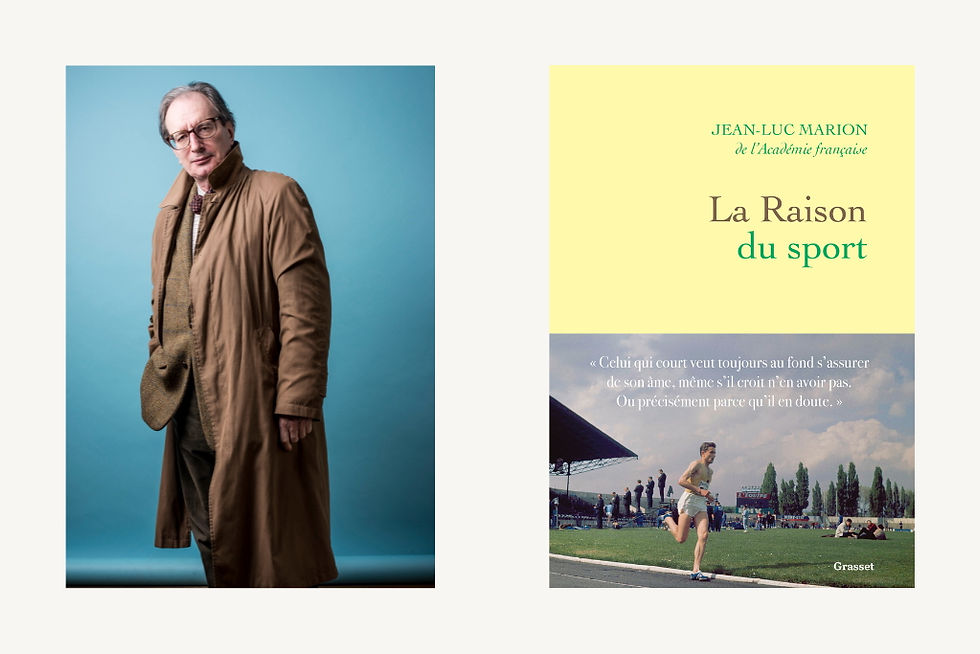
At 79, Jean-Luc Marion—one of France’s best-known philosophers and a member of the Académie française—has published La Raison du Sport (The Reason of Sport), an essay that is both rigorous and accessible about what is really at stake in physical effort. A former middle-distance runner, he puts forward a simple but powerful idea: sport is not primarily about beating other people. It is about coming fully into contact with yourself. We spoke with a thinker determined to take sport seriously, in a way few have before.

Vertige Media: What is the reason for this book?
Jean-Luc Marion: There are two reasons. The first is a kind of coming out. Sport has been a fundamental experience for me, both in the way I perceive the world and in the way I experience myself. I even think it was a great stroke of luck, because it gave me strengths that helped me in other activities, including philosophy.
The second reason is that I believe sport deserves to be treated seriously—that is, analyzed seriously. And I don’t think that happens very often. Usually, that’s because the people talking about sport have not really practiced it, or because they bring technical knowledge about results and training methods but no broader view of sport as a social phenomenon.
I think that if you want to talk about sport, you need a few precise concepts. Philosophy gives you those concepts. So I wanted to pay tribute to sport by trying to bring out its logic, its rationality.
Vertige Media: You were a middle-distance runner, right?
Jean-Luc Marion: Yes, when I was a teenager. I did it seriously at Stade Français and took part in a few competitions. Then I more or less stopped to prepare for the entrance exam to the École Normale Supérieure. After that, I came back to it and ran road races for 20 years. I was a solid regional-level runner. But as my coach used to say, I was good, but not ready. I was never going to be an Olympic champion.
Vertige Media: How does your work as a philosopher help shed light on sport?
Jean-Luc Marion: I’ll give you a clear example, one many readers noticed right away. In contemporary philosophy—more specifically in phenomenology, the tradition founded by Edmund Husserl, the German philosopher and logician—there is a crucial distinction in how we think about the body. Because the body has at least two statuses.
First, there is the mechanical body, which treats our physical body as a machine. A great deal of medicine is built on that idea. A great deal of sport is too. The body then becomes an instrument we use. That mechanical interpretation of the body may be partly true, but it is largely insufficient.
Because there are cases in which my body becomes what Husserl calls Leib—lived flesh, the body as it feels itself from within. In other words, that which senses itself.
Vertige Media: What do you mean by that?
Jean-Luc Marion: Take Descartes’s principle: it is not the body that feels, but the soul. I feel myself when I feel something, when I undergo an experience. And in sport, you can reach that state of fully sensing yourself relatively easily. That state of exaltation in effort, where you no longer know whether you are enjoying yourself or suffering.
What is interesting about that state is that you experience yourself much more intensely than when the body is at rest.
“In fact, I think that when you are making a serious effort, you do not watch yourself doing it. You are fully inside it”
Vertige Media: So is that the primary reason to do sports—to push past yourself, in a sense?
Jean-Luc Marion: Not exactly, though that matters a great deal. It is not really about beating someone else; that is secondary. It is about truly experiencing yourself.
In daily life, our minds are almost always somewhere else. We are not really ourselves. We do not quite know what we are doing. There is a common feeling now that professional activity is wasted time. That expression doesn’t really mean anything, except that we are there without fully being there. We do not feel our bodies.
As I’m speaking to you right now, I do not feel my body. And when you are swallowed up by work, moving at a relentless pace, you feel as though you are giving yourself away, yet not really finding yourself in the process. The worst feeling is that anyone could do it in your place. Sport—climbing especially—is something no one else can do for you.

Vertige Media: In your other work, you develop the concept of the adonné. The term does not appear in La Raison du Sport, but it seems to describe sport very well as an “exercise of the self.” Could you explain it?
Jean-Luc Marion: To be adonné means to receive oneself at the same moment one receives the phenomenon that happens to them. Put differently, I come into myself at the same time things happen to me.
The obvious example is birth. At birth, suddenly, the world happens to me, and I arrive with it. So to be adonné means that I myself am received. And I think that when an athlete gives everything, they are in fact giving what they do not possess in advance. They receive it.
“In sport, by contrast, the limit—whatever it may be—is always the thing to be exceeded, without knowing whether we have the means to do so. You cannot calculate in advance where the limit will be. That is what makes it exciting”
Vertige Media: Climbing is often described as a meditative practice because you cannot think about anything other than what you are doing in the moment. Is that related?
Jean-Luc Marion: Yes, absolutely. In that moment, you are entirely in what you are doing. You are not in the position of a spectator. You are not watching yourself climb.
In fact, I think that when you are making a serious effort, you do not watch yourself doing it. You are fully inside it. You surrender to what you are doing. You do not let yourself be distracted. You do not step back from yourself.
Vertige Media: You write, “No one knows what they may end up being able to do. The true possible is the impossible that one has nevertheless done.” What makes that surpassing of the self specific to sport?
Jean-Luc Marion: As far as I can judge from ordinary professions, most of the time we calculate what is possible. Professional performance is based on goals we are supposed to meet and on the means available to meet them. We set achievable goals. We are calculating the relationship between ends and means. So we are working within a definition of the possible, within a limit.
Of course we hope to go beyond the limit, to generate growth. But in principle, we plan what we are going to do and how far we are going to go. In sport, by contrast, the limit—whatever it may be—is always the thing to be exceeded, without knowing whether we have the means to do so. You cannot calculate in advance where the limit will be. That is what makes it exciting.
Vertige Media: Even in a world now saturated with data?
Jean-Luc Marion: What we call data helps define limits—limits we reinforce because we can calculate them, quantify them, fix them. But in sport, data is never the last word. At most, it is the first word.
Vertige Media: Many mountaineers say they discover who they are when they reach the summit. How can your philosophy help explain that feeling?
Jean-Luc Marion: I studied the climber Erhard Loretan, the Swiss alpinist and mountain guide, who decided to do Himalayan ascents in alpine style—fast and with the lightest gear possible. At that point, alpinists have the impression that they are freeing themselves from earthly constraints. They feel a kind of liberation.
This phrase—that sport reveals the athlete to themselves—has been used by many champions. The sprinter Christophe Lemaitre said it. The middle-distance runner Michel Jazy said it. I think there is indeed a moment of self-revelation.
Vertige Media: You write that sport tends to become more and more spectacular. Can it lose credibility through that escalation?
Jean-Luc Marion: Oh yes, absolutely. Some sports have already lost their credibility. Boxing, for example, used to be a global sport. It drove some of the first live radio coverage between the United States and France, for fights involving Marcel Cerdan and Tony Zale. It was enormous. Fights still happen, of course, but now most people do not care.
I think soccer is also under serious threat. There is a growing gap between spectators and players—economically, in fame, in lifestyle. The bond of identification between spectator and player is weakening. The moment sport splits in two, between practitioner and spectator, that bond becomes both essential and fragile.
For the spectator to stay invested, they need to be a former participant themselves—or, in one way or another, whether through nationalism, ideology, or something else, they must still identify with the spectacle.
“Through spectacularization, sport tends to become more extreme. And in doing so, it pushes spectators farther away”
Vertige Media: What exactly is at stake there?
Jean-Luc Marion: We should not forget that it is the spectator who makes the sports economy possible. If sport becomes a market, a field of investment, it is because spectators exist. So spectators have to believe that what they are watching is real. And that it belongs to them in some sense—that it involves something they themselves can feel and participate in.
Through spectacularization, sport tends to become more extreme. And in doing so, it pushes spectators farther away.
Vertige Media: How do you see the future of sport?
Jean-Luc Marion: In general, it is in danger. Some sports will survive—perhaps not the ones people expect. That is why I attach great importance to mass-participation road races. People are not there to fool themselves. They are not there to be seen. They are there to experience themselves. That is serious. In a way, it is sport outside the spectacle. And that is the kind of sport that seems to be growing, which is a rather good sign.
Any sport that cannot maintain a close relationship with the broader base of people who actually practice it, and is reduced to spectacle alone, is in danger. There has to be a real social and historical grounding for sport not to be reduced to a moving image.
Read: La Raison du Sport by Jean-Luc Marion (Grasset, €20, 240 pages).


