
The Business of the Climbing World Cup: Anatomy of a Sport in Transition

Updated: Mar 30
The 2024 books from World Climbing (IFSC) tell a less glamorous story than the idea of a sport that has suddenly become a cash machine. What they show instead is something more interesting: an international circuit still driven, above all, by its tour. International climbing is growing. It is spreading. It is drawing attention. But its economy still rests first on a calendar sold to host cities, on media rights that remain fairly modest, and on an Olympic year that swells the flow of money without, by itself, creating durable profit. Put differently, this is still a model that depends more on staging events than on monetizing them through broadcast.
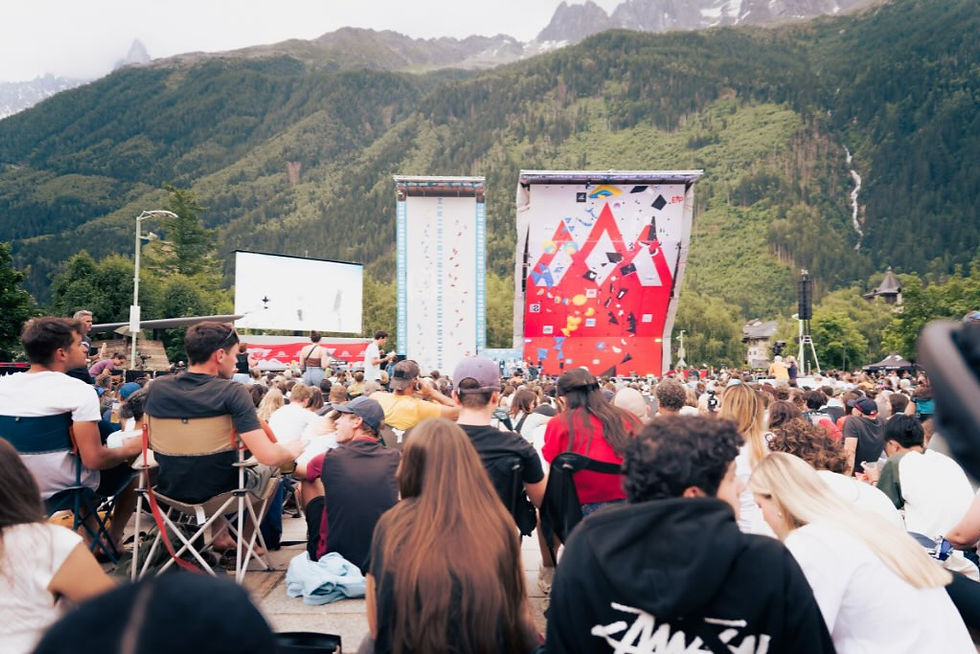
There is a kind of cold truth in the financial statements of international federations, the kind promotional language does not always like to sit with for very long. World Climbing publishes its numbers in black and white: financial statements, fee structures, Executive Board expenses. It is all there, accessible, audited, organized. And as is often the case with information that is publicly available, almost nobody really looks at it. That is a shame, because these tables do not just tell us how much money comes in and how much goes out. They show where the money comes from, what it pays for, and what is left once the machine has run. In 2024, the IFSC posted €6.13 million in operating revenue against €5.31 million in costs, for a net result of €56,724. There is nothing spectacular about that number. But it sets the scene very clearly: plenty of movement, not much structural surplus.
The calendar is king
The heart of the model sits in a single accounting line: “calendar fees.” That is where the real economic backbone of the circuit lives. In 2024, that line alone accounted for €4.07 million, or the bulk of the revenue gathered under “Sport & Events.”
Once you see that, one common misunderstanding falls away. When people ask how much a World Cup stop “brings in,” they often assume there must be a simple answer, as if every event generated the same value through the same mechanism. That is not how this circuit works. A big part of an event’s economics plays out locally: in ticket sales, in the organizing committee’s partners, in the economic spillover a region hopes to capture, and very often in the financial risk the organizer agrees to carry.
What World Climbing is billing for, in the end, is not the full value of a World Cup stop. It is entry into the series. It is the right to place a city on the global calendar, with everything that comes with that: standards, services, visibility, and institutional prestige.
In 2024, World Climbing reported €665,453 in broadcasting rights and €330,000 in sponsorship. Together, those two lines add up to just under €1 million.
In 2024, hosting a bouldering or lead World Cup cost €25,500, with a non-refundable deposit of €5,000. In 2025, that figure rises to €28,000. For speed, the price of entry was €14,500 in 2024, then €16,000 the following year. So before anyone even starts talking about audience, streaming, or sponsors, the first thing a host has to do is buy its place on the tour.
The document also lays out a “no-show” policy aimed not at local organizers, but at national federations. If a federation registers significantly more athletes than it actually fields, beyond a 10 percent tolerance, World Climbing sends it an additional bill at the end of the season. The idea is simple: prevent inflated registrations from distorting event logistics. Here again, the message is clear. The circuit is selling a standardized framework, not just a show.
That distinction matters. For now, international climbing is not yet making most of its money by selling its image. It is first selling a place on its calendar.
Great visuals, modest engine
To understand where climbing really sits in the economy of televised sports, you have to look at the “Marketing” line. In 2024, World Climbing reported €665,453 in broadcasting rights and €330,000 in sponsorship. Together, those two lines add up to just under €1 million. That is not trivial. But it is not yet a foundation strong enough to carry the circuit on its own.
The note attached to the accounts is revealing. It says the change was mainly driven by the renegotiation of the agreement with Dentsu, the Japanese advertising, marketing, and consulting group. That detail matters because it says something concrete about the structure of the model. The circuit does have media value, but that value still depends heavily on a few major channels, and therefore on a few decisive negotiations. This is not a machine that automatically turns visibility into stable revenue. It is still an economy where a small number of major deals can noticeably change the overall picture.
That is not the sign of a broken model. But it is not proof of settled prosperity either.
That has not stopped World Climbing from looking for bigger distribution channels. On September 11, 2025, the organization announced a deal with Bilibili, presented as the new “home of climbing” in China for the final events of 2025 and the full 2026 season in the Chinese market. In its release, World Climbing highlighted the scale of the platform, with more than 360 million monthly active users and more than 100 million daily users. The signal is interesting. Climbing is managing to connect itself to massive storefronts. But precisely because the deal came after the 2024 accounts, it is still too early to know what it will actually produce economically. If the effect is meaningful, it will show up only in later financial years.
That is the paradox. The sport is highly watchable. It has verticality, immediate tension, the clear drama of a miss or a send, that rare ability to compress a full narrative into a handful of moves. But visual potential does not automatically turn into economic power.
First, because producing the product costs money. In 2024, the “TV production” line came to €459,083. In 2023, it was €952,056. You can read that as welcome streamlining, or more cautiously as a scaled-back investment. Either way, the core fact does not change: climbing is not yet in a position where broadcast naturally finances the sport. It is still in an economy where the federation has to spend money in order to remain broadcastable.
There is another limit too, less visible in the accounts but just as important. For part of the general public, climbing is still less immediately legible than other Olympic sports. You have to explain the formats, make the logic of a boulder problem or a lead route clear, and help viewers understand why one move matters more than another. Attention is cyclical too. The Olympics create huge spikes in visibility, but turning that occasional curiosity into regular engagement with the circuit between Olympic cycles remains a challenge.
Climbing is very watchable. For now, it is much harder to monetize.
The Olympic high
The 2024 accounts are readable enough. But they come with a trap: they correspond to an Olympic year. And an Olympic year always brings in flows of money that inflate the totals, distort the picture, and sometimes make a sport look more economically powerful than its underlying model really is.
The engine behind that special sequence is the Olympic Qualifier Series. In the notes, World Climbing explains that the increase in “Sport & Events” revenue was driven in part by the compensation agreed with the IOC and local organizing committees for staging the OQS in Shanghai and Budapest, along with the acquisition of media and marketing rights for those events.
Chez World Athletics, les comptes 2024 annoncent 99,4 millions de dollars de revenus. Dans cet ensemble, 44 millions proviennent du « commercial and broadcast ».
So this is not just classic event revenue. It is a more hybrid structure, where the federation gets paid because it organizes the events, because it controls certain rights, and because it provides a whole range of services tied to Olympic qualification. On paper, the effect is striking. But focusing only on incoming money would be a mistake. The OQS does not just generate revenue. It also generates outflows.
Some of what comes in is redistributed almost immediately in the form of travel grants, prize money, and the coverage of ITO costs, meaning the international technical officials essential to running the competition. Those expenses appear in the accounts under “Olympic & Multi-Sport Games Preparation / Games Services.” In plain terms, an Olympic year can increase the flow of money without making the structure durably richer, simply because a large share of what is collected is also money that has to be redistributed, absorbed, or earmarked.
The final result shows that clearly. Gross operating surplus reached €820,850. That is a solid number. But then it gets eaten away line by line: €60,307 in depreciation, €30,021 in exchange-rate effects, and €36,866 in financial charges. Above all, there is the allocation to “Operating Funds,” worth more than €600,000, in other words the operating cushion that helps the federation stabilize its trajectory. By the end, net profit drops back to €56,724.
That is not the sign of a broken model. But it is not proof of settled prosperity either. It is the portrait of a structure using an unusually dense year both to reinforce its footing and to keep the show running. Even with the Olympic boost, the World Cup economy still does not generate the kind of structural ease that would justify talking about a real rent stream.
Young sports, old gaps
To understand where climbing really stands, the most useful comparison is not with long-established federations that have spent decades building powerful rights-based economies. The better move is to put it back in its real family: young sports, recently added to the Olympics, whose economics still depend heavily on the event itself.
« We get nothing for Tokyo from the revenue sharing of the Games »
Fernando Aguerre, International Surfing Association president
From that perspective, climbing is not unusual at all. In 2024, the International Surfing Association posted total revenue of $5.74 million, of which $4.16 million came from “event revenues.” At World Skate, in 2023, the logic was even clearer: $4.25 million in “events organizational fees and biddings,” while the “advertisement and TV contracts” line sat at zero. In this family of sports, the base is the same. They live first off the tour, off the ability to make competitions happen, find host cities, and sell a calendar. The image comes after.
That is exactly what separates these sports from older, more powerful federations, ones that are far more firmly rooted in a rights-based economy. World Athletics, for instance, reported $99.4 million in revenue in 2024. Of that, $44 million came from “commercial and broadcast.” On top of that sits another revenue stream on an entirely different scale: the IOC’s quadrennial distribution, meaning the share of Olympic revenue redistributed to international federations, which here reached $39.6 million.
At World Climbing, the picture is more fragmented. The 2024 accounts do isolate €174,145 under “IOC Funds,” but some of the money connected to the Olympic orbit shows up elsewhere too, especially in services tied to the Games and the OQS. So the gap is not just a matter of size. It is also a matter of how revenue is structured and how it appears in the books.
Federations that entered the Olympic orbit more recently have sometimes said this very bluntly. In 2020, International Surfing Association president Fernando Aguerre summed it up this way to Reuters: “We get nothing for Tokyo from the revenue sharing of the Games.” The quote is a few years old, but it captures a durable tension. Not every Olympic sport plugs into the major systems of redistribution and value creation at the same pace, or in the same proportions.
At World Aquatics, the structure is even more telling: $107.83 million in revenue, split among $38.86 million from the “Olympic movement,” $36.54 million from “Hosting & commercial revenue,” and $32.07 million from TV rights and sponsorship. There, broadcast and commercial are no longer promises. They are already pillars.
So the point is not that climbing is somehow “behind.” It is that the sport still mostly speaks the language of the calendar, service fees, host cities, and tours that need financing. The bigger federations speak the language of audiovisual rights, major commercial partners, and large-scale Olympic dividends. This is not just a gap in size. It is a gap in structure.
The real product
In the end, everything comes back to a fairly simple question. When a sport lives first off its calendar, it depends mechanically on the ability of cities, organizers, and local partners to buy a stop, produce it, and carry the risk. When a sport lives first off its rights, it depends much more on public attention, on the monetization of that attention, on the strength of its broadcasters, and on its leverage in the image market. These are not just two shades of the same model. They are two different centers of gravity.
In 2024, international climbing still sits mostly on the first side of that line. The Olympic year acted like a turbocharger. It increased the flows, thickened the revenue, and created the impression of rising power. But it also reminded everyone of something essential: Olympic money is not a simple annuity. A lot comes in, and then a lot goes right back out. It inflates the totals more than it installs lasting comfort.
That may be the real blind spot in this debate. The Climbing World Cup does not lack images. It is filmed, broadcast, watched, and discussed. What it still lacks, structurally, is the ability to make those images the main foundation of its economy. Until that shift happens more decisively, the circuit will continue to rest first on its tour, on the sale of its events, on the ability of hosts to pay for entry into the series.
And as long as that balance holds, everything else remains a matter of distribution: prize money, production, working conditions, safety, and the steadily rising standards imposed on events. All of those demands are real, often legitimate, and sometimes urgent. But they are still competing within an economy that is not quite the one the images suggest.
That may be the least spectacular lesson in these accounts, but it is also the most useful one: in international climbing, beauty alone has not yet become a profitable business model.


