
How Summit Journal Raised the Bar for Climbing Journalism

Updated: May 19
Founded in 1955 by two women who hid their gender behind initials, Summit was one of the first great American climbing magazines. In 2024, Michael Levy brought it back as Summit Journal. This is the story of a stubbornly independent editorial bet.

Michael Levy does not wear suits often. Almost never, really. But in early fall 2023, he was heading into a meeting where he had no idea what to expect. So he dressed the part.
The young climber-journalist had landed an appointment at one of New York’s most selective clubs: the Harvard Club. Buttoned up and slightly out of place, he was there to meet an 82-year-old man he had never seen before. Then David Swanson appeared. A former president of the Explorers Club, Swanson is a well-known figure in the American mountain world.
They sat down in a wood-paneled room. Levy laid out his plan to revive the magazine.
Swanson listened closely. Then he nodded and set one condition: if the magazine was not profitable within five years, the rights would go back to him.
Deal.
The Inheritor
With a handshake, Michael Levy had taken responsibility for the legacy of one of the most iconic climbing magazines in the United States. Sixty-eight years of vertical stories, strange detours, and American climbing history were now on his shoulders.
And yet, when Levy appears on a video call, he does not look crushed by history. Calling in from Colorado, where he grew up, the thirtysomething publisher smiles broadly beneath a cap. A little more than two years have passed since “his” Summit Journal first appeared. Since the February 2024 issue, with a climber hanging above the sea on the cover, things have been going, he says, “pretty well.”
He has just sent the fifth issue to press. When we speak in February 2026, he has also just learned that Summit Journal has been nominated for a National Magazine Award in the category of Best Still and Animated Illustrations. It is one of the most prestigious honors in American magazine publishing, with results due in the coming weeks.
“Awards don’t really matter to me,” he says, brushing it off. “But being recognized alongside The New York Times, The Verge, or The Atlantic still means something.”

Nearly three years later, that handshake at the Harvard Club looks like a good deal.
But the story of Summit did not begin with Michael Levy. It did not begin with David Swanson, either. It began in 1955, in the basement of a small brown house perched on a granite spur in Big Bear Lake, in California’s San Bernardino Mountains.
That is where Jene Crenshaw and Helen Kilness stitched and stapled the first issues of America’s first monthly climbing magazine.
The two women had met during World War II, while serving as radio operators in Georgia. After the armistice, they pooled their modest savings, bought a motorcycle, learned to ride it, and crossed the country together. Once they reached the West Coast, they launched Summit Magazine with a simple conviction: the United States needed a serious climbing magazine. And apparently, no one else was going to make one.
To claim that space, though, the founders had to change their names. In a world completely dominated by men, Jene signed as “J.M. Crenshaw.” Helen became “H.V.J. Kilness.” From the beginning, the magazine had a distinctive spirit, one Levy now describes as an “egalitarian ethos.”
“Royal Robbins, one of the great figures in North American climbing, was an editor there from 1964 to 1974,” he explains. “So you had his columns about the first ascents of El Capitan and Half Dome. But on the very next page, you might have a story from a mother writing about going climbing with her son.”
That refusal of elitism, paired with a desire to speak to regular climbers, became one of the magazine’s most durable signatures. The print run eventually reached 10,000 copies. The founders did not want it to grow beyond that. Too much success, they feared, would cut into their climbing time. Sometimes they even skipped issues because they had gone climbing for several weeks.
In 1989, Crenshaw and Kilness sold the magazine. Summit became Summit: The Mountain Journal, a large-format quarterly. That first revival ended in 1996. Then the magazine disappeared for 27 years.
Money, Chris Sharma, and a Few Glasses of Whiskey
A few years ago, Michael Levy had never heard that story.
A fellow writer changed that. In a series of essays published in Alpinist, Katie Ives told the story of Jene and Helen, the “Summit House,” the initials, the motorcycle. At the time, Levy was a journalist and editor who had worked at Rock & Ice and Climbing before both titles were absorbed by Outside Magazine.
“Back then, most climbers had never heard of Summit,” he says. “Katie kind of dusted it off. That’s what put it on my radar. And after that, the name, the brand, just stayed in the back of my mind forever.”

In 2023, Levy decided to act. Tracking down the owner of the rights took time. Jene’s niece, Paula Crenshaw, eventually gave him a phone number. “He might still be alive,” she told him. “He’s in his eighties.”
Levy called David Swanson and gave him the pitch in two minutes. Not long after, the thirtysomething journalist found himself dressed up in a New York club room that smelled of old wood and Scotch.
In reality, there would be several meetings between Levy and Swanson. Enough to settle the name, the logo, the rights to the legendary covers, and the purchase price.
“Modest enough that I could do it with my savings and not ruin myself if the whole thing completely flopped,” Levy says, without giving the figure.
The two men also agreed on a clause in the contract: if Summit Journal was not profitable within five years, the rights would return to Swanson.
“Not because he wanted to do anything with it,” Levy says. “He just wanted to make sure that if I couldn’t make it work, the legacy of the magazine wouldn’t disappear.”
“Summit Journal had been profitable from day one”
Michael Levy in The New York Times
Before the launch, Levy called Mike Rogge, the publisher of Mountain Gazette, another mountain magazine that had been brought back from the dead a few years earlier. Same path, same fight. Rogge became a mentor and pushed Levy to publish two issues a year instead of four, with one guiding principle repeated three times: “Quality, quality, quality.”
“He told me, ‘If you believe in the quality of what you’re doing, other people will believe in it too,’” Levy says.
Levy was already finding his own route, and gathering his own origin stories. In one editor’s note, he writes about climbing the south face of the Moose’s Tooth in Alaska the summer before relaunching Summit Journal. At a belay stance — the anchor where climbers stop between pitches — his mind was not entirely on the wall. He was thinking about the mountain of problems waiting for him back in New York: the website running late, the impossible logistics of subscriptions, all the things that still had to be solved.
On the climb, he met a guy named Zach. Bad weather pinned them down for five days at base camp. They played cards, drank whiskey, and talked about their lives in the tent. Zachary Runyan was a web developer. He would become Summit Journal’s digital director.
The Story Behind the Story
For the launch, Levy bet everything on community. He reached out to every professional climber he had ever emailed over the years and told them about the project. “Like influencers,” he jokes, with a slightly embarrassed smile.
Adam Ondra, Chris Sharma, Sasha DiGiulian: all of them shared the announcement. Within a month, Levy had reached the number of subscribers — a figure he will not disclose — that he needed to make the project viable. A few months later, he told The New York Times that Summit Journal had been “profitable from day one.”
How? A smart preorder strategy and “a lot of luck.”
But above all, Summit Journal has a very clear position. The magazine comes out twice a year, in a large format, on thick paper. No articles are published online. Everything is reserved for subscribers, who pay $60 a year. Advertising makes up barely 10 percent of the pages.
Levy prefers to call his advertisers “brand partners”: companies rooted in the climbing community, investing because, as he puts it, “it’s good for the industry.” Today, revenue is split roughly evenly between subscriptions and advertising. Levy’s dream? “To run 100 percent on subscriptions.”
Recent tariff increases reminded him why. One advertiser, whose business depended heavily on overseas production, pulled out. “That’s 10 percent of my annual revenue gone overnight,” he says.
“Print is a little like vinyl. What’s old becomes new again. There’s an audience that appreciates objects you can hold in your hands and put on a shelf. It’s become a little countercultural”
Michael Levy, Editor-in-Chief of Summit Journal
The editorial budget for each issue runs between $40,000 and $50,000, a threshold Levy exceeds every time. “Because that’s what matters most to me,” he says.
One long profile of French alpinist Benjamin Védrines cost more than $10,000 by itself. But the principle remains the same: editorial work has to be the first budget line. The team is still lean. Levy edits and publishes the magazine, with Randall Levensaler leading art direction, his friend Zach running digital, and two part-time collaborators helping out.
“I’d love to bring all of them on full time,” he says. “We just need to grow a little more.”
The goal is 10,000 subscribers. To get there, Levy keeps coming back to the same thing: editorial quality. And in his view, one way to protect that quality is to commit to print. That means stepping away from the internet.
Summit Journal has a newsletter and an Instagram account, but Levy distrusts the web the way a climber distrusts a bad bolt — fixed protection you are supposed to trust, but really don’t want to fall on. “The internet is like drinking from a fire hose,” he says. “There’s too much. A lot of it is good, but you get lost in the noise.”
His unhappy experiences at Rock & Ice and Climbing, both of which stopped publishing print editions, left a mark. “Print is a little like vinyl,” he says. “What’s old becomes new again. There’s an audience that appreciates objects you can hold in your hands and put on a shelf. It’s become a little countercultural.”
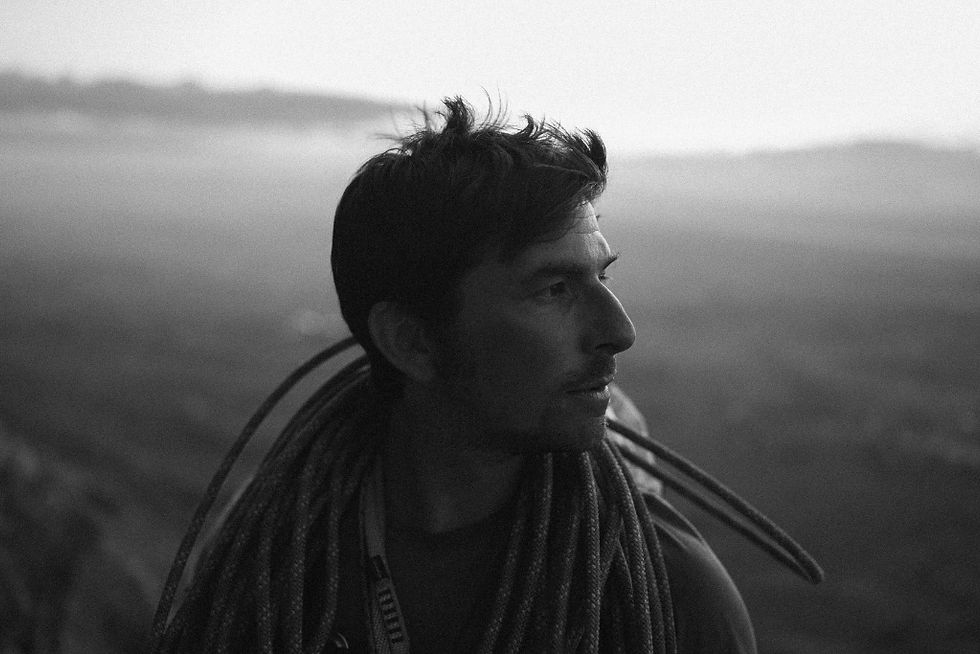
With that inheritance on his back, Levy keeps looking for what he calls “the story behind the story.” When other outlets were chasing a major Himalayan first ascent, Summit Journal took time to find a different angle. The editors discovered that the portaledge used on the climb — a hanging platform climbers sleep on during big-wall ascents — had been designed by a craftsman who sewed it in his garage. The article did not retell the ascent. It told the story of that man.
“I’m constantly asking how the magazine can be a vehicle for human stories, and for seeing the world from different angles,” Levy says. “That’s what keeps me up at night.”
There are still a few steps left before Summit Journal reaches the summit it has set for itself. In an era when one piece of information drives out the next with a single swipe, one magazine is trying to pause the algorithmic feed, the attention crisis, and the three-second view.
Will it work? Either way, “America’s first monthly climbing magazine” has become one of the longest and most stubborn answers to the chaos of modern publishing.
And 70 years later, the story is still being written.


