
Jean Rouaux, or the Art of Not “Cheating”

At 23, Jean Rouaux is the kind of Chamonix local you could walk past without noticing: a climbing instructor, low-key, not exactly chasing the spotlight. And yet last summer, he went after a pretty radical traverse—riding a bike from Chamonix to Nepal to get to Ama Dablam, no shortcuts, driven by an almost private obsession: not to “cheat.”

Behind the plan is a temperament. A way of living in the mountains, of looking at performance, of describing the world from road level. “Okay. Whoa—here we go,” he says, like he opened a door too fast, then laughs and slows down. He talks fast in that way people do when they’re not in a hurry to finish, they’re in a hurry to be in it.
In Chamonix, we catch him between two appointments, during that in-between moment when the valley settles back into itself—no summit scene, no polished adventure pitch, just a guy talking the way he lives, without trying to impress you. He doesn’t have that big, press-kit adventurer tone. He’s got dry humor—the kind you pick up after a lot of hours outside—and the clear-eyed sense that a whole project can hinge on a badly handled flat, a visa that falls through, or food poisoning.
When he talks about what he did, he’s not selling “a performance.” He keeps dragging it back to the real stuff: the fragile stuff, the daily stuff. He circles the same words like they’re both a habit and a compass—road, bivy, fatigue, “the crux” (climbing slang for the hardest, most decisive section), and that fixed idea: hold the line.
Jean Rouaux, 23, a climbing instructor in Chamonix, left the valley by bike on August 10 to reach Nepal and try Ama Dablam. He made it to Kathmandu in 58 days, after roughly 12,000 kilometers. On the way, he had to fly a short stretch—about 500 kilometers—because of an administrative blockage, a bend in the rules he describes like a break in the story. Then, in the Khumbu, the project ended abruptly: an infection, a hospital in Lukla, and a forced stop at 4,100 meters.
A Kid From Here
Before all that, Jean is first a local kid. “I grew up here, in Chamonix. I fell into it when I was little—climbing, mountain culture.” A bit of club climbing, a bit of competition, then injuries as a teenager that made him ease off. Around 16, he came back and set a clear goal: get his French state certification—the diploma that lets you guide and coach professionally. By 18, he had it.
“I brought a hangboard, my climbing shoes, and chalk.”
Jean Rouaux
Why so early? “It was passion. I’ve always loved climbing. And I’ve always liked teaching.” He says it without posing, with a kind of straightforward candor that keeps coming back with him: “I didn’t really know what I was getting into. Turns out, I love what I do.” To get there, he sped everything up, even bending school a bit—finishing his last year of high school remotely. “I was in a rush. And I didn’t want to be stuck in high school anymore.”
The Bike as a Tool
The bike didn’t show up because he’s a cycling guy. It showed up because of friction.
Jean tried a detour into school, moved to Lyon, got interested in journalism… and ran into a feeling he puts bluntly: “City life, after growing up here—I really can’t get used to it.” Then a classroom friendship opened a door. A classmate, chess games, geography games on Google Maps, and a story told almost like a family joke: the classmate’s grandfather had ridden a bike to the North Cape multiple times. The classmate said he might do it “in ten years or so.” Jean cut in: “We’re doing it next year.”

What stands out is how little foundation he had. “No—I’d never really biked before,” he says. “Last time I rode, I was probably 10.” He bought a bike and panniers and started by meeting reality head-on: a kind of janky Tour du Mont Blanc loop, logistical messes, a flat he handled badly, time lost, a body learning. Then he did a loop to England to see a friend—“I must’ve done 3,000 kilometers total… I think it took a month.”
He didn’t build a cyclist identity out of it. He says the simple truth: it wasn’t the bike that pulled him in, it was the long-range goal. “I’m not really into cycling for its own sake,” he explains. “It’s just—having a goal like that long-term is so good.”
The North Cape trip became a kind of proof: “9,000 kilometers in sixty-something days,” winter in Lapland. But in his bags, he carried more than food and a sleeping setup. He carried a piece of who he is. “I brought a hangboard, my climbing shoes, and chalk.”
“Looking back, the main risk is the road.”
Jean Rouaux
Climbing isn’t one sport among others in his story. It’s the base language. The one he learned as a kid in Chamonix, the one he returned to at 16 after injuries, the one that pushed him to get certified and coach. So on the road, he kept speaking that language so he wouldn’t get swallowed by the bike—which stayed, in his mind, a means more than an end.
“Every four days, I’d do a hangboard session,” he says. And whenever he found real rock, he stopped. On the Norwegian coast, in the Lofoten Islands: “I did a few boulder problems there—it was absolutely legendary.” No crash pad, no grade-chasing, no staging it for anyone—just staying connected to the thing in him that doesn’t move.
That’s where the next idea started to harden, almost by accident: Wait. There’s something here.
The Real Danger
That “something” became Nepal. Jean started looking up what had been done mixing bike travel and mountaineering, found the story of Göran Kropp—a Swedish climber who rode from home to the Himalaya—and the plan took shape.
He doesn’t talk like a would-be influencer. “I’ve never posted on social media. I never wanted to publicize what I was doing.” The film happened almost despite him: a friend pushed him to reach out to Simond, the Chamonix brand owned by Decathlon. Jean tried without a plan, with one sentence: I’m leaving, you can give me whatever you want—but I’m leaving either way.
At the time, he says, he had no audience and no real camera skills. “I had 500 followers on Instagram, and I’m not especially good at filming.”

His training also breaks a cliché: no obsession with “getting strong.” “For physical prep, I didn’t do much, because I realized it didn’t really help,” he says. The way he explains it is simple: training makes the beginning easier, then fatigue stacks up and you have to learn to function inside it. The real prep was mental and bureaucratic: leaving alone, far away, for a long time, with visas designed for travelers who book hotels.
“I was bivying the whole way,” he says—bivy meaning sleeping out, usually light and unplanned, not a formal campsite. “The activity just doesn’t fit visa applications. I never had an address to put down.”
“Honestly, I think about eating a lot”
Jean Rouaux
And above all, he puts fear where he thinks it belongs. “Looking back, the main risk is the road.” Not “foreign countries,” not the unknown—the traffic, the speed, the passes. He even places his sketchiest stretch in Europe: “Maybe between Bulgaria and… Turkey.” He describes it with a crisp image that’s almost funny if it weren’t so unsettling: “In Bulgaria they have two lanes. But people basically invent a third lane in the middle while they pass.”
For him, the crux wasn’t a mountain pass. It was the asphalt.
Leaving Home Is the Hard Part
Jean left Chamonix on August 10. And the hardest part, weirdly, wasn’t the faraway. It was the near.
The first hours feel different because the reverse gear is right there. “By car, through the tunnel, you’re home in 15 minutes.” On a bike, the same terrain becomes a constant reminder: you have to earn every kilometer even though you know the shortcut by heart. The start turns into an internal negotiation—hold steady, don’t talk yourself into an excuse, let the valley close behind you.
Then, day by day, the temptation changes shape. The distance becomes normal. Logistics settles. What felt impossible turns into… the day’s work. “The more you move forward, the easier it gets,” he’d tell himself.
“I hadn’t cheated once… and then it all collapsed.”
Jean Rouaux
Over time, life narrows down to basics. “Honestly, I think about eating a lot,” he says. It’s funny, but it’s also the truth: find water, find food, find somewhere to sleep, repeat. “It’s simple. You think about surviving, getting to point B.”
He barely listened to music—two songs in two months, max. He wanted his head clear, no soundtrack masking what was around him. He bivied almost every night: “Out of 58 days, I probably bivied 50 nights… maybe 52.”
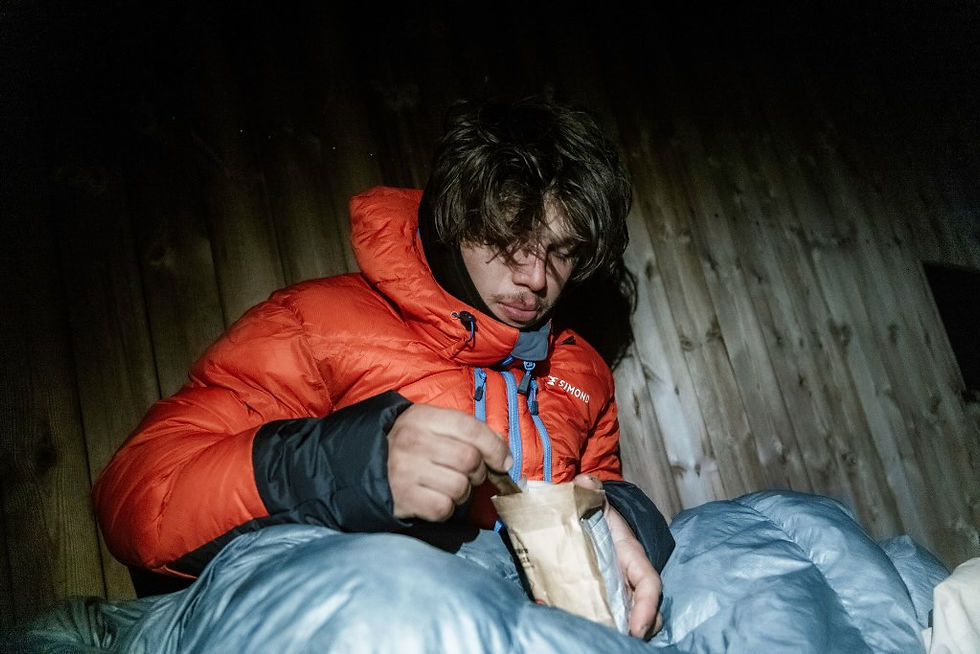
Problems were rare: an issue with dogs, one night ruined because he stopped too quickly and picked a bad spot, an evening in Pakistan when hospitality and curiosity started to feel suffocating—he finally snapped and took a lodge.
And then there’s a choice that says a lot: he didn’t carry a lock for his bike. “I trust people,” he says, almost as a throwaway. He even felt the theft risk was higher in France or Italy, where “people understand a bike can actually be worth money.” Elsewhere, some people assumed he was broke and even offered him cash.
When he tries to name the “best moment,” he doesn’t talk about arriving anywhere. He talks about vertical terrain—the thing he craves instinctively, coming from the mountains. He hates flat riding. “Riding on flat ground… it pisses me off,” he says.
After two weeks of desert and headwind, Tajikistan flipped a switch: “And then suddenly—vertical.” The Pamir Highway, plateaus at 4,000 meters, then up toward Pakistan. A day facing Nanga Parbat. “It was insane,” he says. He keeps coming back to the time-warp part—the part you can’t photograph: a month and a half earlier, he was on his couch in Chamonix.
The Flight, and the Crack in the Story
The worst moment wasn’t epic at all. It was forms, deadlines, doors closing.
In Turkey, Jean realized his Iran visa wouldn’t hold. He’d tried to plan ahead, worked with a visa service, thought it would go through. Then everything jammed up. The options didn’t show up like they do in adventure stories. They had schedules, closed borders, administrative uncertainty. Waiting became a gamble. And he had a calendar in his head: “By late October I needed to be on the mountain,” to leave room for acclimatization and a weather window.
In that game, bureaucracy won. He flew roughly 500 kilometers.
It wasn’t flying, in itself, that bothered him. It was breaking his personal rule: don’t break the continuity. He says he turned down rides from the beginning—out of stubbornness, sure, but also logic. Once you step off the line, you stop knowing when you’re getting back on it.
Now he was strapped into a seat, watching the ground slide by too fast. “Honestly, I was on the plane… it was horrible.” Then he drops the sentence that captures the private defeat: “I hadn’t cheated once… and then it all collapsed.”
“Alpinism is everything that gets you to the foot of the mountain. And if it doesn’t work out… you have to stay humble.”
Jean Rouaux
That’s also his story: a morality meant for himself. He’s not trying to teach anyone. He’s describing a pact he made with himself, and the moment it snapped. The trip kept going the way trips always do—find a box for the bike, wait for hours, then Kazakhstan, the desert, the feeling of starting from zero again. The crack didn’t disappear. It just became part of the narrative, like a scar—proof that your ethics don’t always beat reality.
Kathmandu, Then the Body Says No
Jean reached Kathmandu in 58 days, “way ahead” of what he’d imagined. He took one day off, picked up gear, then got back on the bike toward Jiri, the old starting point for walking into the Khumbu. Those two days cost him more than he likes to admit. “In my head, I’d put the bike in the basement,” he says. He forced it anyway—grimaced through it—then finally got what he’d come for: walking, feeling Nepal underfoot, entering the valley.

That’s when his motivation spiked. He describes an almost physical euphoria, a ridiculous speed: he covered in two days a stretch that usually takes close to a week to trek. “I was so fired up… I had insane energy,” he says.
And then everything flipped on something stupid, almost humiliating: “I ate something I shouldn’t have.” He got sick, kept going anyway, drained himself. At 4,100 meters, his body wouldn’t recover. “Shutting down at 4,100 is rough,” he says. Weakness, dizziness, hallucinations, the hospital in Lukla—and that feeling of being kicked out of your own project before you even understand what happened.
Here, his story thickens, because the failure isn’t just physical. He also describes a shock in the Khumbu: tourism, consumption, certain power dynamics between clients and Sherpas. At the hospital, he says, staff told him an anecdote that stuck with him—a local woman in childbirth complications, and priority going to “a tourist who paid.”
He doesn’t turn it into a big theory. He just says it like a clean wound. “When you see that… it hurts.”
That’s where he offers his definition of alpinism, even though he didn’t “do” the mountain the way people expected. “Alpinism is everything that gets you to the foot of the mountain,” he says. “And if it doesn’t work out… you have to stay humble.” Then he draws a hard line in the middle of the mess: “Not every means is justified to reach a summit.”
Climbing, Fame, and the 20-Meter Problem
On the way back, Jean gives you two numbers that clash—and together say a lot. “I left at 70 kilos. I came back at 53.” Seventeen kilos gone. Not “training fatigue,” just the accumulation: days, nights, managing water, heat, hours in the saddle. He says he was hungry “a bit,” sometimes. He doesn’t dramatize it, but you can hear the cost: long-duration adventure wears down the machine even when the mind holds.
Then he drops the other number like he’s setting it on the table: “But I gained 40,000 followers.”
He’s still surprised by it. “I’m really discreet by nature… I didn’t want to be in the light at all.” Back in Chamonix, people recognized him. A kind of valley fame—sometimes funny, sometimes awkward. The sense of becoming “somebody” because of a trip, while his daily life is still climbing sessions, coaching kids, teaching.
On the sponsor side, he says there was no pressure. Simond funded the expedition. He owed them footage for a film. Not reaching the summit wasn’t a problem. The heaviest pressure, he says, came from people close to him—so invested they experienced his stopping as their own defeat.
And then there’s the modern reality he owns without turning it into a slogan: Instagram wasn’t “the deal,” but he started posting constantly—“one video a day.” Like the storytelling showed up alongside the expedition whether he wanted it or not. Now people even ask him to advise other athletes on communication. He smiles, hesitates, and says the line that sums up his relationship to visibility: “I really don’t feel like I’m the best guy to do that.” It worked, he says, but “kind of by accident.”
He also refuses the moralizer role. Yes, his trips can inspire lower-impact choices. Yes, he’s environmentally aware—he lives “facing the glaciers.” But he doesn’t trust the preachy tone. He knows his contradictions: content production, digital footprint, attention economy. His “consistency,” again, isn’t a banner. It’s caution.
At the end, Jean talks about what he actually cares about: climbing. Not as a backdrop—as work. He trains, follows plans, wants to improve. “I’d like to climb 8c next year,” he says—about 5.14b in the US grading system (8c). Then he says it plainly, without bitterness but with real clarity: that’s not what his audience comes for. “When I’m here and I post climbing stuff on Instagram, nobody cares.”
He sums up the problem in one clean question: “Where’s the journey on a 20-meter line?” He says he can live an adventure just as intense on a short route as on 1,000 kilometers of road. But that doesn’t read to the general public. It isn’t instantly shareable.
So he looks for a bridge. He talks about trad in England, autonomy projects with a pulk sled, the idea of coming back one day to do a “full” Ama Dablam: the gear on the bike, the out-and-back, and—maybe—the summit. He also talks about becoming a mountain guide, because in Chamonix the terrain is vast, and mid-mountain instruction has its limits.
And at the center, what hasn’t changed: his need to pass things on. In his story, adventure isn’t an escape. It’s a way of refusing shortcuts—even the comfortable ones.
“I hadn’t cheated once,” he says, like it’s a point of honor he doesn’t really need to explain. Then he tells you about the moment that point of honor cracked. And maybe that’s where the portrait really holds: in the tension between the straight line you want to keep, and the real world that forces you—sometimes—to compromise.


