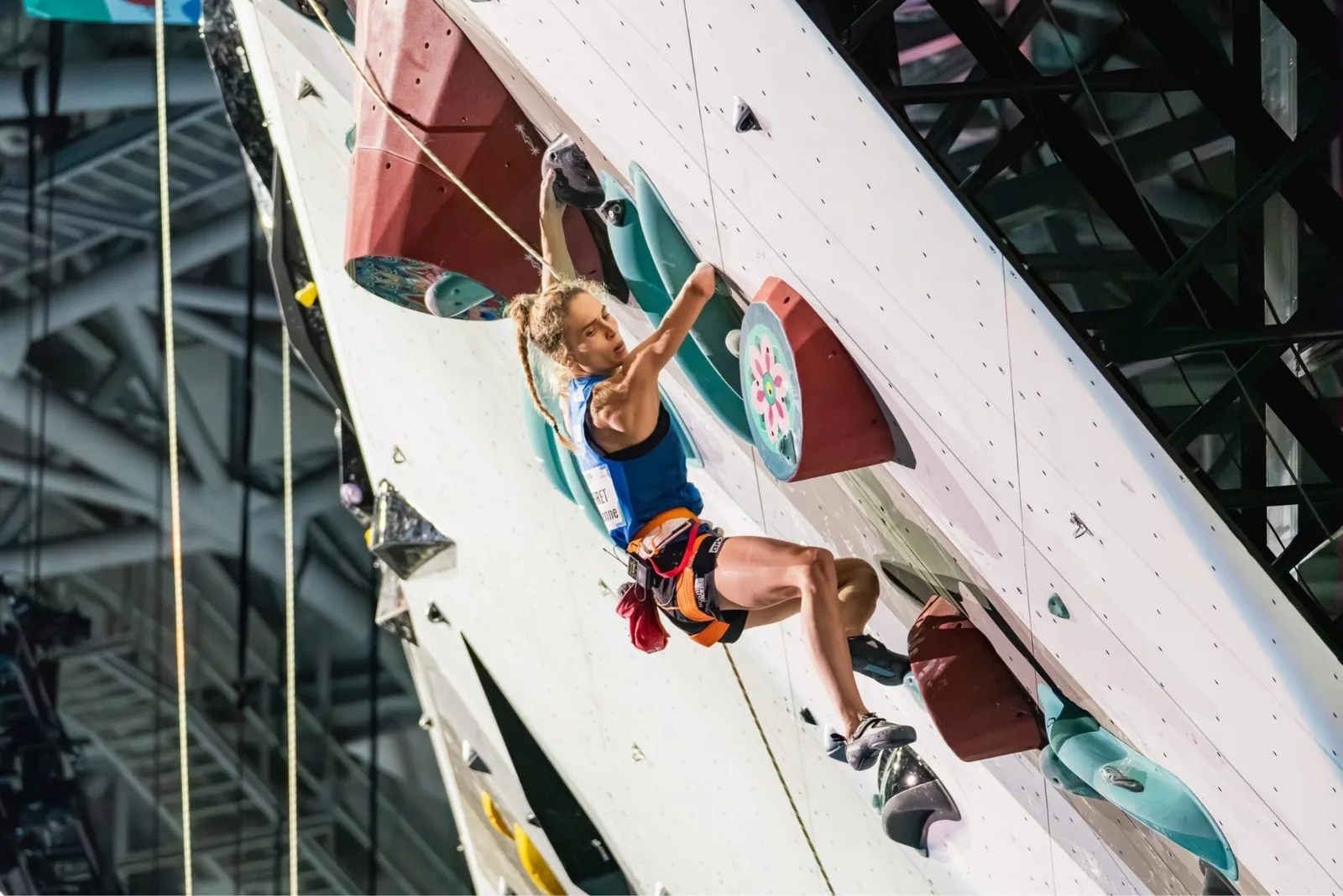


This is the third installment of Heavy Mental, our new series breaking down key psychological concepts in climbing under the weight of performance. It’s written by Léo Dechamboux, a mental performance coach and co-author (with Fred Vionnet) of the french reference book Le Mental du grimpeur.
I’ve been around competition climbing for more than 20 years. From crags to gyms, from my work as a mental performance coach to my own days as “just another climber,” I’ve heard it—and I’ve said it myself: we climb “for the beauty of the movement.” Even in competition, we like to measure ourselves against ourselves, against the route. Not against anyone else.
And yet: competition is everywhere now. Between major national and international federation events, friendly “for fun” comps at private gyms, big-name private events with international reach, and platforms like Social Boulder or 8a.nu, comparison feels baked into the walls. Wherever you are, the message is the same: faster. stronger. farther. So let’s ask the question plainly. If everyone insists they climb for themselves, why does competition feel unavoidable?
That’s the point
Mental performance coaching has two goals: help you get better, and help you stay balanced and well. Where those overlap, you find the stuff that actually makes a practice sustainable—psychological well-being, motivation, and goal-setting.
We pointed out how neoliberal thinking has reshaped psychology by pushing a more individual, performance-driven view of people. Psychology ends up helping produce the “entrepreneur of the self”—someone focused on constant optimization.
Key researchers like Edward Deci and Richard Ryan describe three basic needs that support long-term motivation: autonomy, social connection, and competence. That’s the foundation of self-determination theory. They also show how goal-setting shapes motivation, and they distinguish between two broad goal types: mastery goals and ego goals. Mastery goals are about your own progress—strategies, useful behaviors, collaboration. They tend to support intrinsic motivation. Ego goals are competitive by nature: comparing yourself, trying to “beat” someone, making sure nobody beats you.
The problem with ramped-up external motivation—or goals that lean too hard on ego—is that they can drive anxiety, self-sabotage, avoidance, negative emotions, or quitting altogether. They’re also heavily shaped by your environment: the motivational “climate” created by the people around you, plus the broader social context that influences how you think, feel, behave, and relate to performance.
And this is where competition can start to cut deep. Modern sport took shape in the 18th century alongside industrial capitalism. That shift came with the commodification of people, environments, health, and education. In From Ritual to Record, American historian Allen Guttmann argued back in 1978 that this period also brought standardized measurement: stopwatches, regulated distances, uniform rules—and with them, the concept of the record. For the first time, international comparison became straightforward. Performance became measurable, exchangeable, sellable.
It also turned into something like personal capitalism: optimize your body, make it “pay,” celebrate the self-made man and the “good” athletic body—defined against the one that isn’t. Free climbing emerges in that world, and it quickly plugs into the same logic: performance as product, body as capital, your “project” as a narrative investment. Tick lists—lists of “sends,” the climbs you’ve done, your personal scorecard—mixed with social media, instant communication, and sponsors, turn the climber into a thing to be packaged and valued.
British sociologist Nikolas Rose described this dynamic in 2008 with the idea of “biocapital”: training becomes a rational production plan. The body becomes a machine. Progress becomes a value.
Earlier in Heavy Mental, we pointed out how neoliberal thinking has reshaped psychology by pushing a more individual, performance-driven view of people. Psychology ends up helping produce the “entrepreneur of the self”—someone focused on constant optimization. Sport doesn’t escape that. The pressure ramps up: performance becomes an economic value, and “mental strength” becomes something you’re expected to monetize.
In 2024, a report titled “Navigating Neoliberalism,” published in the Journal of Sport for Development, described how some sport practices line up with efficiency logic and continuous evaluation. Mental performance coaching can slide into that same frame—sometimes aiming less at personal growth than at productivity-driven optimization, with athletes treated like performance units.
When the setting shapes your head
Last September, in an interview with Grimper, a journalist asked me a blunt question: isn’t my job, basically, helping climbers survive in a toxic environment—competition?
It’s true that competition comes with real psychological constraints that can leave long-term marks. But what’s often more problematic is how we approach performance and competition. Mental performance coaching should help climbers thrive in this world if they choose it—without it swallowing the rest of their lives.
Competition isn’t inherently toxic. But it can become toxic if we ignore the mechanisms—and if mental coaching becomes nothing more than “helping you tough it out” instead of building a healthier, durable relationship with performance.
The issue is that we rarely talk about the psychological “set” of competition—the environment that shapes how we feel: how important the result seems, how uncertain it feels, the anxiety it creates, the expectations (internal or external, real or imagined). In 2017, sport psychology researchers Christopher Mesagno and Jürgen Beckmann showed that “choking under pressure”—a drop in performance when the stakes feel high—shows up especially when athletes lock onto the outcome rather than the task.
In climbing, that’s what happens when you’re climbing not to fall, not to disappoint, when every attempt turns into a performance for other people. Competitive demands amplify those patterns. Bigger events mean more distractions. Rankings push ego-oriented motivation. And once you’re stuck judging yourself through that lens, it can drag down emotions, thinking, and behavior.
Flip the format—make it more about learning and exchange—and motivation tends to swing back toward mastery and competence. That’s the direction the broader research points to when it looks at instructions, motivational climate, and the framework around athletes.
These aren’t abstract effects. They show up as less enjoyment, injuries driven by urgency, identity narrowing around “being a performer,” anxious chasing of results, overtraining, burnout. Competition isn’t inherently toxic. But it can become toxic if we ignore the mechanisms—and if mental coaching becomes nothing more than “helping you tough it out” instead of building a healthier, durable relationship with performance.
Recognition, gamification, and micro-fame
For a long time, the competition frame in climbing was simple: a date, a wall, a deadline. Now the ecosystem has grown into something sprawling. Between federation circuits, gym comps, hybrid events, and platforms like 8a.nu or Social Boulder, competition has fractured into endless micro-scenes—each with its rules, rewards, and visibility.
That isn’t unique to climbing. A study by Rob Franken, Hidde Bekhuis, and Jochem Tolsma on digital sports culture shows how platforms—Strava especially—reshape sporting norms by creating what they call “spaces of constant evaluation.”
You’re no longer trying to be seen as a person. You’re trying to match a valued image. Your worth starts to depend on being visible, validated, and ranked.
Design matters here. Gamification—the use of game-style design in sports apps—often does increase engagement, motivation, and consistency. But it’s not cleanly positive. For people with lower self-control—meaning it’s harder to regulate behavior in response to social cues—gamification can also feed comparison and dependence on feedback.
These digital spaces also create new social statuses: micro-celebrity in sport. Researcher Theresa Senft, writing about micro-celebrity culture, describes visibility itself as a resource. A noticed “send” logged on 8a.nu, a well-edited Instagram clip, a #1 spot on the monthly Social Boulder leaderboard, a cameo in a private comp aftermovie—these things can produce “micro-stars” whose recognition rests less on athletic value than on cumulative visibility: fast, consumable, and fleeting.
That shift creates a new kind of competition: continuous, and often invisible. You’re not measuring yourself only at one event. You’re measuring yourself every day—through what you post, what you like, what you log, what you “send.” (To “send” is to complete a climb cleanly—your personal stamp of “done.”) That diffuse competition shapes how you train, how you compare, how you judge yourself. Competitiveness seeps into how you climb.
And the broader context directly shapes how we approach climbing, progress, performance, and well-being. A competitive environment can satisfy those core needs and feel energizing. It can also frustrate them—by squeezing autonomy and competence under external control.
So it’s reasonable to hypothesize that this always-on competitive climate—fed by a broader environment that commodifies bodies, progress, and performance—helps generate a psychological need that feels especially modern: recognition. We know recognition matters for self-esteem. But sociologist Axel Honneth argues that the pursuit of recognition hits a wall when it stops being support for self-worth and becomes a condition for legitimacy. It can creep into the core of our needs, reshaping them without us noticing.
Philosopher Nancy Fraser adds another layer: when recognition becomes a kind of “social currency,” it stops being relational and becomes an expectation. You’re no longer trying to be seen as a person. You’re trying to match a valued image. Your worth starts to depend on being visible, validated, and ranked.
In sport—and in climbing—that slide is easier to miss because performance is so easy to display, count, and compare. Psychological needs can get artificially “filled.” External rewards can feel like autonomy while quietly steering behavior. They can mimic competence while really just handing you approval. They can imitate connection while actually running on constant comparison.
Recognition stops being just a human need. It becomes an identity requirement—a proof of existence, sometimes even a duty to perform. Another way to put it: competition, now everywhere, doesn’t exist without person-to-person evaluation, and that evaluation feeds the hunger for recognition. That hunger stops being one pillar of self-esteem and starts behaving like something closer to a basic need—warping autonomy, competence, and connection.
You still hear the old lines in climbing spaces: I climb for myself—alone, facing a problem to solve. Those lines keep echoing because they’re part of climbing’s symbolic culture. But the spaces have multiplied, and the environment has changed. When every move can be quantified, every climber can be ranked, every send can be filmed and uploaded, competition stops being an event. It becomes a condition. And it threads itself into our needs—turning recognition into an identity requirement that quietly redraws what it means to exist as a climber.